






In this interview, options educator Steve Ganz breaks down the mechanics behind the butterfly options trade, the different variations traders can use, and how he structures it as part of an income-focused approach.
If you are an intermediate retail options trader looking to refine your strategy selection, this deep dive will give you practical insight into whether butterflies deserve a place in your trading plan.
Learn about butterfly options trades
Steve Ganz
Steve Ganz is an options trader and trading coach with more than 30 years of market experience. He has specialized in structured, risk-defined strategies and has taught butterfly trading for over a decade. In this interview, he explains how the butterfly options trade became one of his core strategies and how he has refined it over time. Steve has previously been interviewed on Theta Profits about his Flyagonal strategy.
What is a butterfly options trade?
A butterfly options trade is a defined-risk options strategy built using four contracts in a 1–2–1 structure. It can also be seen as two spreads together with the shorts on the same strike:
- Buy one lower strike
- Sell two middle (typically at-the-money) strikes
- Buy one higher strike
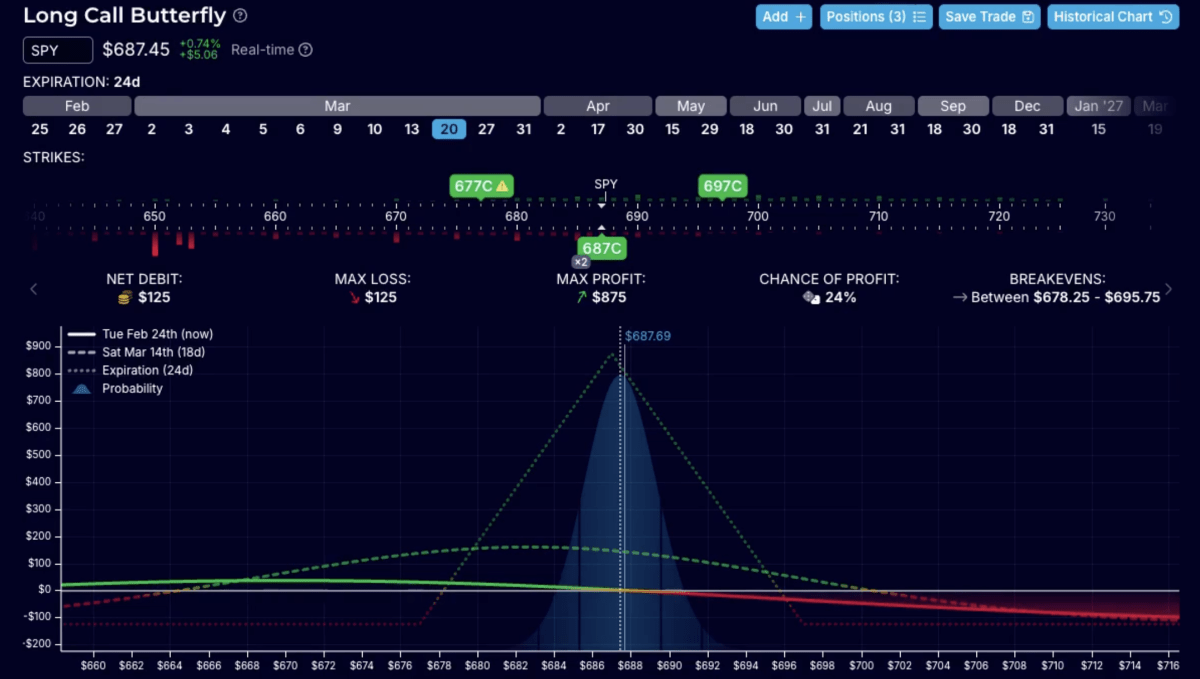
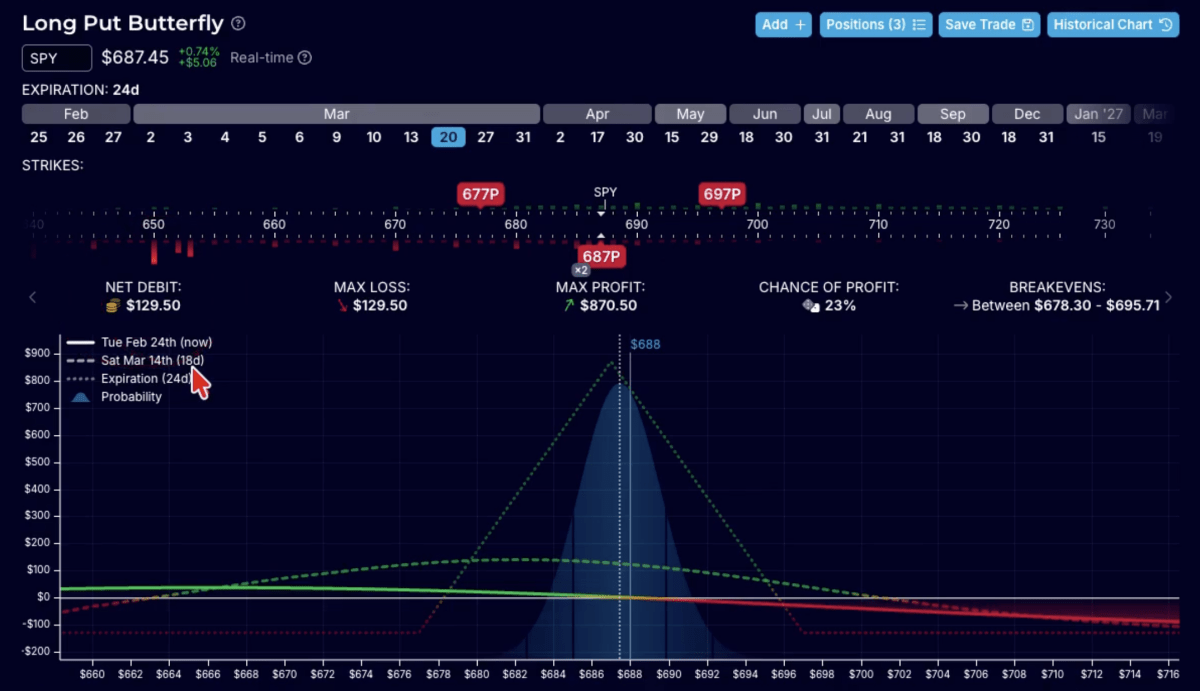
The payoff at expiration forms a “tent” shape. Maximum profit occurs if the price stays near the middle strike, while maximum loss is limited and defined at entry.
Butterflies can be constructed in different ways:
- Long call butterfly
- Long put butterfly
- Iron butterfly
- Broken-wing butterfly
See more about the different types below. Although the structures differ slightly, they often produce very similar profit-and-loss profiles. The choice between them usually depends on volatility conditions, pricing differences, and trader preferences.
- Other video interviews about butterflies on Theta Profits:
- Doc Severson: 0DTE Iron Fly
- Azhar Pasha: 0DTE Adaptive Butterfly
- Steve Ganz: Flyagonal
- Simon Black: Time Flies Spread
- Carl Allen: 21DTE Put Broken Wing Butterfly
- Date Perryman: 0DTE Iron Fly
- Maria & Rob Helmick: The Maria Shoe Trade

Why do traders use the butterfly options trade?
One of the main reasons traders use a butterfly options trade is capital efficiency combined with defined risk.
Time decay works in your favor
Butterflies benefit from theta decay because they involve selling two options, which contain the most time value. As time passes, that premium erodes, helping the trade’s profit profile improve — especially if price remains relatively stable.
For income-oriented traders, this makes the butterfly options trade appealing as a structured way to harness time decay.
A wide and forgiving T+0 profile
Early in the trade, the T+0 line is often relatively flat. This means moderate price moves may not immediately create large swings in profit and loss. Compared to a simple vertical spread, the butterfly can move more slowly, which can be an advantage for traders who cannot monitor markets constantly.
Defined and controllable risk
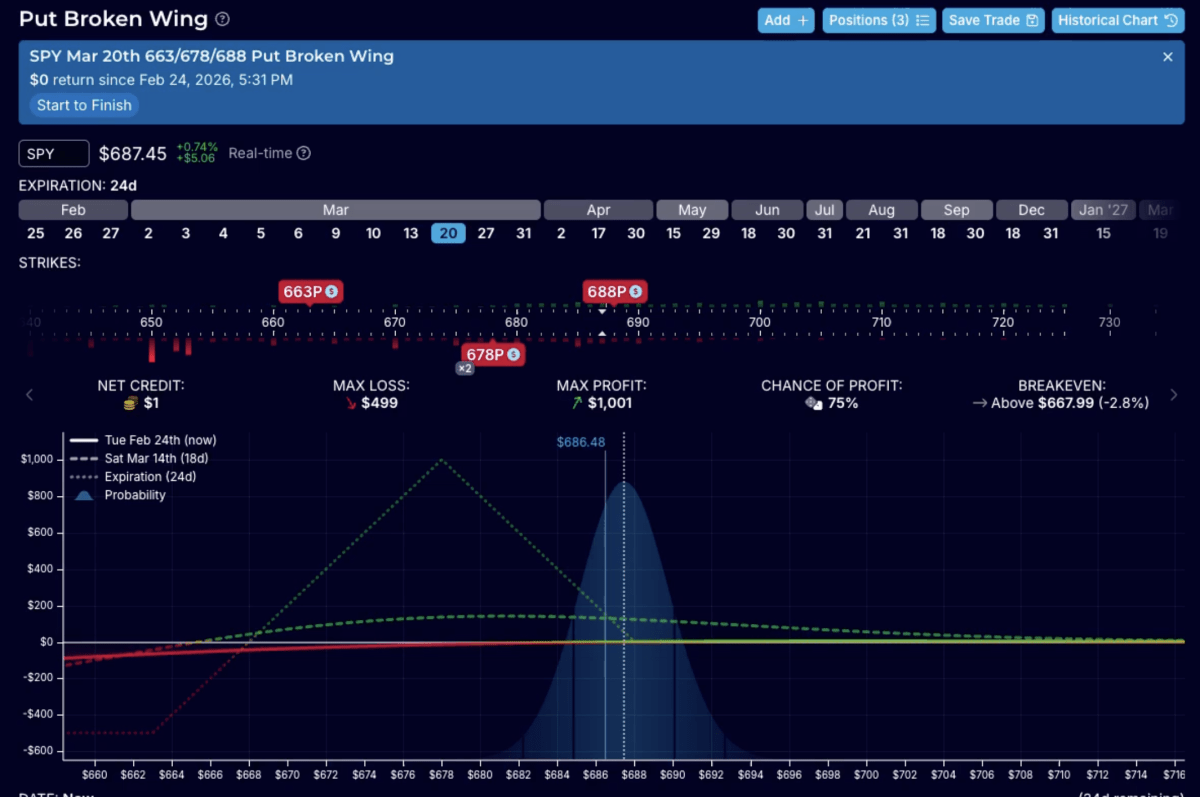
The maximum loss of a butterfly options trade is known at entry. With a broken wing butterfly, a trader can even eliminate risk on one side by widening one of the wings. Steve often structures his trades so that he has little or no risk to the upside while accepting defined risk to the downside.

Different types of butterfly options trades
Standard (balanced) butterfly
This is the classic butterfly options trade with equal distance between the wings. It carries risk on both sides and works best in range-bound markets where the price is expected to stay near the center strike.
- With a call butterfly, all option legs in the trade are calls
- With a put butterfly, all option legs in the trade are puts
Broken-wing butterfly
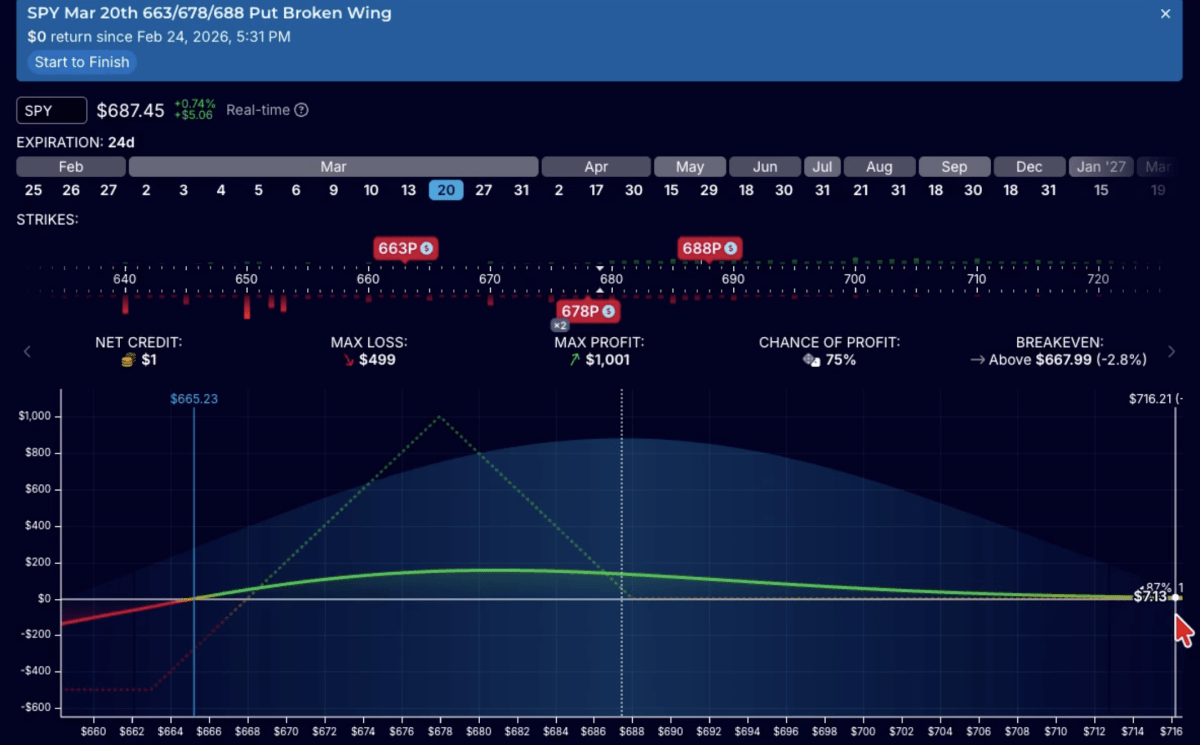
A broken-wing butterfly widens one side of the structure. This shifts risk in one direction and can create a position with no risk on the opposite side. Steve favors this variation because it allows him to align the trade with broader market trends while still benefiting from time decay.
Iron butterfly
An iron butterfly combines a put credit spread and a call credit spread with the same short strike. It is often entered for a net credit and behaves similarly to a short straddle with protection. The iron butterfly is another common version of the butterfly options trade, especially in higher volatility environments.
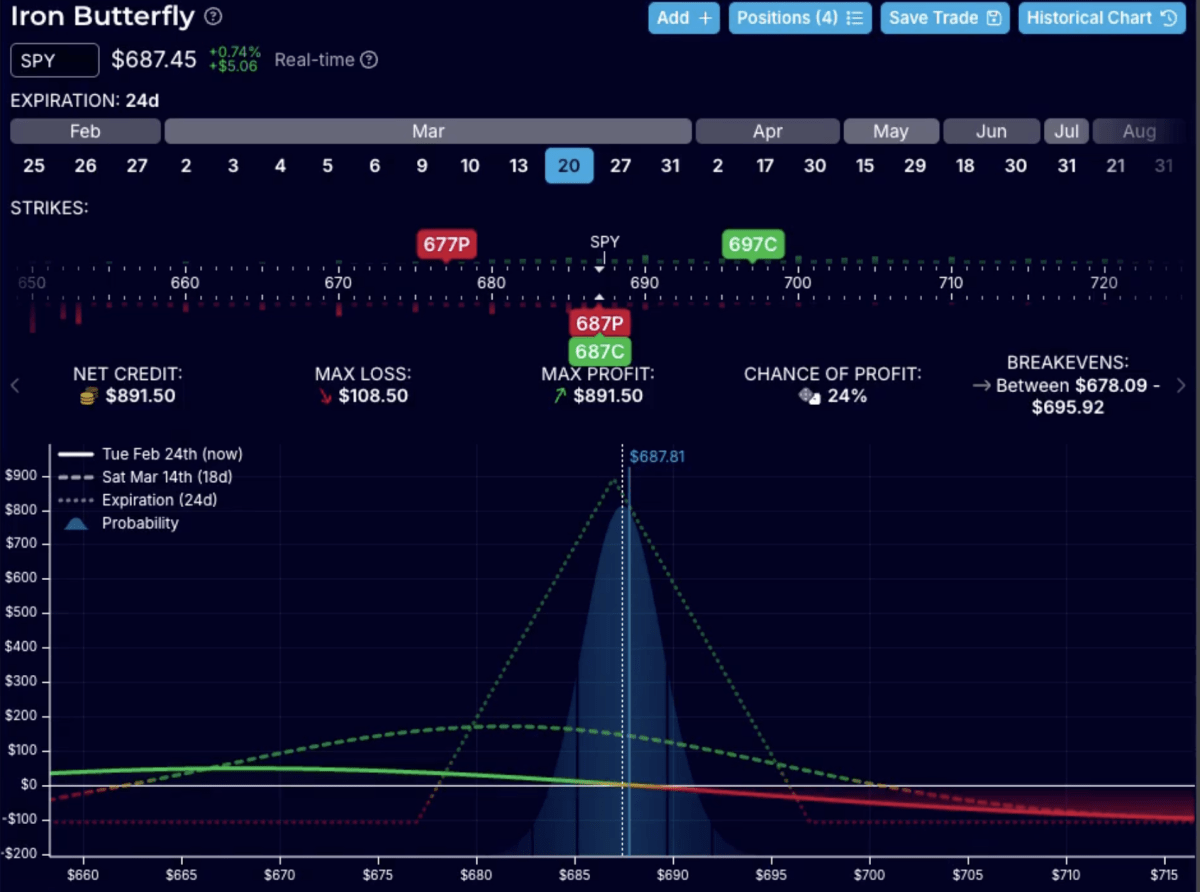
How volatility affects a butterfly options trade
The butterfly options trade is generally short vega, meaning rising implied volatility can hurt the position after entry. If volatility increases sharply, the short options can expand in value, temporarily pushing the trade into a loss.
However, higher volatility can create better entries. When implied volatility spikes, at-the-money options become more expensive. Selling those richer premiums can improve the risk-reward ratio. Steve prefers entering butterfly trades when volatility is elevated and then benefiting if volatility contracts.
Steve’s favorite butterfly options trade
Steve typically places a put broken-wing butterfly options trade 30 to 60 days to expiration. Rather than holding until expiration for maximum profit, he targets more modest gains earlier in the trade.
His typical framework includes:
- Entering during higher volatility
- He will typically place the upper long at the money
- He will close the trade when it reaches about 10% of the maximum risk as profit
- Exiting well before expiration to avoid excessive gamma risk
He also stresses the importance of learning how to adjust the position, usually by rolling strikes vertically to manage delta exposure if the price moves.
Common mistakes traders make
One of the biggest mistakes with a butterfly options trade is entering at the wrong time. Placing the trade when volatility is low can result in weaker risk-reward dynamics.
Another common error is constantly changing structure. Steve recommends trading the same configuration repeatedly. By doing so, traders become familiar with its pricing behavior and can more easily identify attractive entry points.
Who is the butterfly options trade best suited for?
The butterfly options trade is best suited for intermediate traders who:
- Want defined risk
- Prefer slower-moving strategies
- Seek structured income approaches
- Are willing to learn adjustment techniques
It is less appropriate for traders chasing large directional moves or those unwilling to manage positions.

[…] Steve Ganz: Butterfly trades explained […]
[…] Steve Ganz: Butterfly options trade explained […]
[…] Steve Ganz: Butterfly options trades explained […]
[…] Steve Ganz: Butterfly options trades explained […]
[…] Watch our interview with Steve Ganz about butterfly trades to learn more […]