





Selling puts can look simple: choose a stock, pick a strike, and collect a premium. For TOS, The Options Seller, the important work in her put selling strategy happens before she places the trade. She has a precise five-step process which helps her identify the best trades.
Learn the 5-step put selling strategy
The Options Seller – TOS
TOS is a returning Theta Profits guest and an options trader who sells premium. In our earlier interview, she discussed options on futures. This time, she walks through her approach to selling puts on individual stocks. TOS lives in Los Angeles, USA:
- Our first interview with TOS: Options on futures explained
- Her website
Why she sells puts
TOS wanted a trading style that would give her more time away from the screen. Selling puts appeals to her because a trade doesn't always need an immediate rise in the stock to work: time decay can help, and she doesn't have to predict an exact upside target.
That does not mean she sells puts on any stock offering an attractive premium. She considers companies she would be willing to own and sizes trades with possible assignment in mind. She may sell an uncovered put when she wants the shares and has room for the exposure. When she wants defined risk, she often uses a put credit spread instead.
Her put selling strategy has five steps.
Step 1: Research the companies first
TOS begins with a curated watchlist, which she reviews roughly twice a year. Before adding a company, she examines how it makes money, its financial health, its management, and its position within its sector. She also monitors developments that could damage her reason for owning it.
This gives her a starting point when a stock falls. She already knows why it interests her; the next question is whether the decline presents an opportunity or signals a problem with the company.

Step 2: Wait for an oversold alert
Her own TradingView indicator uses bands around a slow moving average to flag stocks that have become extended. When a watchlist stock reaches the lower band, TOS starts investigating.
She stresses that an alert is not an automatic signal to sell a put. A stock can keep falling after it looks oversold. She first checks whether the move reflects a broader pullback or news that changes her view of the company. For traders without her indicator, she suggests looking at a longer moving average alongside the stock’s own volatility, rather than treating the same price move as significant for every stock.

Step 3: Map the gamma levels
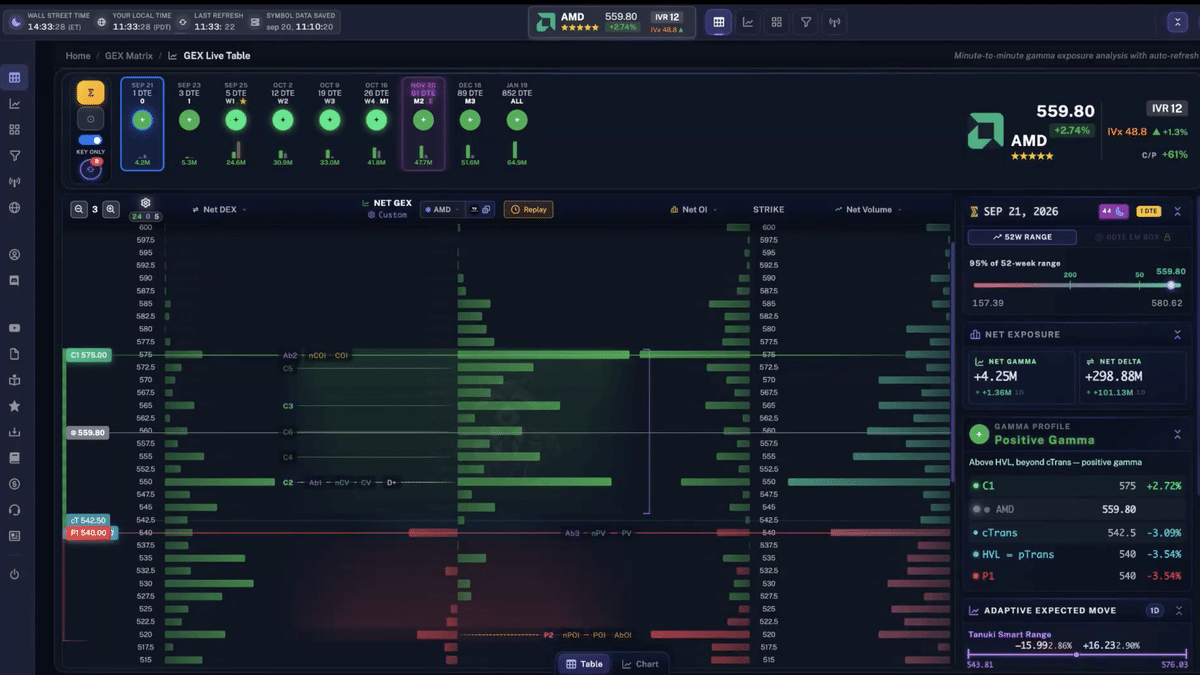
Next, TOS uses TanuniTrade to look at gamma exposure, or GEX, for possible areas of support, resistance, or faster price movement. She generally wants her short put strike below a significant put wall or another meaningful downside level.
These levels are guides, not guarantees. They can change as the stock moves and options positions change. TOS looks for agreement between gamma levels and the other parts of her process before choosing a strike.
In the video, she shows how its gamma chart in TanukiTrade helps her identify put walls and the high volatility level. She normally looks for a short strike below a major put wall, then checks whether volume profile, price structure, and the available premium support that choice
TanukiTrade
…is an essential options trader toolkit offering seamless GEX levels, an options scanner and lots of useful data in a user-friendly interface. Works both as a web app and with TradingView.
Step 4: Check volume profile and price structure
TOS studies a six-month volume profile, especially its point of control: the price area with the most trading volume over that period. Where possible, she wants her short put strike below that level and below meaningful support shown on the chart.
Her reasoning is straightforward. If she might have to buy the shares through assignment, she wants a price she considers attractive, rather than one the market has recently treated as normal.

Step 5: Look at options flow
Finally, TOS checks for unusual options activity, including large put sales. Flow can help her assess an expiration, but she does not copy another trader’s strike simply because the trade was large. The trader behind that order may be wrong—or may have a very different risk tolerance.
She also considers liquidity, available premium, upcoming earnings, and how much time the stock might need to recover. She does not use one fixed rule for days to expiration or delta.

How the five steps came together in an AMD trade
TOS illustrates the process with an AMD trade she opened on September 14. Her indicator flagged the stock during a broader sell-off in AI and semiconductor names. She checked for AMD-specific news that might undermine her original investment case before moving on to gamma levels, volume profile, and options flow.
She noted an earlier support area around $423–$425 and chose a short strike below it. The resulting trade was a January 2027 400/300 put credit spread, opened for a $17.45 credit per share.
AMD rebounded, and she closed the spread on September 17. TOS reports that she kept about 46% of the original credit, or approximately $800 per spread. That 46% describes the share of premium captured; it is not a return on the capital at risk. Rather than wait months for the remaining premium, she took the gain and freed up the capital.

Results, exits, and the risk in her put selling strategy
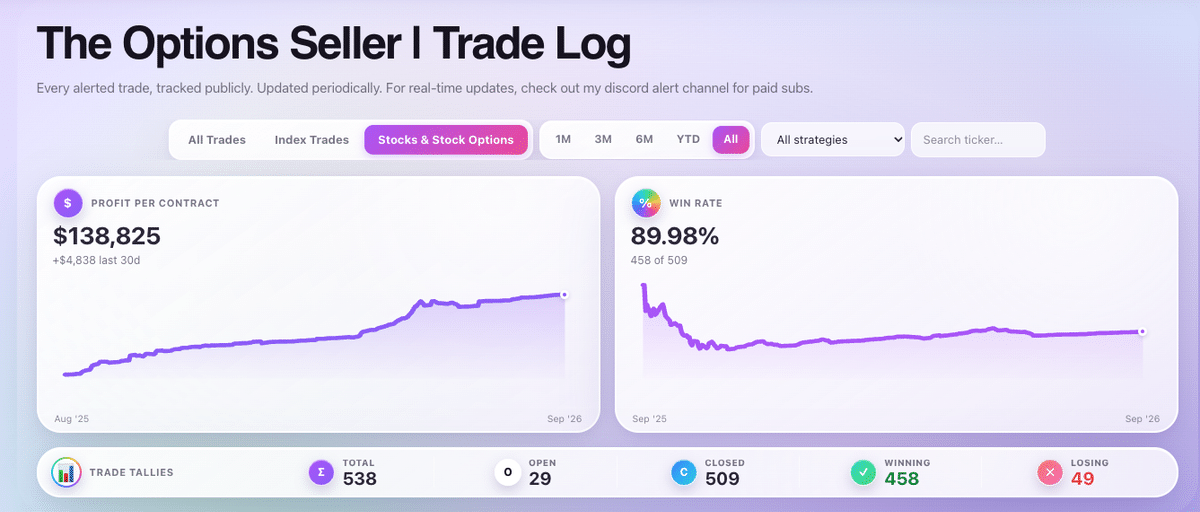
TOS reports 452 winners among 502 closed alerted trades—a 90% win rate. She says the record amounts to more than $137,000 in profit using one contract per alert, with her alerts sized around a $100,000 account. These are her reported trade-log results, not a promise that another trader would achieve the same outcome.
Her exits are discretionary. She may close when a stock approaches an upside level, when much of the premium has been captured with considerable time remaining, or when market conditions change. She does not place a conventional stop-loss order on these put trades; instead, she says she will accept a loss if the company no longer fits her thesis or the position no longer fits her risk plan.
