





This 0DTE long strangle takes the opposite approach from most short-duration strategies featured on Theta Profits. Instead of selling premium, Tompkins buys a call and a put to benefit from gamma when the market makes a strong move.
Learn about the 0DTE long strangle strategy in this video
Jeff Tompkins
Jeff Tompkins has traded since the late 1990s and today trades on both the retail and institutional sides of the market. He manages client money through Altos Capital and founded Altos Trading, where he teaches and develops trading strategies for retail traders.
Although much of his own options trading involves selling premium, his Golden One-Day Options Trade is deliberately a long-premium strategy.
How the 0DTE long strangle works
At its core, the strategy is a 0DTE long strangle.
Tompkins buys an out-of-the-money call and an out-of-the-money put on the same underlying with the same expiration. Instead of predicting whether the market will rise or fall, the objective is to profit if it makes a sufficiently large move in either direction.
The strategy can be traded with either 0DTE or 1DTE options. Tompkins does not go further out because he wants to exploit the high gamma of very short-duration options.
That creates an interesting contrast with many 0DTE strategies. Option sellers benefit from theta decay but face substantial gamma risk. As the buyer, Tompkins accepts theta decay but tries to put gamma on his side.

Entry mechanics for the 0DTE long strangle
The starting point for the trade is the market’s expected move, sometimes called the implied move.
Tompkins looks at how far the options market is pricing the underlying to move before expiration. He then adds and subtracts that amount from the current price to find approximate strikes for his call and put.
For example, if SPY were trading at 765 and the expected move were roughly three points, the starting strikes would be:
- Buy the 768 call
- Buy the 762 put
He then checks the premiums on both sides. Because puts and calls can have different pricing due to skew, he prefers the amount paid for each side to be reasonably similar.
If a trading platform does not display the expected move directly, Tompkins says it can be approximated by adding the prices of the at-the-money call and put.
OptionStrat
…is a toolkit for options traders. OptionStrat is great for calculating and visualizing your strategies and trades
Get 20% OFF your first month with OptionStrat with this affiliate link
When does he enter?
This is not a trade Tompkins puts on blindly every day.
A long strangle benefits from movement and can be hurt badly by volatility contraction. He therefore prefers situations where implied volatility is relatively low or is already increasing and expected to continue rising.
He generally regards an IV percentile below about 35% as relatively low.
Tompkins also looks for range expansion on the chart. He watches for a period of narrow daily candle ranges that begins to widen, potentially signaling that volatility is moving from contraction toward expansion.
Timing depends on the expiration.
For a 0DTE trade, he generally enters near the market open to capture as much of the day’s potential movement as possible.
For 1DTE, he typically enters near the previous day’s close.
He also has price limits. On SPY, for example, he generally does not want the total strangle to cost more than about $1.15, while his guideline for QQQ is roughly $1.30–$1.40.

Exit mechanics: Targeting 50–100%
Tompkins normally targets a 50% to 100% return on the capital invested in the trade.
How aggressive he is depends partly on volatility. If implied volatility starts low and is expanding, he may aim toward the 100% target. If volatility is already somewhat elevated and not increasing much, he is more likely to take profits around 50%.
The short duration means relatively small moves in the underlying can sometimes create much larger percentage changes in the option premium.
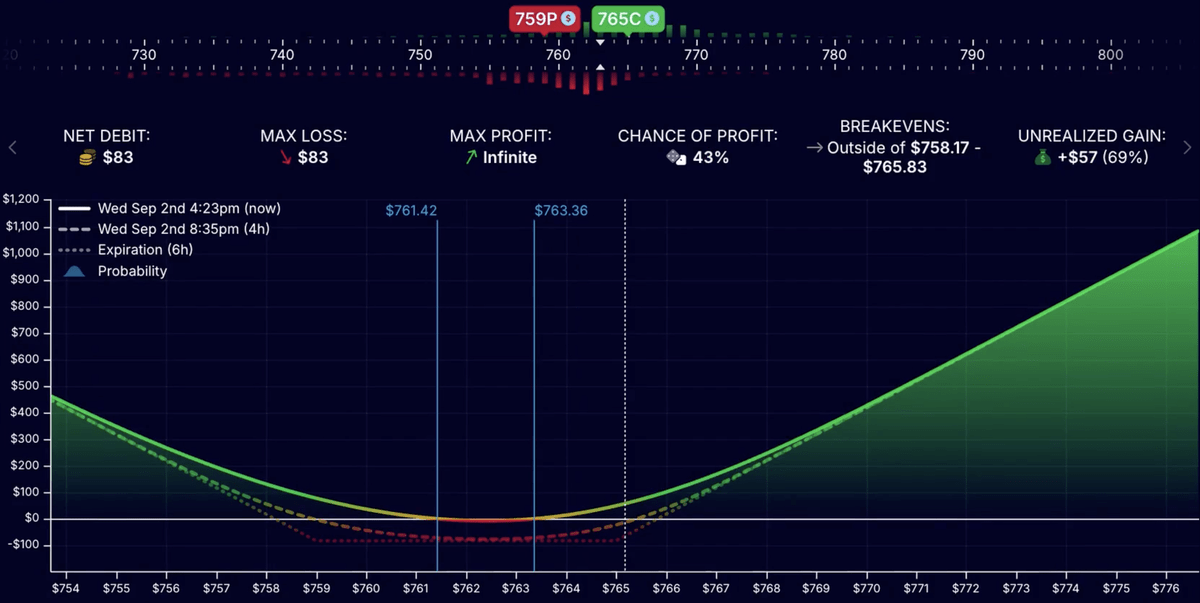
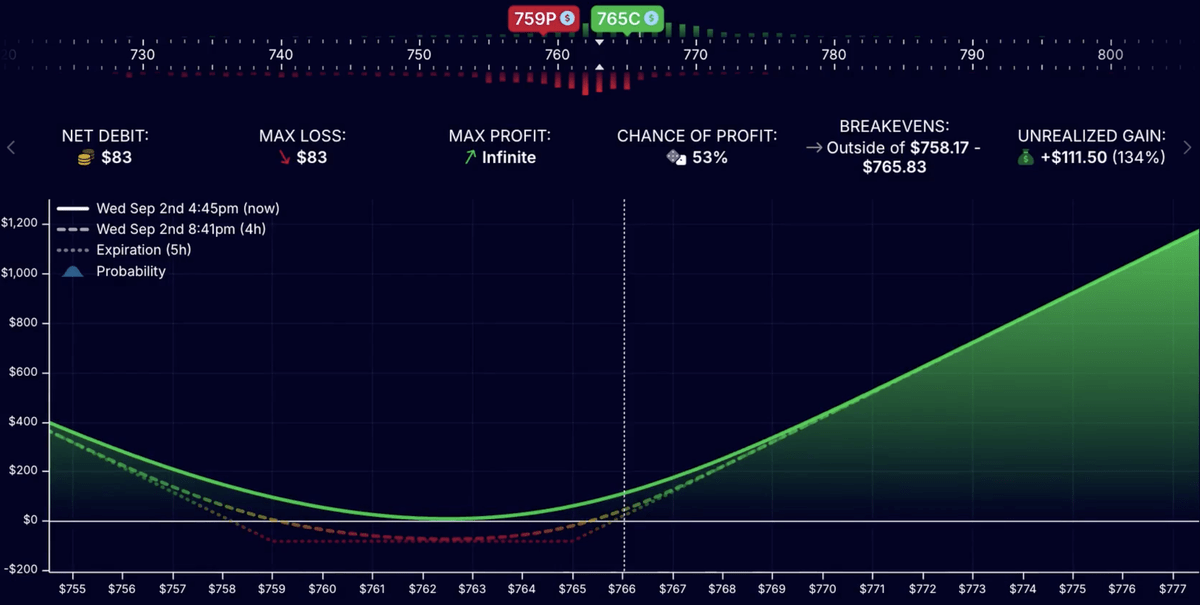
In the interview, I put on a live SPY example shortly after the market opened. The trade cost just $83. About an hour later, it had gained more than 100%, providing an unusually timely demonstration of the principle behind the strategy.
Trade management when the market does not move
The maximum loss on the original 0DTE long strangle is straightforward: the premium paid.
Tompkins calls his approach “sizing for zero.” He determines how much he is prepared to lose before entering and sizes the number of contracts assuming the entire debit could go to zero. He therefore does not normally use a stop loss on the original trade.
But he does sometimes adjust losing positions.
If the market fails to move and enough premium remains, Tompkins may sell options against the original long strangle. This can transform the position into either an iron butterfly or an iron condor.
The objective is to collect enough short premium to offset part or all of the loss in the original long options. Tompkins says there have been cases where this has turned a losing Golden One-Day trade into a net profitable position.
He will not always adjust, however. If insufficient premium remains, or if market conditions are too erratic to justify adding short options, he may simply accept the defined loss.

What results does Tompkins report?
Tompkins showed the most recent 25 examples from the Altos Trading live room. According to his records, 20 were winners, representing an 80% win rate.
He says his longer-term experience with the strategy has generally produced a win rate around 75–80%, with winning trades typically returning 50–100% and losing trades generally falling within a similar 50–100% range.
Those are Tompkins’ reported results rather than an independent performance study, and he emphasizes that the strategy should not simply be traded every day without understanding the market conditions and trade-management rules.

Why this 0DTE long strangle stands out
For traders accustomed to selling 0DTE premium, this strategy turns the usual logic around.
Instead of collecting theta and defending against gamma, the Golden One-Day Options Trade accepts rapid time decay in exchange for owning the explosive gamma of short-duration options.
That makes this 0DTE long strangle particularly interesting when volatility is poised to expand—and when the trader expects a significant move but does not want to predict its direction.
