





This 0DTE mean reversion strategy is built around a simple idea: when SPX reaches its expected move, Jamaal looks for an opportunity to trade in the opposite direction. Instead of chasing momentum, he uses directional credit spreads to position for a potential reversal.
Learn Jamaal's 0DTE mean reversion strategy in this video
Jamaal Ghauri
Jamaal Ghauri has been trading for about seven years and options for about five. He previously worked at Raymond James and today focuses primarily on options strategies designed to benefit from theta.
In our interview, he walks through his 0DTE mean reversion strategy from entry to exit, including expected moves, credit spreads, strike selection, stops, and risk management.
- Jamaal on LinkedIn
- Watch our first interview with Jamaal: 0DTE butterfly strategy
- Watch more videos about 0DTE trading

The basic idea behind his 0DTE mean reversion strategy
Jamaal’s underlying thesis is straightforward: Markets rarely move in a straight line. Even during directional days, prices often swing back toward an average after moving too far in one direction.
His preferred underlying is SPX, which accounts for around 90% of his trades with this strategy. The remaining trades are typically in large blue-chip stocks.
The starting point each day is the expected move derived from the options market.
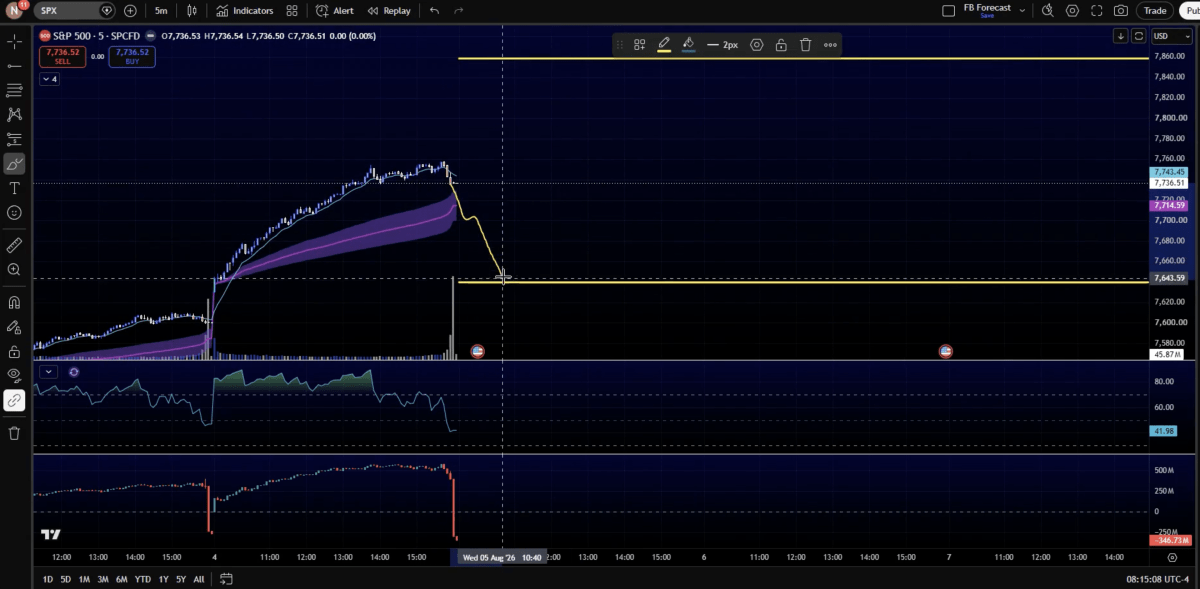
Jamaal marks the upper and lower expected-move levels and waits. If SPX remains between them, he normally does nothing. He is looking for a larger directional move that takes SPX to one of those boundaries.
If SPX reaches the upper expected move, he looks to enter a call credit spread, betting on a move back down.
If SPX reaches the lower expected move, he does the opposite: he enters a put credit spread, looking for a bounce.
In other words, instead of chasing a big move, he attempts to fade it.
He doesn’t wait for confirmation
One of the more unusual features of Jamaal’s 0DTE mean reversion approach is that he does not wait for the market to confirm that a reversal has started.
Once SPX reaches the expected-move level and his other criteria are satisfied, he enters the trade.
Why?
Because 0DTE options move quickly. Jamaal says that by the time a trader waits for a five-minute candle or another signal to confirm the reversal, the credit spread could already have captured 20%, 25%, or even 30% of its potential gain.
For his approach, waiting for confirmation can therefore mean arriving too late.

How Jamaal selects the credit spread
After the expected move triggers a potential entry, Jamaal turns to strike selection.
He typically uses credit spreads between 5 and 20 points wide, with 10 points being his usual preference.
For the short strike, he looks for a nearby support or resistance level that can provide an additional reference point. On a put credit spread, for example, he may position the short strike below a recent support level.
But the delta also has to make sense.
Jamaal says his preferred range for the short strike is approximately 10 to 25 delta. He then chooses the long strike according to his selected spread width.
This combination of expected move, support or resistance and delta determines the structure of the trade.

A 50% target – often in 20 to 30 minutes
Jamaal’s exit mechanics are clearly defined.
His initial profit target is 50% of the credit received. If he collects $100 in premium, for example, he is looking to make $50.
His initial stop is set so that he loses 100% of the credit received. Using the same example, that means a $100 loss.
But there is another important part of his trade management.
Once the position reaches around a 25% profit, Jamaal will often move his stop toward breakeven or even lock in a small gain of around 10%.
This is designed to prevent an initial mean-reversion move from turning back into a full losing trade.
The trades are also quick. Jamaal says they last around 20 to 30 minutes on average.

Timing matters
Not every touch of the expected move is equally attractive.
Jamaal prefers setups that occur early in the trading session. In his experience, an expected-move touch during the first 30 to 60 minutes after the open has a greater tendency to mean revert.
He generally stops taking new setups after 1 PM Eastern Time.
He also says the put version of the strategy has performed better for him than the call side, which he attributes to stronger mean-reversion tendencies following downside moves.

Risk management is central to the 0DTE mean reversion strategy
Credit spreads have defined theoretical maximum losses, but Jamaal does not intend to let positions reach them.
He uses a stop-market order on the entire spread, initially targeting a maximum loss equal to the credit received. He acknowledges that fast markets can produce slippage and a worse fill, although he says this has been uncommon in his experience.
This matters particularly with 0DTE options. With only hours remaining until expiration, prices can move rapidly, making disciplined risk management essential.
Jamaal typically risks around 1–2% of his account per trade.

Not a standalone “Holy Grail”
Perhaps the most important message from Jamaal is what he doesn’t recommend.
He does not view this 0DTE mean reversion strategy as something traders should simply copy and trade in isolation.
Instead, he combines mean-reversion trades with strategies that behave differently, such as trend-following or momentum strategies. He may also use an event-volatility strategy around events such as FOMC announcements or economic releases.
The objective is diversification: when market conditions become unfavorable for mean reversion, another strategy may perform better.
For Jamaal, the bigger lesson is not simply finding another 0DTE setup. It is understanding when a strategy should work, how to control losses when it doesn’t, and how it fits into the rest of your trading portfolio.
