







Selling puts is one of the most widely used strategies among options traders who aim to generate steady premium income. In this interview, options trader Josh Walker explains how he approaches the strategy, how he analyzes potential trades, and how he manages the risks involved in selling weekly puts.
Watch the video to learn how Josh is selling puts
Josh Walker
Josh Walker is a full-time options trader – or soft-retired, as he prefers to label it – based in Prescott, Arizona. With a background in engineering and mathematics, he approaches options trading in a highly systematic way, focusing on technical analysis and clearly defined risk parameters.
After many years of trading stocks and experimenting with different strategies, he eventually focused on selling puts – specifically weekly options – as his primary method for generating options premium.
Selling puts as a weekly income strategy
Selling puts involves collecting premium by agreeing to buy a stock at a specific price if it falls below the option’s strike price. If the option expires worthless, the seller keeps the entire premium.
Josh Walker’s approach centers on identifying price levels that a stock is unlikely to reach during the coming week. Once those levels are identified, he sells put options that expire within just a few days.
Ideally, the options expire worthless, allowing the collected premium to become profit.
The strategy may sound simple, but the key lies in accurately identifying price levels and structuring trades so that the probability of assignment remains relatively low.

Why does he focus on weekly puts?
One of the defining aspects of Walker’s strategy is the use of weekly options rather than longer-dated contracts.
The main reason is time decay, often referred to as theta in options trading.
Options lose value faster as expiration approaches, particularly during the final days of the contract’s life. By selling puts with only a few days until expiration, the remaining time value can decay quickly.
This rapid decay benefits the option seller.
Walker also notes that selling longer-dated options exposes the trade to more time and more potential market events. A three-week option may bring in more premium than a one-week option, but it also leaves more time for unexpected news or market moves.
Weekly options limit that exposure, in his opinion.
Finding stocks to sell puts on
Another important element of the strategy is choosing the right underlying stocks.
Walker primarily focuses on technology stocks and maintains a watch list of roughly 80–90 names. Each weekend, he reviews the entire list to identify candidates that may present opportunities during the coming week.
The first screening process is surprisingly fast.
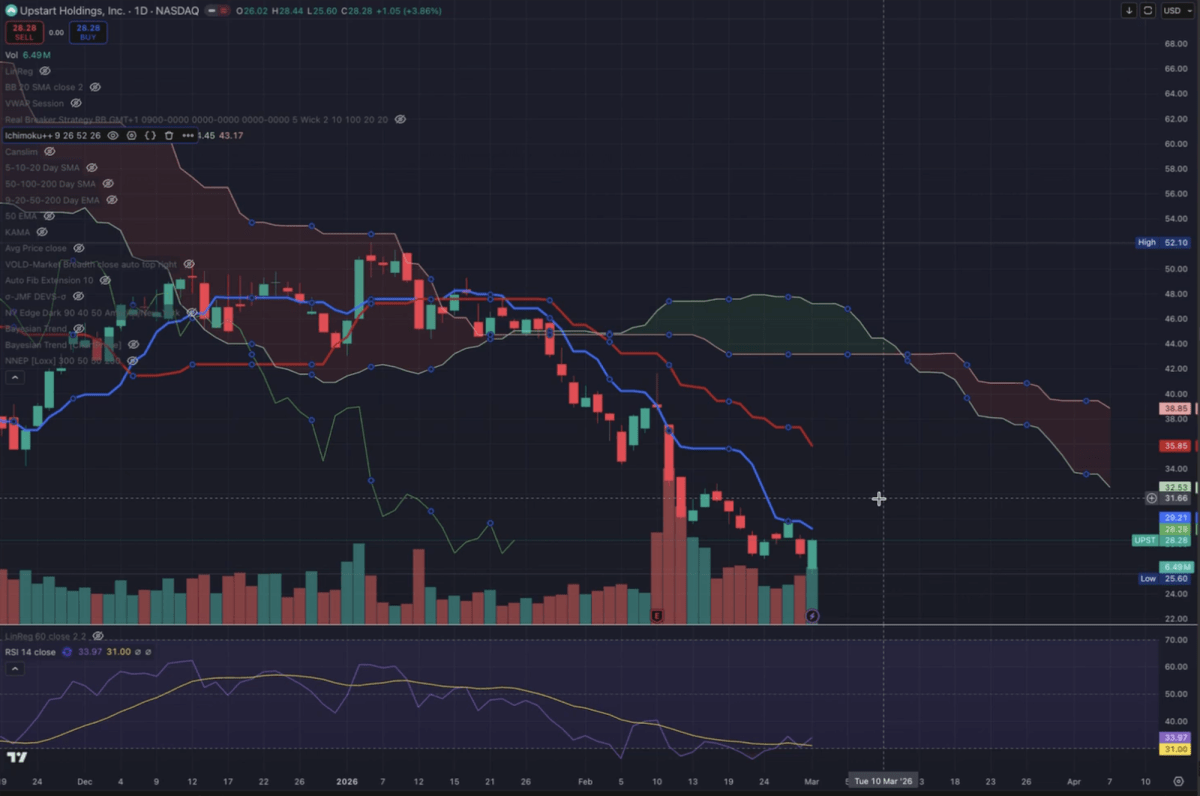
Using charting tools such as moving averages and the Ichimoku Cloud, he can often determine within seconds whether a stock looks tradable. If it passes this quick test, he then analyzes the stock more closely across multiple time frames.
This process typically narrows the watch list down to just a handful of potential trades.
The goal is to find stocks that are trading within clearly defined trends and levels.
Choosing strike prices when selling puts
Once a stock has been selected, the next step is determining the strike price of the put option.
Rather than relying solely on delta, Walker bases his strike selection primarily on technical levels. These include:
- Moving averages
- Support and resistance zones
- Linear regression channels
- Bollinger bands
These levels help him estimate how far the stock might realistically move during the week.
The put strike is typically placed below those levels to reduce the probability that the stock will drop through the strike price before expiration.
In other words, the trade is structured so that the stock would have to make an unusually large move for the option to finish in the money.

A weekly income goal: 1.04%
Instead of focusing on the outcome of individual trades, Walker measures success based on his weekly account-level performance.
His goal is to generate roughly 1.04% of his account value per week in options premium. The number may seem unusually precise, but it includes a small adjustment for interest earned on the cash in the account. Because his goal is to start each week with 100% cash and no stock positions, that capital can earn interest while the options trades are active.
In practice, the results vary from week to week. Some trades produce higher premiums, while others generate less. What matters is the combined premium collected across all trades during the week.
Looking at his results, Walker said that last year his average weekly premium income was about 1.28% of account value in his main trading account. However, because he occasionally held stocks that had temporarily declined in value, the overall account growth ended up lower when including those unrealized positions.
Even so, the annual performance of that account ended up roughly in the 30–40% range, illustrating how a strategy based on consistent premium collection can compound over time.
What happens when trades go wrong
Like any options strategy, selling puts involves risk. If the stock falls below the strike price at expiration, the trader may be assigned shares.
Walker generally handles these situations in one of three ways:
Selling the shares quickly
If the stock rebounds shortly after assignment, he may simply sell the shares.
Writing covered calls
If the position remains below the entry price, he may sell call options against the shares to collect additional premium.
Using a repair strategy
In cases where the stock drops significantly, he sometimes uses an options repair strategy designed to reduce the cost basis of the position. His specific stock repair strategy is described in detail in the video interview.
These methods allow him to gradually manage the position rather than exiting immediately at a loss.

Risk considerations when selling puts
Although selling puts is a common options strategy, it still carries meaningful risk.
If a stock were to decline significantly, the seller could be assigned shares at a much higher price than the current market value.
Walker estimates that his strategy falls roughly between 6 and 8 on a 10-point risk scale, depending on market conditions.
To control risk, he focuses on two main principles:
- Careful analysis of technical price levels
- Conservative position sizing
He also avoids committing too much capital to new trades in any single week.
Who this strategy may suit
According to Josh, selling puts does not require highly complex option structures. However, it does require discipline, preparation, and a willingness to follow a structured process.
The strategy may appeal to traders who prefer systematic approaches and who want to generate income from options premiums rather than relying on directional market bets.
Most importantly, he emphasizes that traders should adapt strategies to their own risk tolerance and trading style rather than copying someone else’s trades directly.
For traders interested in options income strategies, selling puts remains one of the most widely used and adaptable approaches.

[…] Josh Walker: Selling weekly puts […]