






Eighteen months after his first Theta Profits interview, Dale Perryman returns to explain what changed in his 0DTE Iron Flies approach. He and host John Einar Sandvand review the trade structure, entry and exit rules, days Dale avoids, and the risks behind the results.
Learn how Dale trades 0DTE Iron Flies
Track your trades
SPONSORED MESSAGE: OptionsPro syncs your trades from your broker and shows your real P&L. Theta Profits readers get the first year for $139 until November 1.
Dale Perryman
Dale is a Texas-based investor and options trader with a background in corporate training and leadership development. He began trading options after the 2008 market crash, and says his current Iron Fly approach evolved over several years.
How Dale’s 0DTE Iron Flies work
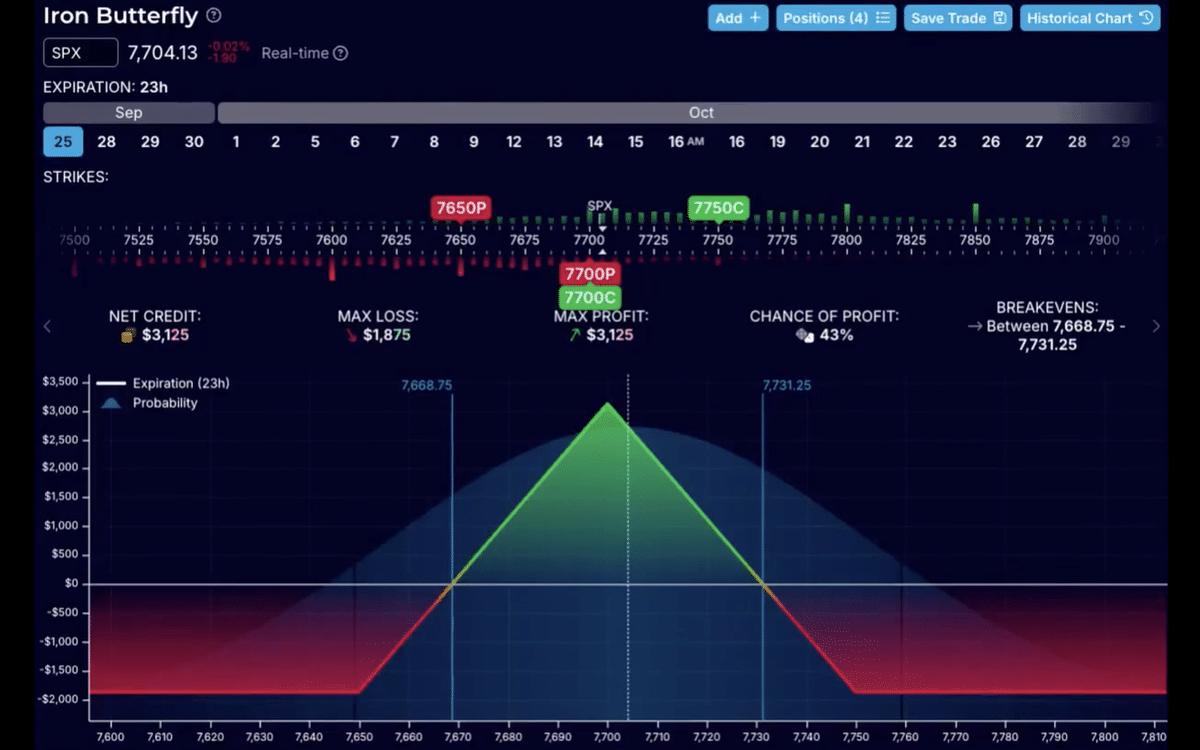
An Iron Fly, also called an Iron Butterfly, combines four options with the same expiration: a short call and short put at the same near-the-money strike, plus a long call above and a long put below it. Dale trades these on the S&P 500 Index (SPX) with options that expire the same day, or 0DTE.
The trade collects a credit when opened. Its payoff is highest if SPX finishes near the short strike; as price moves farther away, the position loses value. Dale describes the strategy as market-neutral: he wants SPX to stay within its expected move, rather than make a large move either way.
He adds and removes separate flies during the session, with strikes adjusted around the market price. The goal is to have overlapping profit zones around a range where the market may close.
OptionStrat
…is a toolkit for options traders. OptionStrat is great for calculating and visualizing your strategies and trades
Get 20% OFF your first month with OptionStrat with this affiliate link
Entry rules have changed
Dale says his current entry signal uses the opening expected move. He adds the at-the-money call and put premiums to estimate it, then waits for the expected move to fall to 83% of its opening value before entering. He says this gives early market activity time to settle and reflects his historical data analysis.
The first fly’s credit sets the distances for later entries. In his example, a $20 credit means adding another fly after SPX moves 15 points from the short strike, with the new short strike 20 points away. With a $15 credit, he described a tighter schedule: a 10-point move before adding, with the next strike 15 points away. These are examples from Dale’s method; setup varies with credit and market conditions.
He starts with wings 50 points wide and gradually narrows them as the day progresses. His target is for the long options to cost around 40 cents, while weighing that against the added risk of wider wings. Near the close, wings may narrow to about 20 points.
Dale avoids three sessions:
- the third Wednesday of each month,
- the last trading day of the month
- Federal Open Market Committee (FOMC) rate-decision days.
He says his analysis suggests that avoiding these days would have improved past performance. His explanations for the calendar patterns are hypotheses.

How he manages open flies
Dale’s exit trigger is based on the credit collected. If a fly collects $20, he closes it if SPX moves 20 points away from its short strike. He does not normally take flies off at a profit target. Positions that have not hit the exit trigger may stay open into the close, when time decay can accelerate.
That approach exposes trades to sharp late-day moves. Dale says about 80% of losing fly exits are between $2 and $6 per contract; this does not describe tail losses or the day’s combined result. He may close a fly and later open another with more time value, moving away from positions he sees as riskier and toward new opportunities.
Dale uses custom automation built with help from people in his group. He says it is not an off-the-shelf product, and he still monitors activity on his phone.

Results and risk belong together
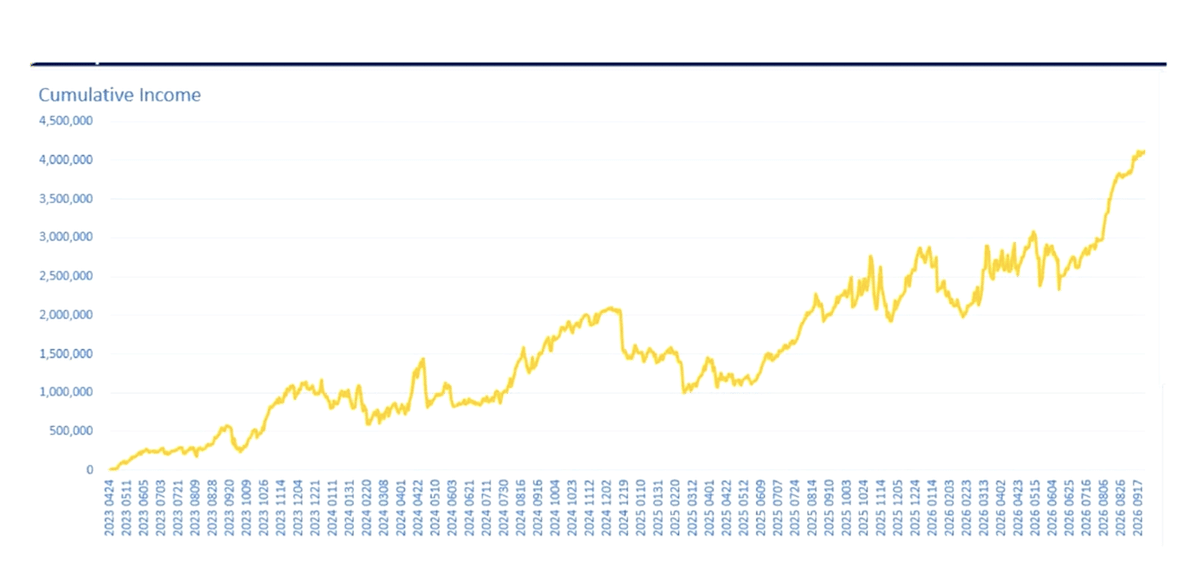
At the time of the interview, the profits Dale reported had grown from about $1.5 million at the previous interview to more than $4 million. Dale said the accounts shown had experienced a drawdown of roughly $800,000. He also described annual returns in the 30% range and said one account was up 39.1% at that point.
Dale said Iron Flies use about 25% to 30% of his account allocation but contribute roughly 75% to 80% of his annualized return. He recalled losing about $11,000 per contract on a bad day and said some accounts had lost as much as $15,000 in a day. He rates the strategy seven out of ten for risk.

Who should consider the strategy?
Dale says the approach is not for everyone. In his view, traders need considerable assets and must withstand substantial losses without putting essential expenses at risk. He would not trade it in an account below $50,000 and says $100,000 or more may be preferable. He stresses trading small enough to stay in the game after a losing day.
