







The ZEBRA options strategy is a strong alternative for intermediate options traders looking for a more capital-efficient way to gain stock exposure. In this interview, options trading coach Fauzia Timberlake explains how the ZEBRA options strategy works, when to use it, and why it can be a powerful alternative to simply buying shares.
Learn about the ZEBRA options strategy in this video
Fauzia Timberlake
Fauzia Timberlake is an experienced options trader with over a decade of experience. She started her journey after a career in finance and has since focused heavily on options strategies, particularly those that improve capital efficiency and risk control. She also offers private coaching to options traders.

The ZEBRA options strategy
ZEBRA stands for “Zero Extrinsic Value Back Ratio.” The ZEBRA options strategy is designed to replicate stock ownership using options while reducing capital requirements and limiting risk.
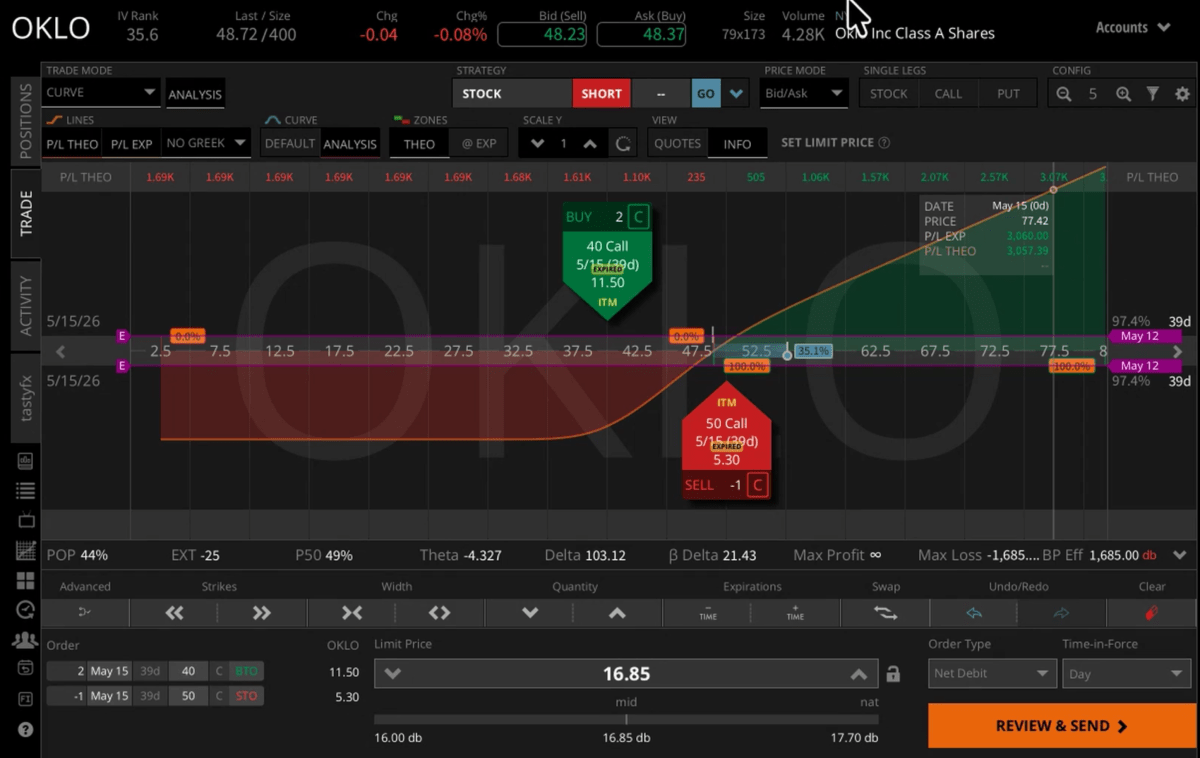
The standard ZEBRA setup involves:
- Buying two in-the-money call options
- Selling one at-the-money call option
This structure creates a position with approximately 90–100 delta, meaning it moves almost one-for-one with the underlying stock.
A key feature of the ZEBRA options strategy is minimizing extrinsic value. Since extrinsic value decays over time, reducing it improves the efficiency of the trade.
Why traders use the ZEBRA strategy
The main advantage of ZEBRA is capital efficiency, explains Fauzia.
Instead of buying 100 shares of a stock – which can require significant capital – you can achieve similar exposure with a much smaller investment. In the example discussed, a stock position costing around $4,800 could be replicated with roughly $1,700 using a ZEBRA.
This makes the ZEBRA options strategy especially attractive for traders with smaller accounts.
Another major benefit is defined risk. With the ZEBRA options strategy, the maximum loss is limited to the premium paid for the position.

How the ZEBRA options strategy behaves
The ZEBRA is built to mimic long stock as closely as possible.
If the stock moves higher, the position gains value almost dollar-for-dollar. This makes it ideal for traders with a strong directional (bullish or bearish) view.
However, there are some key differences:
- The downside is capped at the initial cost
- The position may not track perfectly at all times
- Active management may be required
Because of this, the ZEBRA options strategy is often referred to as a synthetic stock replacement.
Choosing the right ZEBRA setup
To use the ZEBRA effectively, Fauzia highlights a few important considerations:
Low implied volatility (IV)
Entering the ZEBRA options strategy when IV is low helps reduce cost.
Strike selection
Carefully selecting strikes is essential to minimize extrinsic value.
Expiration (duration)
Longer durations provide more time for the trade to work but increase cost. Traders must balance time and capital.

Generating income with the ZEBRA options strategy
The ZEBRA can also be combined with income strategies.
Traders can sell out-of-the-money calls against the position, similar to a covered call. This generates premium and helps reduce the cost basis over time.
This flexibility makes the ZEBRA options strategy useful not only for directional trades but also for income generation.
Managing risk and adjustments
Although the ZEBRA has defined risk, it requires active management, says Fauzia.
If the stock moves against the position, extrinsic value can increase. In these situations, traders may need to “ratchet” the position—closing the current trade and opening a new one with better characteristics for a debit.
This adjustment process is a key part of successfully trading the ZEBRA options strategy.

ZEBRA vs other stock replacement strategies
The ZEBRA options strategy is often compared to:
- Buying stock outright
- Synthetic stock positions
- Buying multiple call options
Compared to these alternatives, the ZEBRA options strategy, according to Fauzia, offers:
- Better capital efficiency than owning stock
- Lower extrinsic value than many option-based strategies
- Greater flexibility in managing positions
However, it also requires a solid understanding of options.
Key takeaways on the ZEBRA strategy
The ZEBRA options strategy is a powerful tool for traders who want stock-like exposure with less capital and defined risk.
It works best when:
- You have a clear directional view
- Implied volatility is relatively low
- You are comfortable managing positions
For intermediate traders, the ZEBRA options strategy can be a valuable addition to the toolbox—especially as a replacement for traditional stock positions.
Used correctly, it offers a compelling combination of leverage, flexibility, and risk control.
📚 Books recommended in this video
Fauzia recommends TastyLive as a great resource for learning options trading.
She also recommends these two books:
- Julia Spina: The Unlucky Investor’s Guide to Options Trading
- Richard Lehman: Far from Random
