






Many 0DTE traders focus almost exclusively on selling option premium. But sometimes buying premium offers a better opportunity. Options trader Jason Ruchel uses both approaches, with two distinct strategies designed for different market conditions. He shares the trading rules, backtests, results, and risks behind each one.
Learn Jason’s two 0DTE strategies
Jason Ruchel
Jason Ruchel is an experienced options trader with nearly 20 years in the markets. After spending more than a decade trading alongside a corporate career in financial accounting, he transitioned toward full-time trading during the pandemic.
Today, he trades stock options and SPX strategies, using backtesting and automation as important parts of his approach. He lives in Seattle, Washington, USA.
Backtest and automate your options strategies
Option Omega helps you test your options strategies against historical market data, fine-tune your trading rules, and automate the execution.
How Jason chooses between buying and selling premium
Jason’s 0DTE strategies start with implied volatility.
Most of the time, he prefers selling premium. Historically, implied volatility has often overstated actual market moves, giving option sellers an advantage.
But not always.
When options become too cheap relative to the moves he expects, Jason considers buying premium instead. He looks at several indicators to make that decision, and has done extensive backtesting of all strategies using Option Omega:
- VIX: Higher volatility generally favors selling premium, while lower volatility can create opportunities to buy it.
- VIX 1D: The one-day volatility index helps him assess how much movement the options market expects during the trading day.
- Gamma exposure: He watches whether dealer positioning could contribute to relatively stable prices or larger moves.
- Economic events: Fed announcements, employment reports, and other events can change the risk of intraday moves.
He also pays attention to the time of day. His premium-selling strategy enters late in the session, while his premium-buying strategy looks for opportunities in the morning.

0DTE strategy 1: Selling an Iron Fly late in the day
Jason’s first 0DTE strategy is a short Iron Fly, or narrow Iron Condor, designed to benefit from limited price movement and rapid time decay during the final hours of trading.
He calls it his 1:45 trade because it enters at 1:45 PM Eastern Time.
The idea is that the market often becomes more balanced later in the session, after much of the early volatility has passed.
Entry rules
The backtested setup uses:
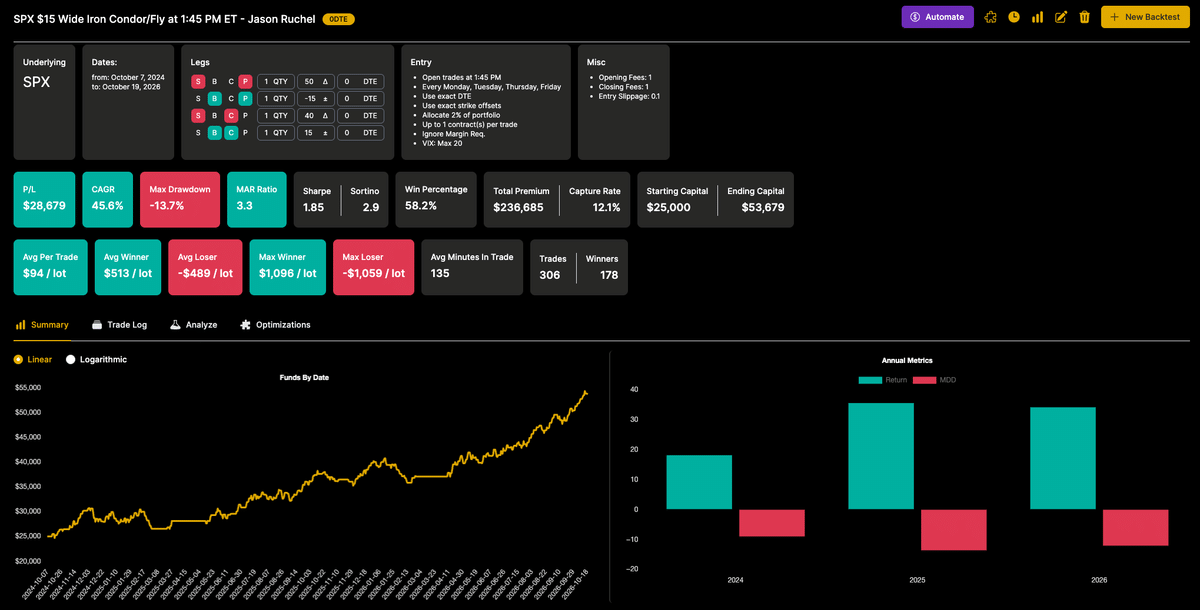
- A short put around 50 delta
- A short call around 40 delta
- Long protective wings 15 SPX points away
- Entry at 1:45 PM Eastern
- VIX below 20, preferably closer to 15–16
The trade aims for approximately a 1:1 risk/reward ratio. Jason also explains how traders with smaller accounts could use 10-point-wide wings instead.
His backtest favors Mondays and Fridays. He excludes Wednesdays because the results have been less favorable, potentially reflecting the impact of Fed-related events.
Exits and backtested results
Jason generally lets this strategy expire at the close, accepting the defined maximum risk. However, he sometimes takes profits early if the position reaches a 50% gain quickly.
He describes it as a ride-or-die trade rather than one that requires constant adjustments.
The backtest covers nearly 300 trades over approximately two years, showing a win rate around 58% and an annualized compound return of 44%.
Jason says he has automated the strategy using Option Omega and has been trading it across multiple accounts. However, the 44% figure comes from the backtest, not his verified live performance.
- Option Omega users can find the backtest here
- Get 50% off your first year on Option Omega with Theta Profits’ affiliate link

0DTE strategy 2: Buying a reverse iron condor
The second strategy takes the opposite approach.
Instead of selling premium and hoping the market stays within a range, Jason buys a long iron condor, also called a reverse iron condor, designed to profit when SPX makes a larger move than the options market anticipates.
Importantly, he doesn’t have to predict whether the market will go up or down.
Entry rules
Jason looks for opportunities during the first part of the trading day, particularly when:
- VIX opens lower than the previous close.
- VIX continues falling, preferably by 0.5%–1% from the open.
- Conditions suggest there is a potential for a trending day.
- The entry criteria are met before 11:00 AM Eastern.
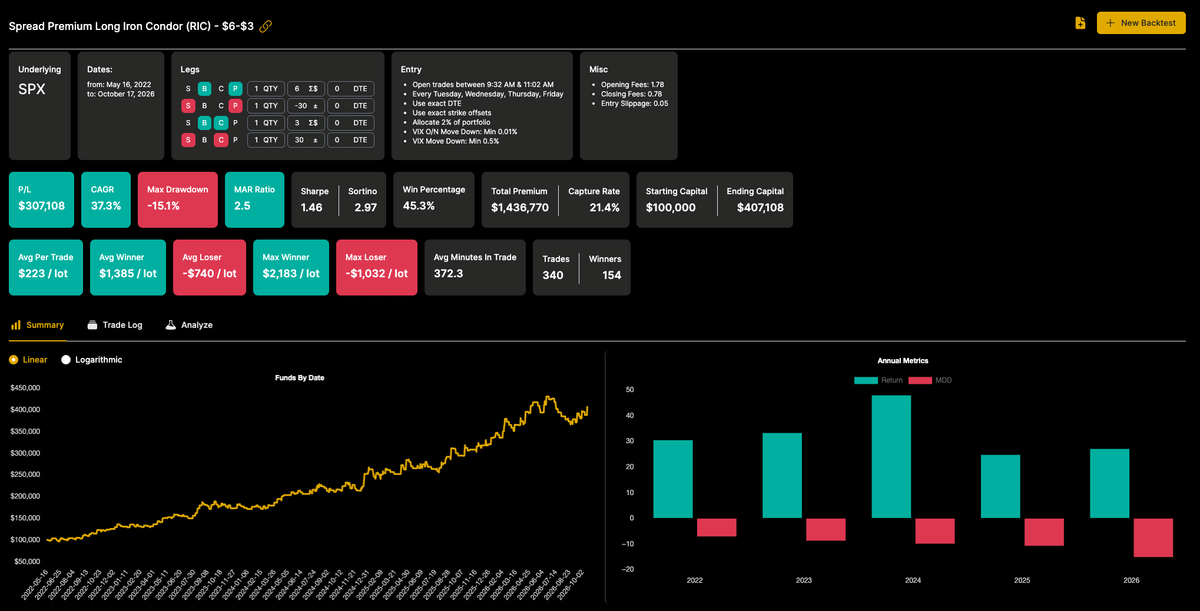
His backtested setup buys a 30-point-wide put debit spread costing approximately $6 and a 30-point-wide call debit spread costing approximately $3.
That creates a total debit around $9, or $900 per SPX contract combination, with the possibility of a substantially larger payoff if the market makes a strong move.
Exits and backtested results
Jason often lets this position run until expiration, although he sometimes closes it early after a quick 100% gain.
The backtest includes approximately 338 trades over more than four years. The strategy wins slightly less than half the time, but its winning trades are considerably larger than its losing trades.
The result is a 36.7% annualized backtested return, despite a win rate below 50%.
Jason finds the strategy particularly interesting later in the week, especially on Thursdays, when economic releases and market events can create larger moves.
He also points out that traders with smaller accounts could consider XSP, which is one-tenth the size of SPX.
- Option Omega users can find the backtest here
- Get 50% off your first year on Option Omega with Theta Profits’ affiliate link

Why two opposite 0DTE strategies can work together
The central lesson from Jason’s approach is that no single 0DTE strategy works equally well in every market environment.
His short iron fly seeks to benefit from relatively quiet conditions late in the day. His reverse iron condor looks for larger-than-expected moves, typically earlier in the session.
Sometimes, both strategies can even be traded on the same day.
The backtests show how these approaches have performed historically, but they also include drawdowns. Jason emphasizes understanding the risk of each trade, sizing positions appropriately, and recognizing when market conditions favor one strategy over the other.
