







Most options traders use covered calls to generate income. Hemanth Swamy takes a different approach. His goal is to use options to systematically reduce the cost basis of quality stocks while steadily building a long-term investment portfolio.
Learn about Covered Strangle Wheel in this video
Hemanth Swamy
Hemanth Swamy is a technology professional and long-term investor in New York who combines stock ownership with systematic options trading. Rather than trying to predict short-term market moves, he focuses on owning leading companies while generating recurring option income through what he calls the Covered Strangle Wheel.
A different goal than most options traders
Many options traders focus on maximizing monthly income or generating the highest possible option premium.
Swamy’s objective is different. He wants to own high-quality companies for many years while continuously lowering his effective purchase price through option premiums.
Instead of viewing options as a separate trading activity, he treats them as a tool that supports long-term investing. Every premium collected reduces his cost basis, allowing him to increase the profitability of his stock portfolio over time.
Because he works full-time, he also wanted a strategy that does not require him to watch charts throughout the trading day.
- Interviews about similar strategies:
- Paul Gundersen: The Wheel options strategy
- Lance Kaminsky: Covered Strangle
- Levi Woods: The Wheel with a twist

What is the Covered Strangle Wheel?
The Covered Strangle Wheel builds on the traditional Wheel strategy.
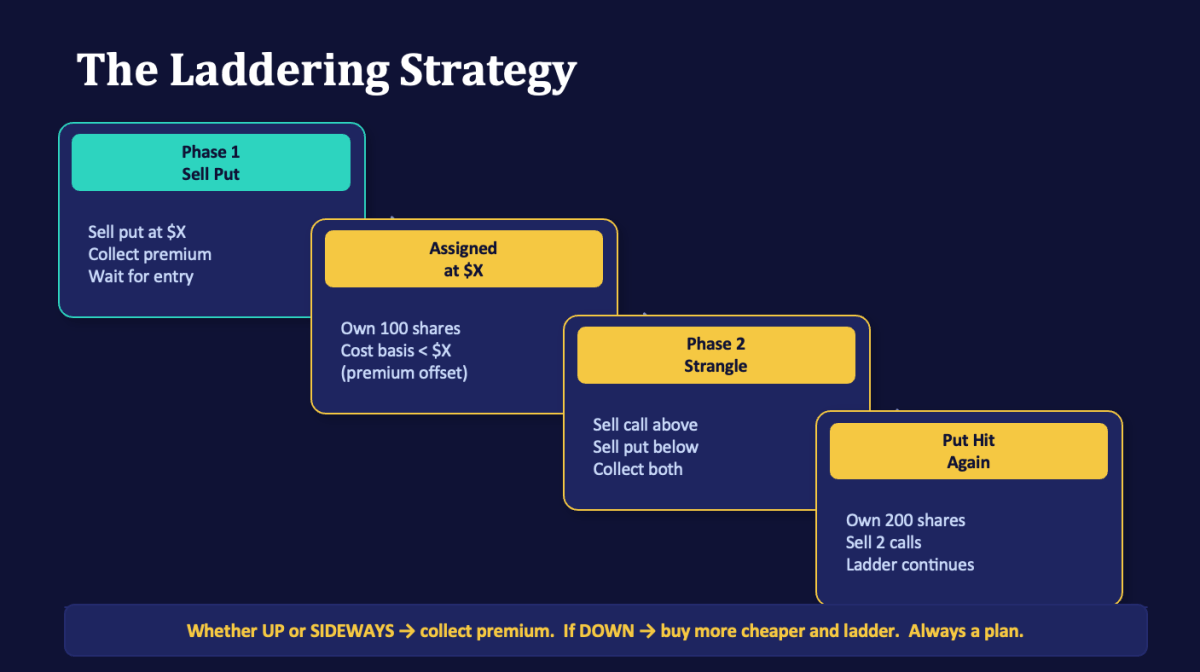
The first phase is familiar to most options traders. Swamy sells cash-secured puts at prices where he would be happy to own the underlying stock. If the options expire worthless, he simply repeats the process and collects another premium. If assigned, he purchases 100 shares at his chosen price.
The strategy changes after assignment.
Instead of selling only a covered call, he simultaneously sells:
- a covered call above the current stock price
- another cash-secured put below the current stock price
This creates two potential sources of option income while continuing to build the stock position if prices decline.
Choosing the right stocks
Stock selection is one of the most important parts of the strategy.
Hemanth primarily focuses on large, established companies that he is comfortable owning for ten years or longer. Rather than searching for speculative opportunities, he prefers businesses with strong fundamentals and consistent long-term growth.
He often starts with leading companies in the S&P 500, looking for stocks with sufficient option liquidity and enough implied volatility to produce attractive premiums without becoming excessively volatile.
His philosophy is simple: if the underlying investment is strong, temporary market fluctuations become much easier to manage.

Managing the different market scenarios
Hemanth has a plan for how to respond in each of the possible scenarios with the strategy.
If the stock rises, the sold put expires worthless, and the covered call generates additional income.
If the call becomes threatened, Swamy generally rolls the position rather than allowing his shares to be called away, since his goal is to continue holding the stock.
If the stock trades sideways, the strategy performs particularly well. Both the covered call and the short put can decay simultaneously, allowing him to collect premium from both positions before opening new contracts.
A modest decline is also manageable because previously collected premiums help offset part of the loss by reducing the position’s effective cost basis.
A sharp decline requires more attention. If he still wants to own the company, he can simply accept assignment on additional shares. If he wants to reduce risk, he has several adjustment techniques available, including rolling positions and restructuring the strangle.

A NVIDIA example
In the video, Hemanth walks through a real NVIDIA position during the sharp selloff that followed the DeepSeek news last year.
After selling an at-the-money put, he was assigned shares when NVIDIA dropped approximately 17% overnight.
Instead of simply holding the losing position, he immediately entered the second phase of the strategy by selling both a covered call and another put. Thanks to the elevated implied volatility, he collected substantial additional premium, significantly lowering his effective break-even price.
As the stock later recovered, he closed the profitable strangle and rolled into a new one with updated strikes, allowing him to continue generating premium while maintaining ownership of the shares.
The example illustrates how the strategy seeks to use volatility as an advantage rather than something to fear.

Risk remains an important consideration
Although Hemanth considers the strategy relatively conservative when applied correctly, he emphasizes that risk still exists.
The largest risk is owning a company that experiences a prolonged decline or permanent deterioration in its business. Because of this, careful stock selection is far more important than trying to maximize option premium.
He also protects his overall portfolio through portfolio-level hedging rather than hedging each stock position.

Using options to build wealth over time
The Covered Strangle Wheel is not designed to generate spectacular short-term returns.
Instead, it is a systematic approach to combining long-term investing with recurring option income. By repeatedly collecting premium from covered calls and cash-secured puts, Swamy aims to lower his cost basis, generate consistent cash flow, and gradually build larger positions in companies he already wants to own.
For investors who like the traditional Wheel strategy but want additional income opportunities while continuing to accumulate quality stocks, the Covered Strangle Wheel offers an interesting variation built around patience, discipline, and long-term portfolio growth.
📚 Books recommended in this video
- Brian Overby: The Options Playbook
- Lawrence G. McMillan: Options as a Strategic Investment
