


This article and video have been produced in collaboration with Option Omega and EarningsWatcher. Theta Profits has an affiliate relationship with both and may earn a commission if you subscribe through my links.
__________________________________________
More and more options trading tools are becoming accessible directly through AI assistants like ChatGPT, Claude, and others. This opens up new possibilities for finding trading opportunities, testing strategies, and analyzing results — without constantly switching between platforms.
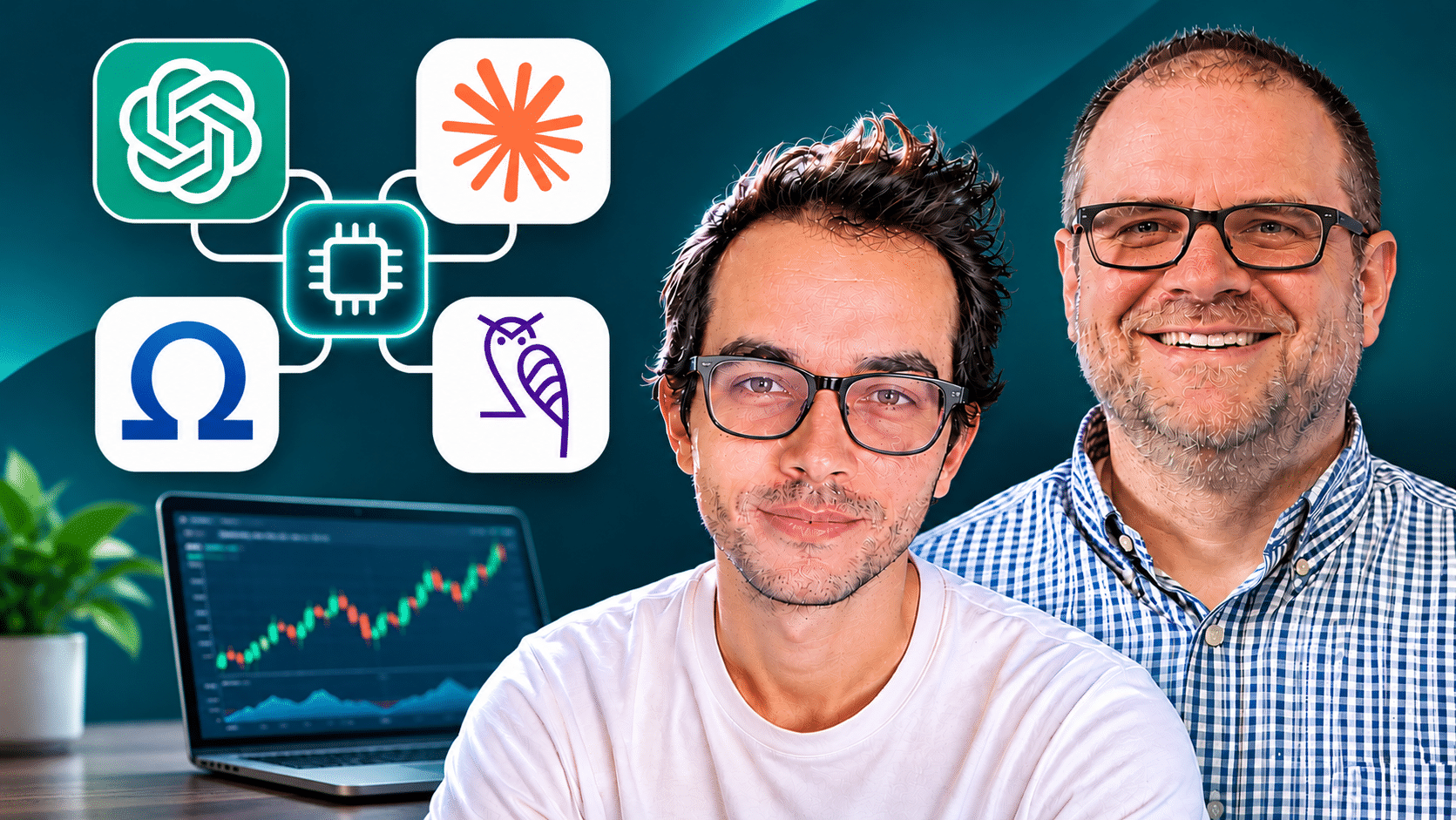
How Option Omega and EarningsWatcher work with ChatGPT and Claude
In this Theta LAB interview, Matt Simon from Option Omega, an options backtesting platform, and Amin Khribi from EarningsWatcher, a platform specializing in earnings-related options research, demonstrate how these connections work. They also combine their tools to explore what AI can offer options traders beyond the capabilities of either platform alone.
A new way to work with options trading tools
Traditionally, using specialized trading software means learning its interface, navigating menus, setting filters, and interpreting results yourself.
Connecting these tools to AI assistants changes that workflow.
The technology behind the connection is called MCP (Model Context Protocol). It allows compatible AI assistants to communicate with external services and access their tools and data.
Instead of clicking through a platform, traders can describe what they want in ordinary language. The AI assistant can then use the connected service to retrieve information, perform calculations, or run analyses.
Both guests report enthusiastic responses from users. Interestingly, the benefits aren’t limited to advanced traders. Beginners can also use AI to understand unfamiliar strategies and learn complicated tools.
EarningsWatcher: Find and analyze earnings trading opportunities
Amin demonstrates several ways to use EarningsWatcher through an AI assistant.
For beginners, AI can act as a research partner and teacher. It can explain implied volatility, IV crush, and IV expansion, then guide traders through the platform’s data and strategies.
Experienced traders can go further.
In one demonstration, Amin asks ChatGPT to identify companies reporting earnings over the next two weeks that have historically shown pronounced post-earnings price drift or momentum.
The assistant retrieves information from EarningsWatcher and presents the findings in a table. It can also create visualizations and help explore the results.
Another example involves evaluating a potential short-volatility trade around earnings.
Starting with a short straddle idea, Amin asks AI to examine the risk-reward profile and challenge the assumptions behind the trade. The conversation explores alternatives, including an iron condor.
Instead of simply suggesting trades, AI helps investigate opportunities, understand risks, and compare approaches.
EARNINGSWATCHER: Get your edge in earnings trades
EarningsWatcher turns messy earnings volatility into clear, research-backed setups — so you can trade with consistency, not luck.
Get 33% off the annual plan (affiliate link)
Option Omega: Backtest options strategies by asking
Matt demonstrates how AI connected to Option Omega can simplify options backtesting.
Traders can describe a strategy in natural language, including entry time, market conditions, position structure, stop-loss rules, commissions, and slippage.
For example, Matt describes asking AI to backtest a 0DTE iron fly entered at 10:01 a.m. when VIX is up, comparing results with and without a stop loss.
The assistant can translate those instructions into a backtest using Option Omega.
But the possibilities extend beyond setting up tests.
Matt also revisits a reverse iron condor strategy that has performed poorly in 2026. Using AI, he investigates whether its historical edge may be fading, examines statistical measures, and explores modifications.
The analysis produces a more robust version with additional trades, but importantly, it doesn’t fix the strategy’s poor recent performance.
That’s a useful reminder that better research tools don’t automatically produce profitable strategies.
Matt also demonstrates backtesting the wheel strategy, including different option deltas and expirations, and transitioning from selling puts to covered calls following assignment.
OPTION OMEGA: Backtest it. Then automate it
Option Omega: Test any options strategy against real market data back to 2013, then run the winner at tastytrade, Tradier, Schwab, or TradeStation. No code, no server, no guesswork.
Get 50% off your first year (affiliate link)
Combining two tools: From earnings research to backtesting
Perhaps the most interesting part comes when Matt and Amin combine EarningsWatcher and Option Omega.
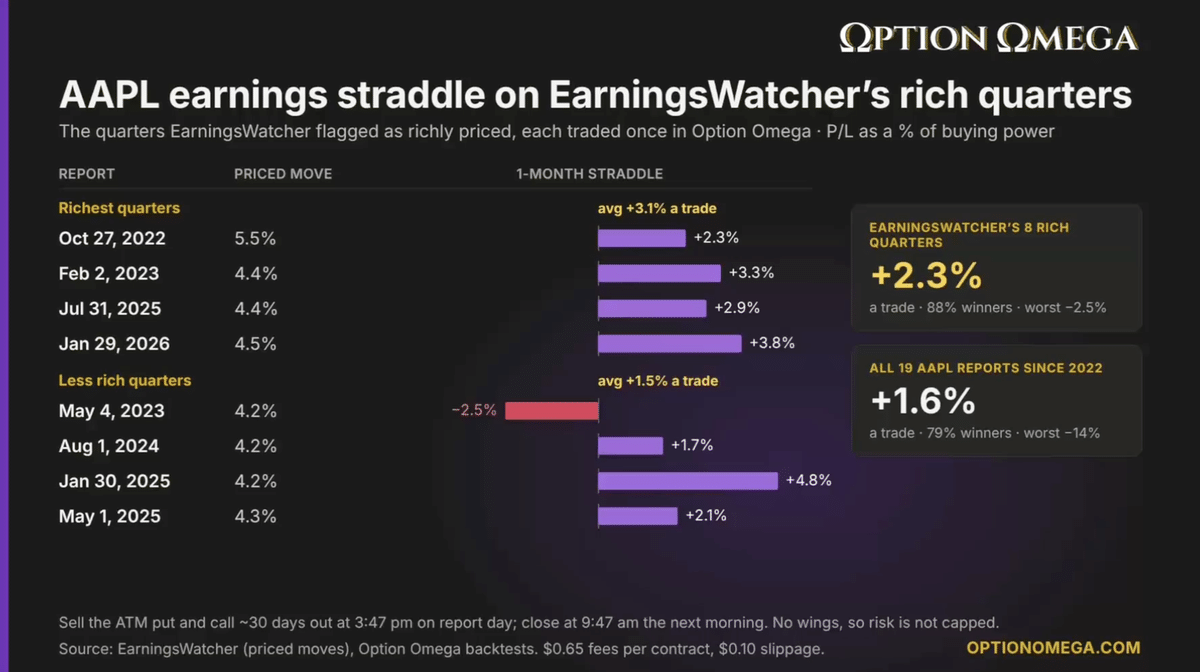
They explore a workflow involving Apple earnings.
First, EarningsWatcher identifies historical earnings events when implied volatility appeared particularly elevated — what they call rich volatility.
The underlying idea is straightforward: selling options when implied volatility is unusually high may offer an opportunity to benefit from a subsequent volatility decline.
Matt uses Option Omega to test a simplified version of that idea.
The example involves selling a longer-dated straddle before earnings and closing it the following morning, aiming to capture the decline in implied volatility around the announcement.
They initially backtest historical Apple earnings events without additional filters.
Next, they narrow the test to events EarningsWatcher identified as having especially rich volatility.
The filtered results are encouraging. Matt reports that seven of eight selected historical events supported the rich-volatility idea in their small sample backtest.
However, he acknowledges the limited sample size. This is a proof of concept, not evidence of a reliably profitable strategy.
The real significance is the workflow: research from one specialized platform can inform backtesting through another, with an AI assistant helping connect the steps.
Powerful tools still require human judgment
Both guests emphasize that AI-generated results must be checked.
Matt cautions against treating AI like a magical solution. Poor instructions can produce incorrect results, and traders need to verify that backtests reflect their intended strategies.
Amin agrees, recommending that traders review the reasoning behind AI-generated analyses. He even suggests asking another AI assistant to review important findings.
The opportunity is substantial: faster research, easier access to sophisticated analysis, and more flexible ways to combine trading tools.
But responsibility for understanding strategies, evaluating risks, and making trading decisions remains with the trader.
As more platforms become accessible through ChatGPT, Claude, and other AI assistants, the way options traders research and test their ideas could change significantly.
