






- This article and video are produced in collaboration with Option Samurai. Theta Profits has an affiliate relationship with Option Samurai and may earn a commission if you subscribe using our link.
Selling puts can be an attractive options strategy. But finding opportunities that offer a reasonable return without taking excessive risk requires more than looking at premiums or probability of profit. In this Theta LAB interview, Leav Graves demonstrates three approaches to finding better put-selling opportunities.
Learn 3 ways to find put selling trades
Leav Graves from Option Samurai
Leav Graves is a licensed portfolio manager and founder of Option Samurai, an options scanning and research platform. He originally developed the tool to automate his own trade research and save time while managing investments.
His central philosophy is straightforward: The best put trades combine several different edges working in your favor.
Those edges might come from options pricing, company fundamentals, technical indicators, or market conditions. Rather than relying on a single measure, Leav looks for opportunities where several factors support the same trade.
OPTION SAMURAI: Find the best opportunities in the market
Option Samurai is a simple-to-use, yet very powerful options scanner. Lots of ready-made templates get you started for numerous options trading strategies. Probably the best options scanner out there.
TRY FREE FOR 2 WEEKS
(affiliate link)
+ 2 extra weeks if you tell them that you are from Theta Profits
Three ways to start scanning for put-selling trades
In this interview, Leav shares three of his favorite ways to find put trades. All of them are ready scan templates in Option Samurai, but you can also set them up in other tools.
1. Find put trades with a high probability of profit
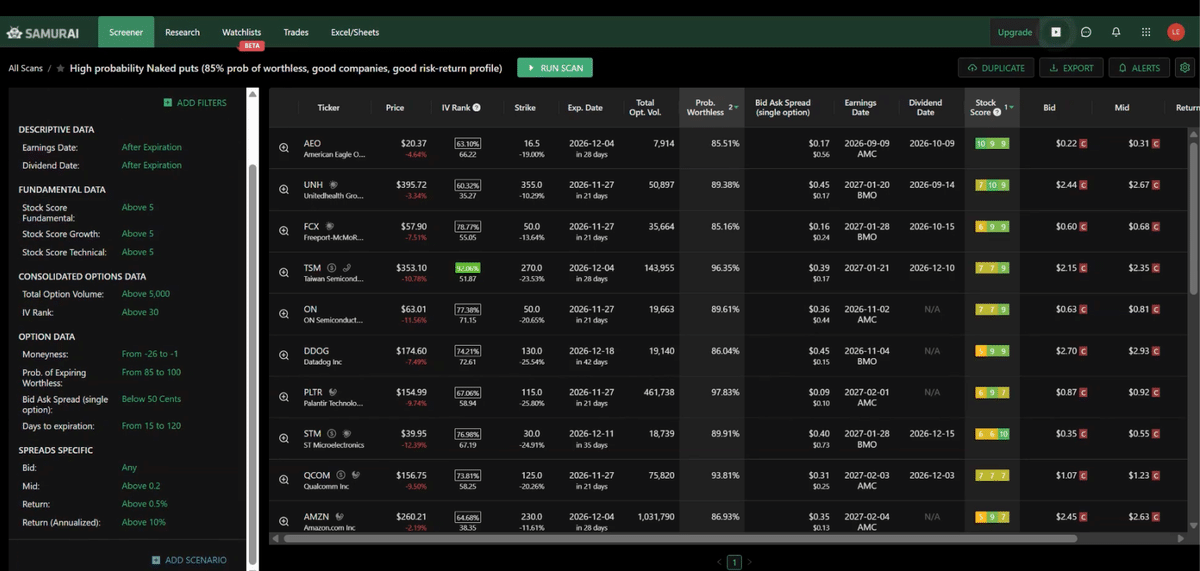
Leav’s first approach starts with a broad scan for put options with at least an 85% probability of expiring worthless, based on options market pricing.
In Option Samurai, he uses a predefined scanner that includes several criteria:
- Minimum 85% probability of profit.
- At least 10% annualized return.
- No earnings or dividend events during the trade.
- Better-than-average company fundamentals.
- Basic liquidity requirements, including options volume and bid-ask spreads.
The scanner produces a shortlist of potential trades, ranked by stock score and probability of profit.
But this is only the beginning of Leav’s research.
He demonstrates a Palantir put approximately 25% below the current share price, with 21 days until expiration. The trade shows a probability of profit of almost 98% and an annualized return of nearly 13%.
At first glance, that looks attractive. However, Leav emphasizes that the market may be pricing in risks that are not immediately obvious.
His next step is to investigate the company, its valuation, growth prospects, and technical support levels.
He particularly likes selling puts with strike prices below recent support levels. Just as importantly, he asks whether he would be comfortable owning the shares at the strike price if assigned.
Leav generally aims for annualized returns of 20–30% on these trades, although he accepts lower returns for stocks he considers especially safe.
These are his return targets, not guaranteed or demonstrated performance results.
2. Sell puts on dividend aristocrats
The second strategy narrows the search to a specific group of companies: dividend aristocrats.
These are companies that have increased their dividends for at least 25 consecutive years.
Leav favors this group because he considers its established dividend history an additional source of confidence when selling puts.
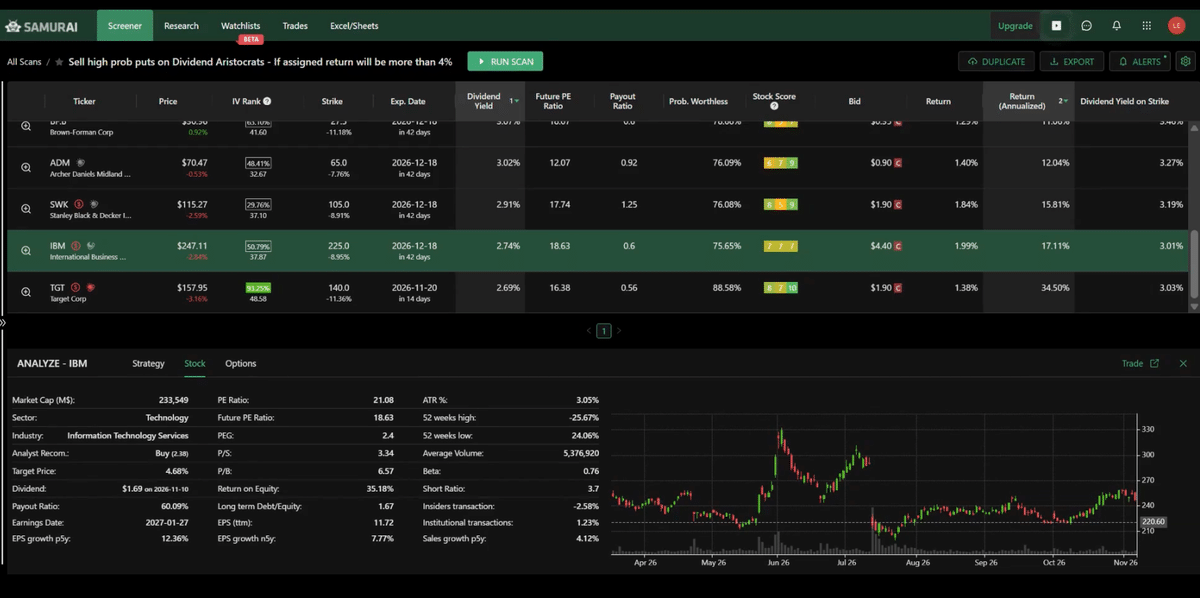
The approach builds on the first scanner but adds dividend-related requirements. One particularly useful metric is dividend yield on strike.
Instead of calculating the dividend yield based on the current share price, this measure calculates what the yield would be if the trader were assigned shares at the put’s strike price.
Why does that matter?
When you sell puts, you must be prepared to buy the underlying shares if assigned. With dividend-paying companies, assignment can create another potential income opportunity.
Leav explains that he can then hold the shares to collect dividends or sell covered calls as part of a wheel strategy.
He is willing to accept lower put premiums on dividend aristocrats because he considers these companies relatively safer than the broader stock universe.
During the interview, he highlights IBM as an example of a potential trade, with an annualized return of around 17%.
Leav also uses this strategy to ladder his trades, opening smaller positions regularly rather than committing all his capital at once.
However, dividend aristocrats are not risk-free. Their share prices can fall significantly, and assignment still exposes the trader to the risk of owning the stock.
3. Find put trades when stocks become oversold
The third strategy adds something different: market timing.
Instead of continually searching for attractive premiums, Leav looks for stocks that have experienced unusually strong selling pressure.
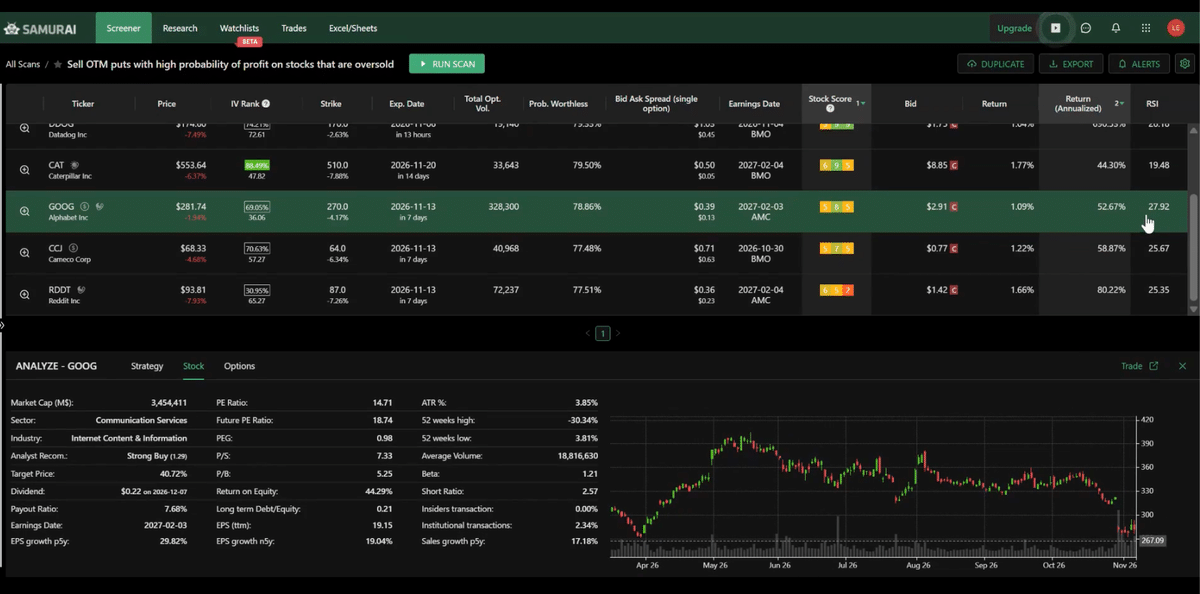
His scanner uses the 14-period Relative Strength Index (RSI 14) to identify oversold conditions.
It also includes requirements for company fundamentals, growth, liquidity, and a probability of profit above 75%.
The thinking is that an oversold stock may offer an attractive opportunity to sell puts, particularly when other factors support the trade.
Leav demonstrates the approach using Google.
The company was already on his watchlist because he followed its earnings and business prospects. When the scanner identified an oversold condition, it prompted him to investigate further.
He subsequently bought shares and sold puts.
The scanner showed a potential seven-day put trade with an annualized return of 52.7%.
Normally, Leav is cautious about trades displaying extremely high annualized returns. But an oversold setup can be an exception when he believes several independent edges support the opportunity.
He may also use different expirations or close shorter-term positions early.
An especially useful feature is the ability to set alerts when new stocks meet the scanner’s conditions.
This allows Leav to monitor opportunities without manually checking the market every day.
The biggest mistake put sellers make
Throughout the interview, Leav warns against two related mistakes: becoming dazzled by annualized returns and underestimating the risks behind high-probability strategies.
A trader can collect premiums successfully for years, only to suffer devastating losses during an extreme market event.
Selling puts carries substantial downside exposure if the underlying stock collapses. High probability of profit does not eliminate that risk.
This is why Leav emphasizes combining different sources of information rather than relying on a single impressive number.

How to build a better put-selling process
The three strategies serve different purposes.
The high-probability scanner provides a starting point for finding potential trades. The dividend aristocrat scanner helps identify established companies for regular put selling. The oversold scanner highlights opportunities when market conditions create potentially attractive entry points.
Leav’s broader message is to treat trading as a marathon, not a sprint.
Save your scans, maintain watchlists, document your research, and build a repeatable process that improves over time.
The goal is not simply to find put trades with the highest premiums. It is to find opportunities where the potential reward, underlying company, market conditions, and risks make sense together.
