


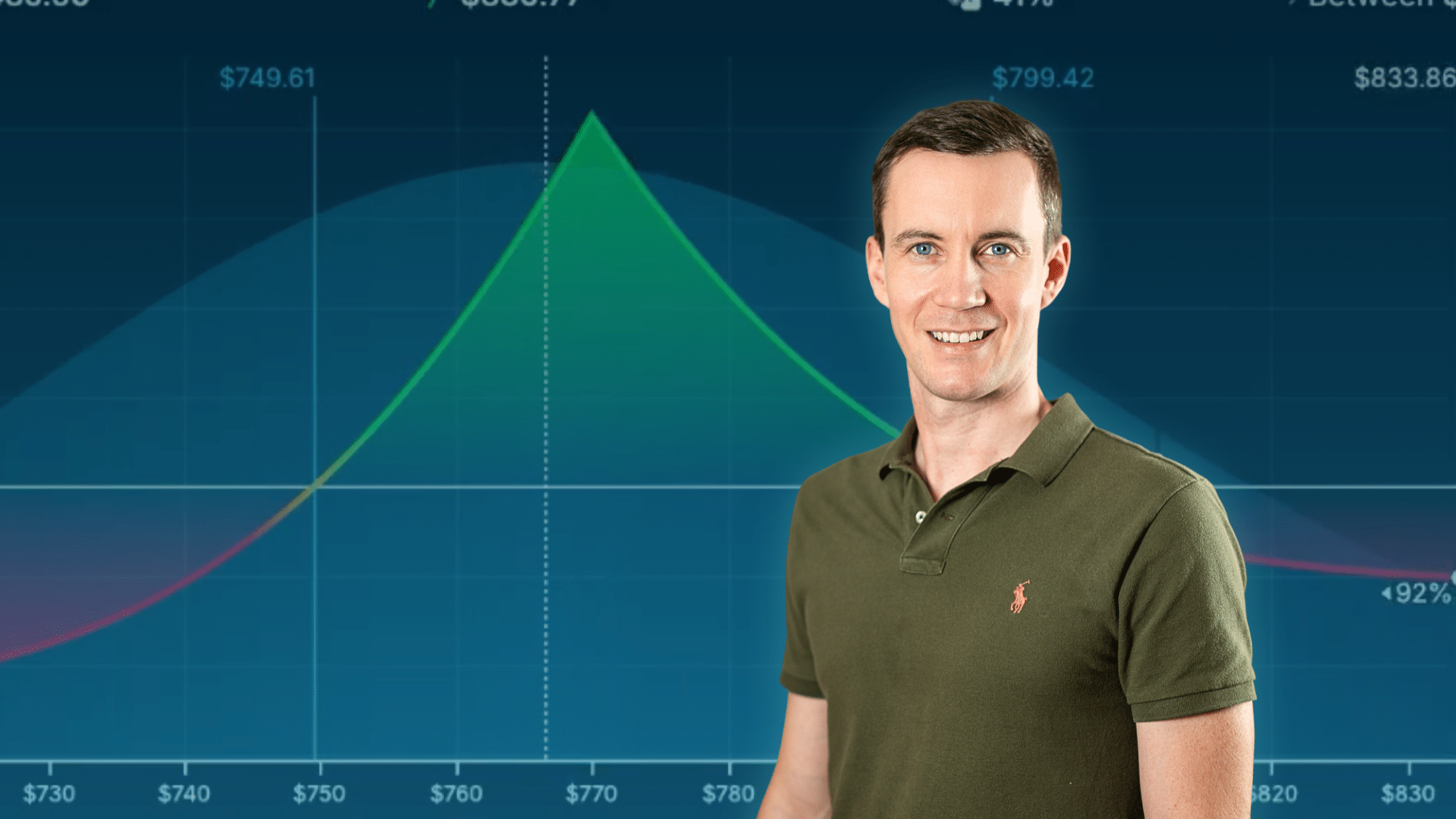


What makes this SPY call calendar strategy particularly interesting is how simple it is. Max opens a new trade every Friday, follows a few clearly defined rules, and doesn’t use a stop loss. But behind that straightforward approach are extensive backtests and a deliberate focus on managing risk.
Learn the SPY Call Calendar strategy in this video
Max Bothe
Max Bothe is a professional options trader from Germany with a background in mechanical engineering. He has traded full-time since 2019 and runs an options trading consultancy with his business partner, Alex.
A dedicated backtester, Max combines commercial tools such as Option Omega with his own research, using approximately 20 years of historical options data to develop and evaluate trading strategies.
🧰 Recommended tools for options traders
These are affiliate links. Theta Profits may earn a commission if you sign up through them. I have tried all the products myself and believe they add real value for options traders.
🎯 EDGESEEKER — Quant analysis for options traders. Edge first. Then trade. Try free for two weeks, then save €20 monthly or €220 on the annual plan.
🟣 TANUKITRADE — Gamma levels and options data, available as a web app or on TradingView. Get 10% off through this link.
📉 EARNINGS WATCHER — Research and analyze options trades around earnings releases. Save 33% on the annual plan.
🗓️ OPTION OMEGA — Backtest options strategies and automate your trades. Get 50% off your first year.
📊 MENTHORQ — AI-powered market intelligence and trading insights. Get 20% off with code MQ20.
🛠️ OPTIONSTRAT — Plan, analyze and visualize your options trades. Get 20% off your first month.
🚀 OPTION SAMURAI — Scan the market to find options opportunities that fit your trading strategy. Free 2-week trial.
How the SPY call calendar strategy works
A call calendar spread involves selling a call option and buying another call at the same strike price, but with a later expiration date.
Max trades this strategy on SPY, the exchange-traded fund tracking the S&P 500 index. He prefers SPY because its options are highly liquid, with many available expiration dates and relatively tight bid-ask spreads.
His rules are remarkably straightforward:
- Underlying: SPY
- Short leg: Sell an at-the-money call with approximately 60 days to expiration (DTE)
- Long leg: Buy a call at the same strike with approximately 90 DTE
- Entry: Every Friday, normally during the first hour of trading
- Profit target: 30% of the initial debit
- Stop loss: None
- Final exit: No later than the short call’s expiration, usually one day before in his actual trading
The trade is opened for a net debit, which defines the maximum loss while both legs remain in place and through the short call’s expiration.
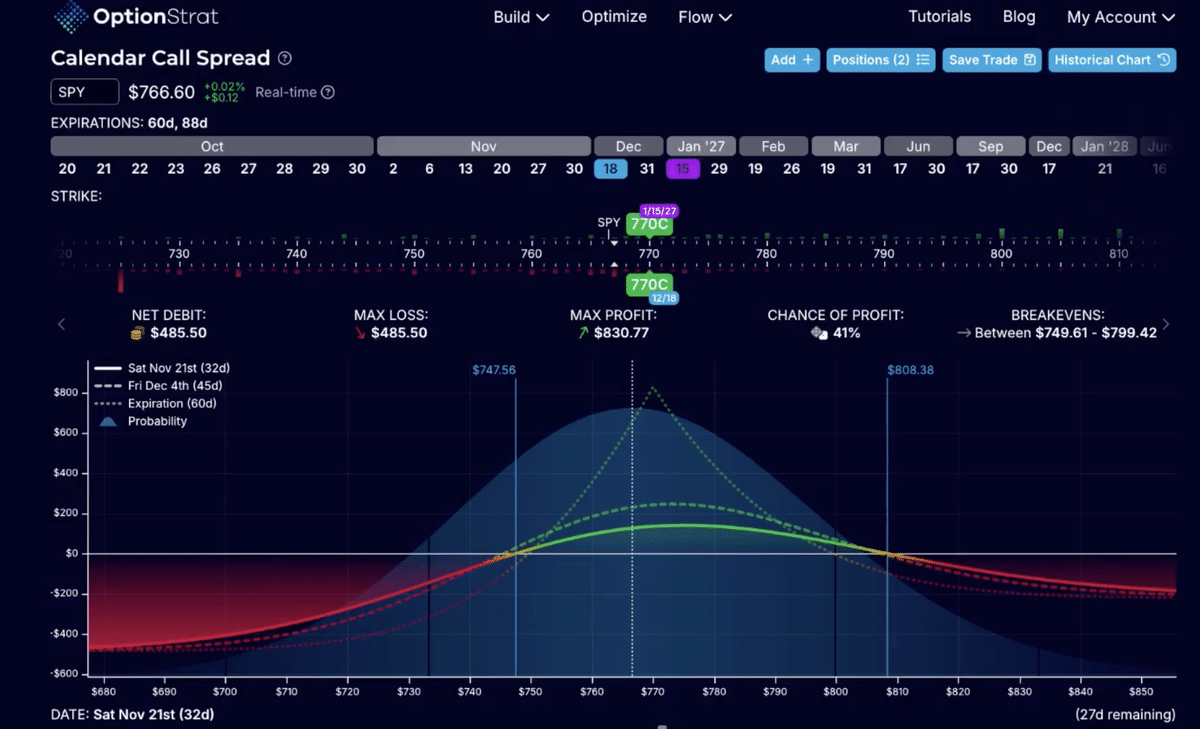
For example, Max demonstrates a call calendar costing approximately $485. That debit represents the maximum potential loss for the spread within the stated period, while the position offers opportunities to profit if SPY remains near the strike price.
How does a call calendar make money?
The SPY call calendar is designed primarily for a market that moves sideways rather than making a substantial directional move.
Two option Greeks are central to its performance.
Theta: The strategy has positive theta, meaning it can benefit from the passage of time. The shorter-dated option generally loses time value faster than the longer-dated option, working in favor of the position.
Vega: The spread also has positive vega, meaning rising implied volatility can benefit the trade. However, the relationship is complicated because implied volatility on the two expiration dates does not necessarily move together.
The highest theoretical profit occurs when SPY approaches the strike price around the short option’s expiration. But Max isn’t trying to capture that maximum.
Instead, he aims for a much more modest profit of 30% of the debit paid.
OptionStrat
…is a toolkit for options traders. OptionStrat is great for calculating and visualizing your strategies and trades
Get 20% OFF your first month with OptionStrat with this affiliate link
Why 60 and 90 DTE — and why Fridays?
Max didn’t choose his expiration dates randomly.
His backtests compared many combinations of short and long option durations. He found that longer-dated combinations, particularly around 60 and 90 DTE, performed considerably better than shorter combinations such as 21 and 42 DTE.
Importantly, neighboring combinations also performed reasonably well. Max regards that as encouraging because a strategy that works only with one precise set of parameters may be overfitted to historical data.
He also tested different entry days and found that Friday produced the strongest results.
For SPY, he deliberately avoids additional entry filters based on the VIX or other volatility indicators. The objective is to keep the process consistent and easy to execute.
Why Max doesn’t use a stop loss
Perhaps the most surprising element of Max’s call calendar strategy is his decision not to use a stop loss.
This isn’t simply about ignoring losing trades.
Max tested different stop-loss settings and found that they generally reduced the strategy’s historical performance. Even a tight stop at 25% of the debit produced negative overall results in his testing.
Instead, he accepts the possibility of losing the entire debit on an individual trade.
If the spread doesn’t reach its 30% profit target, he normally holds it until shortly before the short call expires. He then closes the entire position, rather than leaving the long call open.
This distinction matters: the debit-based maximum-loss calculation no longer applies in the same way once the short option has expired.

What do the backtests and actual results show?
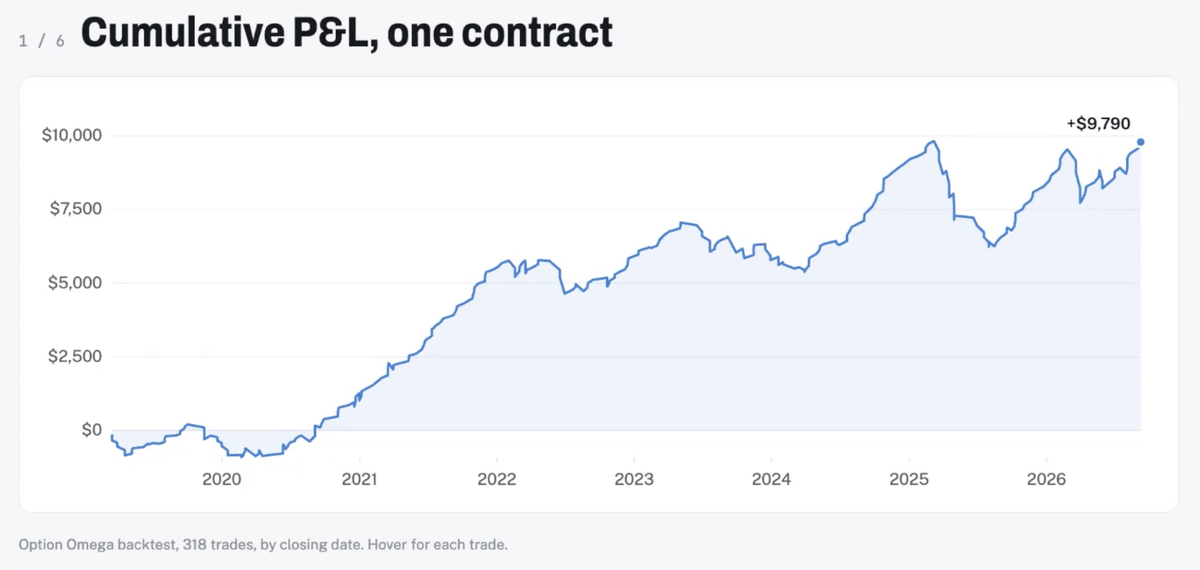
Max reports a 72% historical win rate for the strategy.
He has also traded it in his own accounts for approximately two years. According to Max, his actual results have differed by less than 5% from his backtested results.
That is encouraging, although it doesn’t mean the strategy is profitable in every market environment.
His backtests show difficult periods, particularly during the sharp market movements of 2025 and the COVID-era market disruption.
Max emphasizes that this isn’t a home-run strategy. For a hypothetical $100,000 account trading just one contract each week, he estimates an average annual contribution of approximately 2–3%, based on his historical results.
The intended advantage is a relatively modest return combined with controlled position sizing.
The biggest risk: Multiple call calendars open simultaneously
Although each spread has defined risk during its intended holding period, Max’s weekly entries mean several positions can be open at the same time.
He typically has around six call calendars running simultaneously.
If ten spreads each cost $500, the combined debit at risk becomes $5,000. A major market move could hurt multiple positions at once.
This is why Max calculates the combined maximum exposure rather than looking only at the risk of an individual trade.
There is also an assignment consideration with SPY calls, particularly around dividend payments. Max discusses cash-settled alternatives such as XSP and SPX, although he prefers SPY’s liquidity.

A simple strategy within a diversified portfolio
Max sees his SPY call calendar as one component of a larger options portfolio, not a complete trading system on its own.
His broader philosophy is to combine several small, preferably uncorrelated positions and strategies instead of relying on one approach to deliver exceptional returns.
The main takeaway is that simplicity can be a strength when supported by sound research, disciplined execution, and appropriate position sizing.
A call calendar doesn’t have to involve complicated adjustments or constant market predictions. But traders still need to understand theta, vega, expiration risk and how quickly their total exposure can accumulate.
As Max demonstrates, a simple set of trading rules can be useful — provided the risks behind those rules are understood.
