




This article and video have been produced in cooperation with EdgeSeeker, which is an affiliate partner of Theta Profits
Finding a promising options trade is one thing. Knowing whether the potential reward actually justifies the risk is something else entirely. Many traders focus on collecting attractive premiums or achieving a high probability of profit without examining whether the trade has a genuine statistical advantage.
In this Theta LAB video, we explore a systematic approach to finding an options trading edge, using live market data and a process that moves from analyzing overall market conditions to evaluating individual trading opportunities.
Learn how Kai finds his options trading edge
Kai Oberländer
Kai Oberländer is a former university professor of mathematics and financial mathematics. He is also the founder of EdgeSeeker, an options trading platform developed in Germany that uses mathematical and statistical models to help traders identify opportunities and evaluate risk.
His philosophy is simple: Replace guesswork with numbers.
EdgeSeeker
…offers quant analysis for the retail options trader. From the proprietary EdgeNerve Score through EdgeSignature premium edge detection to risk-optimized strategies in one streamlined workflow. Free 2-week trial.
€20 off per month with this affiliate link, or €220 off the annual plan.
The biggest mistake options traders make
According to Kai, one of the biggest mistakes traders make is forcing trades when no real opportunity exists.
This becomes especially tempting during periods of low volatility, when attractive premiums are hard to find.
Instead of accepting that market conditions are unfavorable, traders sometimes convince themselves that a mediocre opportunity is worth taking.
Kai’s approach starts with a different question: Does this trade actually offer an edge?
The goal isn’t to trade every day. It’s to identify situations where the potential compensation is attractive relative to the risk.
Step 1: Start with the overall market environment
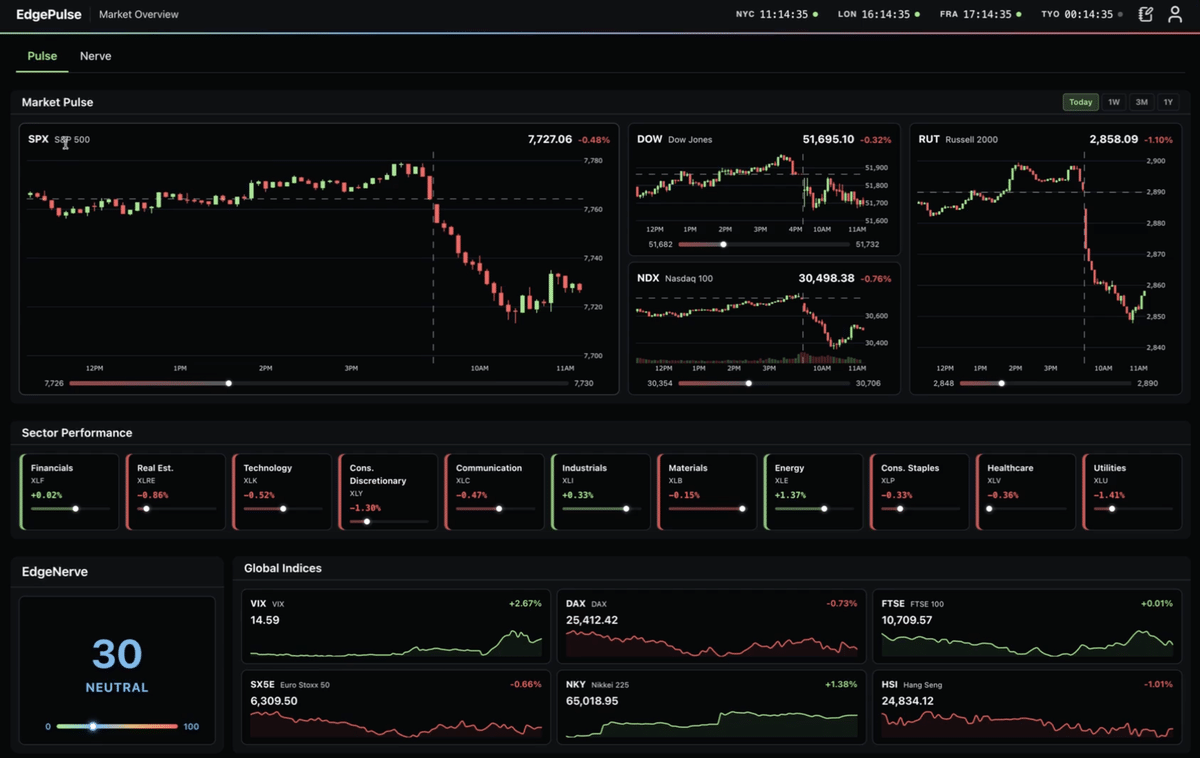
Before looking for individual trades, Kai evaluates the broader market using EdgeSeeker’s EdgePulse module.
This provides an overview of major US stock indexes, including the S&P 500, Nasdaq, Dow Jones, and Russell 2000.
He also examines EdgeNerve, a proprietary risk indicator that combines six inputs, including volatility indexes, macroeconomic indicators, and options skew.
The resulting score ranges from 0 to 100 and helps assess the current market environment.
Higher volatility can mean richer options premiums, but it may also indicate greater market risk. Understanding that environment is the starting point for evaluating potential trades.
Step 2: Find stocks where options premiums are attractive
The next step is to scan for stocks where options may be offering unusually attractive premiums.
A central concept in Kai’s methodology is the relationship between implied volatility and realized volatility.
Implied volatility reflects the volatility priced into options. Realized volatility measures how much the underlying asset actually moved over a given period.
For premium sellers, an opportunity may exist when implied volatility is sufficiently high relative to the movement risk.
Kai uses several indicators to investigate this relationship:
- IV rank and IV percentile: Show how current implied volatility compares with its historical levels.
- IV Z-score: Measures how unusual current implied volatility is relative to its history.
- Variance risk premium: Helps evaluate whether options premiums are attractive relative to the underlying volatility risk.
In the demonstration, Kai identifies IBM as a potential candidate because its volatility indicators suggest attractive premiums.
But finding a stock with rich options premiums is only the beginning.
Free three-part course: Master Volatility
If you trade options, you’re trading volatility — but do you really know when IV is actually giving you an edge? From October 21, 2026: In a free Theta TRAINING course, Reiner Hofmann from EdgeSeeker breaks down all you need to know about volatility.
Step 3: Estimate future price movements
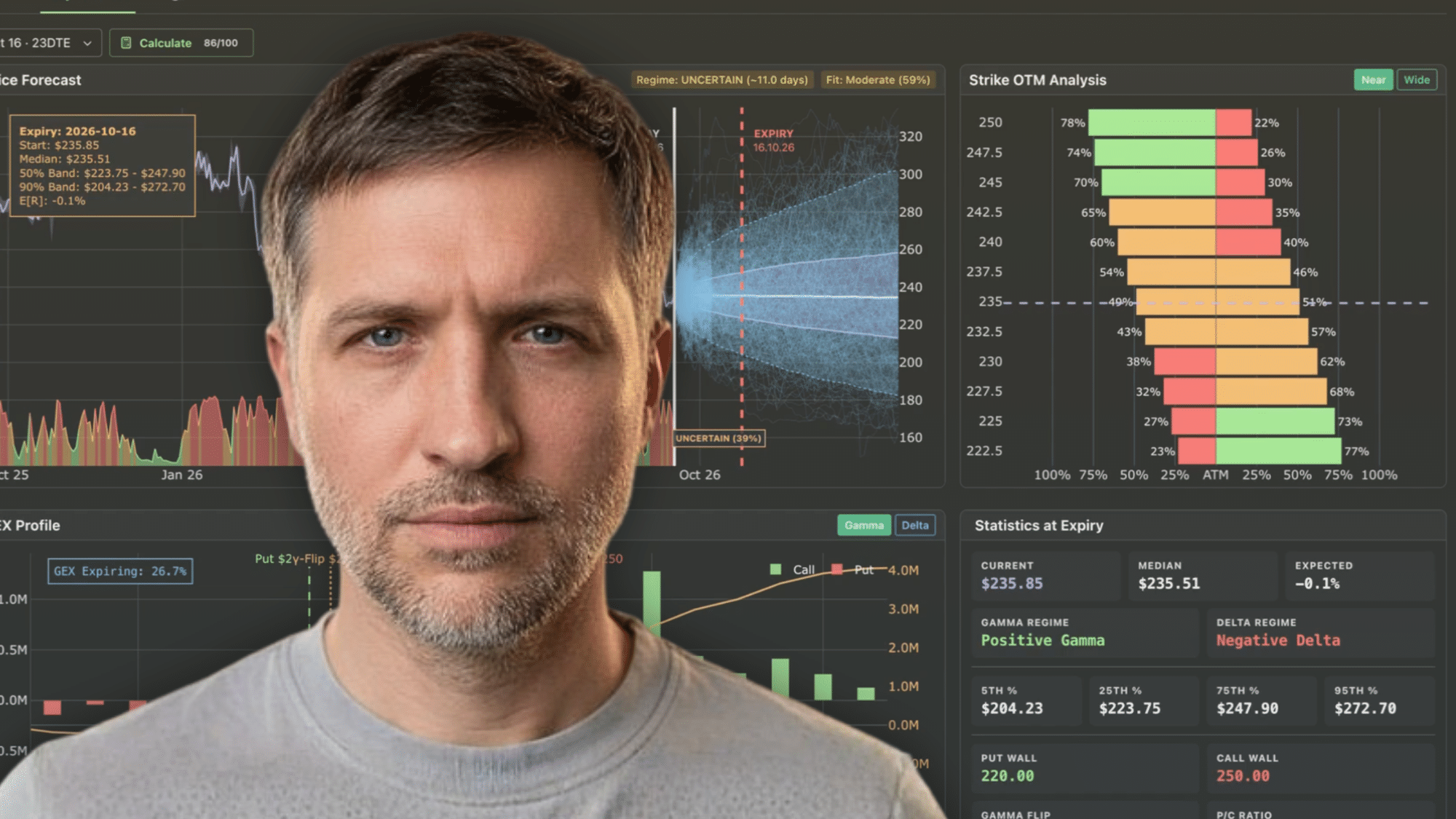
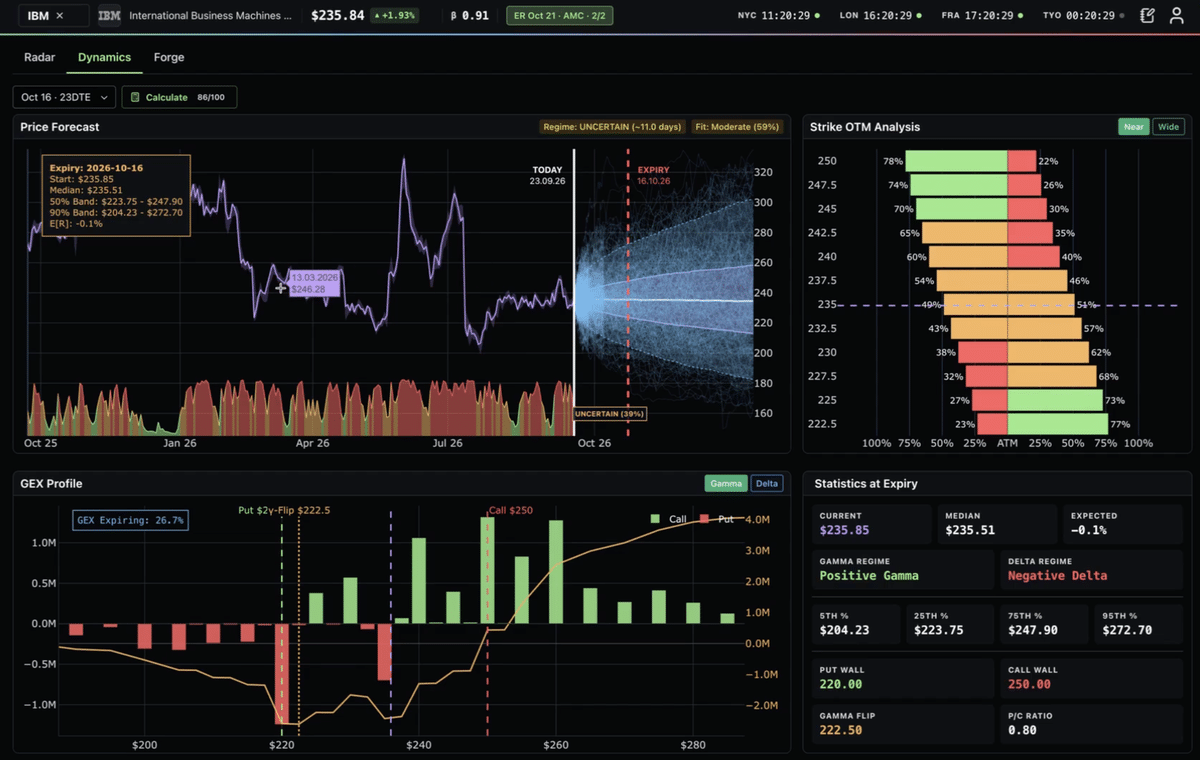
Next, Kai moves into EdgeSeeker’s Dynamics module.
Here, the software simulates one million possible future price paths based on the underlying stock’s historical behavior.
These simulations produce a probability cone illustrating potential future price movements.
Unlike a conventional expected move derived from options prices, this model uses historical price behavior to estimate a range of possible outcomes.
Kai uses these projections to evaluate possible strike prices.
His personal preference is to select short strikes with at least a 75% modeled probability of remaining out of the money.
He also examines gamma exposure, open interest, and potential areas of support or resistance.
Importantly, Kai doesn’t need to predict whether the stock will rise or fall. He concentrates on identifying a probable trading range and evaluating whether the options premiums justify the risk.
Step 4: An 85% probability of profit can still be a bad trade
This is perhaps the most revealing moment in the demonstration.
Kai evaluates a potential IBM options trade with approximately 85% probability of profit.
That sounds attractive.
But the analysis reveals something important: Despite the high probability of winning, the trade initially has negative expected value.
The reason is tail risk. A relatively small number of large losses could outweigh the profits from the many winning trades.
Kai experiments with adding a protective option to create a defined-risk spread. This improves the expected value, but the potential return and risk still don’t meet his requirements.
He ultimately rejects the trade.
The lesson is important: A high probability of profit is not the same as a positive expected value.
Finding an options trading edge requires looking beyond win probability and considering the size of potential gains and losses.
Step 5: Let the scanner identify potential opportunities
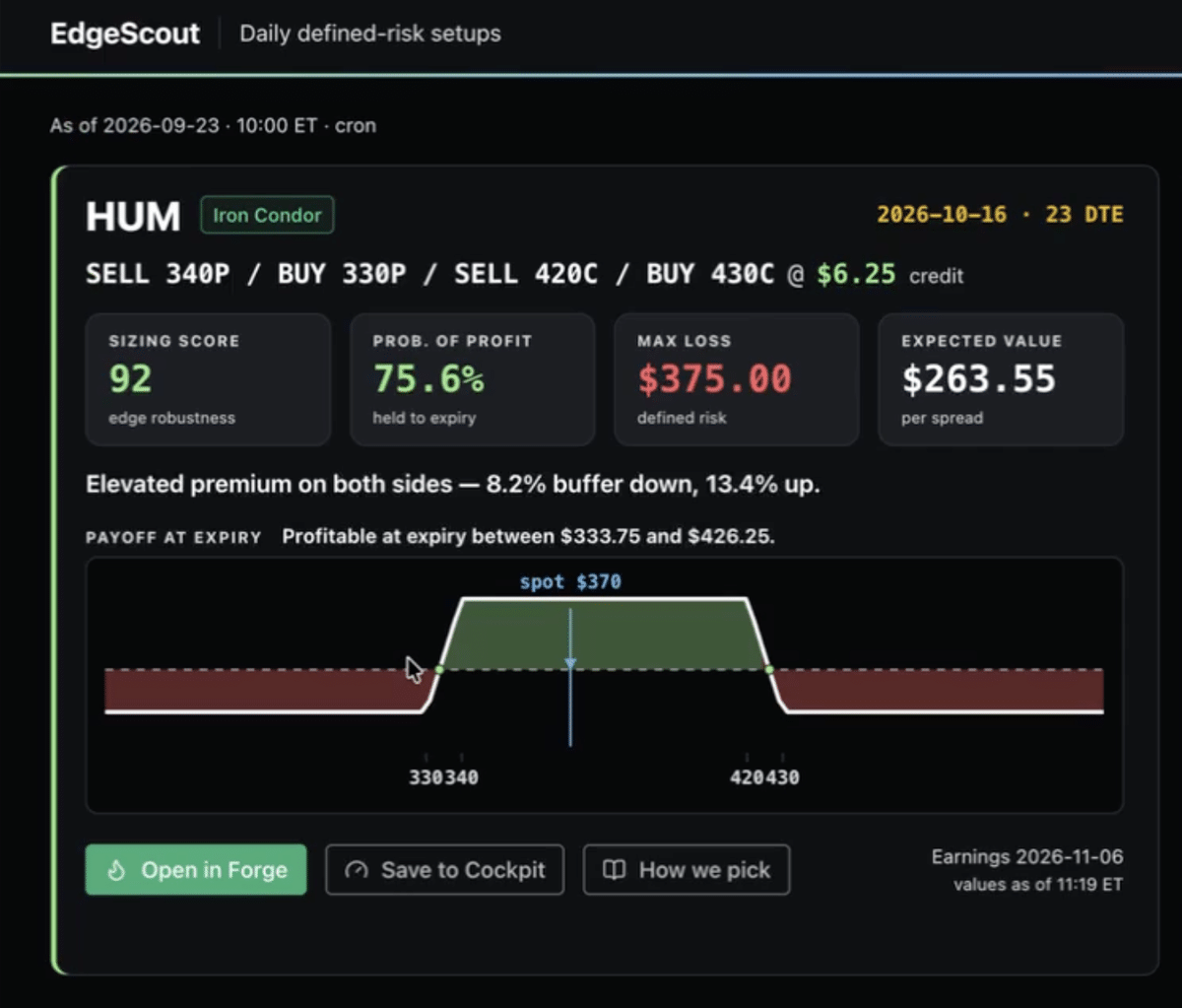
After rejecting the IBM setup, Kai demonstrates EdgeScout, an automated scanning module within EdgeSeeker.
Instead of manually repeating every analytical step, EdgeScout screens supported underlying stocks and identifies potential trading opportunities.
It evaluates candidates using the same methodology, including probability of profit, expected value, and position sizing.
One of the opportunities identified is an iron condor on Humana (HUM).
Kai examines the proposed trade and finds:
- Approximately 75% probability of profit.
- Positive expected value.
- A position-sizing score of 82.
- Attractive variance risk premium on both the call and put sides.
He considers this a trade worth entering.
The sizing score is particularly important because Kai doesn’t evaluate trades solely on whether they might be profitable. He also wants to determine how much risk is appropriate for each opportunity.
The interview demonstrates his decision-making process, not the eventual outcome of the HUM trade.
Finding your own options trading edge
Kai’s methodology is based on a principle that applies well beyond EdgeSeeker itself.
Successful trade selection isn’t simply about finding high premiums, picking the right direction, or maximizing the probability of profit.
It’s about systematically evaluating whether the potential reward adequately compensates for the risk.
That means considering volatility, expected price movements, probability of profit, expected value, and position sizing together.
As Kai demonstrates, sometimes the most important outcome of a thorough analysis is deciding not to trade.
And that may be just as valuable as finding the next promising opportunity.
