



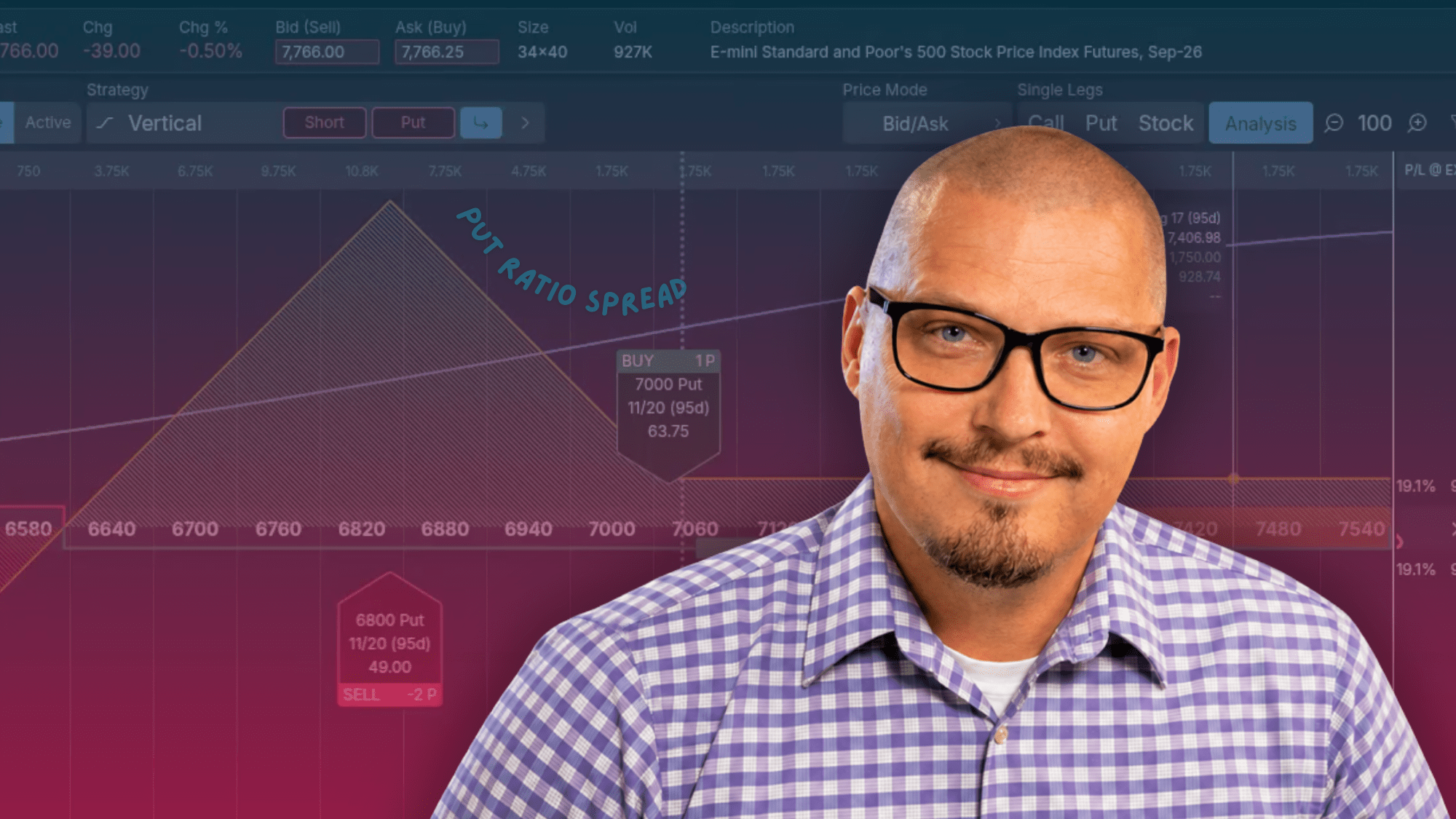


Most bullish options traders want one thing: for the market to go up. Derek Taylor’s approach is different. His put ratio spread can generate a profit if the S&P 500 rises or trades sideways, while a gradual decline can potentially move the position into a much larger profit zone.
Learn about Derek’s 90DTE Put Ratio
Derek Taylor
Derek Taylor is an experienced options trader based in Louisiana, USA. He has traded options since around 2012–2013 and says he now places roughly 2,000–3,000 trades per year.
What is a put ratio spread?
A put ratio spread combines two familiar options positions: a short put and a put debit spread.
Derek’s standard version consists of:
- Buying one put at a higher strike
- Selling two puts at the same lower strike
- Entering the complete position for a net credit
Derek primarily trades the strategy on S&P 500 futures, using /ES or the smaller /MES contract. He prefers futures because SPAN margin can make the trade much more capital-efficient than trading an undefined-risk version in SPY or SPX with standard Reg T margin.

Derek’s 90 DTE put ratio spread setup
His typical starting point is around 90 days to expiration.
Derek normally sells the two puts at approximately 10 delta.
Why 10 delta? He says backtests of a simple 90 DTE 10-delta short put on the S&P 500 have produced win rates around 95–97%. Importantly, that figure applies to the short put backtest, not to the complete put ratio spread.
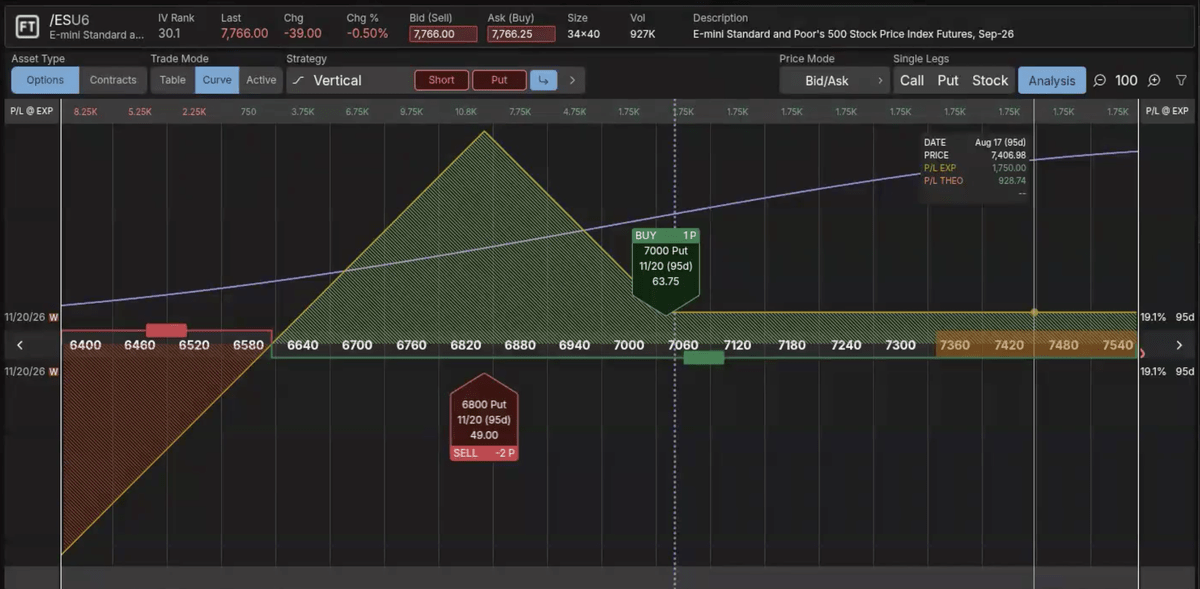
Derek then buys one higher-strike put to create the embedded debit spread. In a typical ES position, he makes this spread about 200 points wide.
The result is an unusual P&L profile.
In the example shown in the interview, the trade collects approximately $1,750 in credit. If ES stays above the long put through expiration, that credit becomes the profit. Derek calls this the “skinny profit.”
But there is another possibility.
The 200-point put debit spread adds another $10,000 of potential value. If the market gradually declines into the spread, the trade can potentially generate a much larger profit. In Derek’s example, maximum theoretical profit at the short strike at expiration is around $11,750.
Derek isn’t expecting to hit that exact maximum. But he says a gradual decline into the profit tent could potentially turn the position into a $4,000, $6,000 or $8,000 winner.
Why a slow market decline can be good
This is what makes Derek’s put ratio spread particularly interesting.
If the S&P 500 moves higher, he can make the initial credit. If it trades sideways, he can make the credit. And if it gradually moves lower toward the short strikes, the embedded debit spread can potentially generate a substantially larger profit.
Derek can also change the character of the trade by changing the width of the debit spread.
His normal 200-point spread creates what he considers a neutral-to-bullish position. If he becomes more bearish, he can widen the debit spread. That sacrifices some or all of the upside credit in exchange for a larger potential profit zone below the market.

The big danger: A fast crash
A falling market isn’t automatically good for this strategy.
In fact, Derek says the worst scenario is a large market decline immediately after entering the trade.
Early in the 90-day cycle, the debit spread has plenty of time value remaining and may provide relatively little immediate profit. Meanwhile, the naked short put can lose significant money.
A market crash would also normally cause implied volatility to surge. That can increase the unrealized loss and dramatically increase the buying power required to maintain the position.
In the /ES example in the interview, Derek demonstrates how a 1,000-point immediate decline combined with higher volatility could result in an unrealized loss of around $11,000.
That is why position sizing is critical.

How Derek manages the trade
Derek typically targets 50% of the initial credit in the current bullish environment. When he reaches that target, he closes the entire put ratio spread.
If the trade reaches 21 DTE, he also exits rather than exposing the position to increasing gamma risk.
Recently, some positions have reached 50% profit very quickly. Instead of moving to another expiration, Derek may establish another put ratio spread in the same expiration cycle, resetting the short puts to approximately 10 delta.
He also ladders his positions, typically leaving two to three weeks between entries rather than concentrating everything in a single expiration cycle.
Derek does not use an automatic stop loss. He says his backtesting suggests stop losses significantly hurt the strategy’s performance. Instead, his primary risk control is trading small.
If a position does require defending, his first choice is generally to roll the problematic short put out in time and down in strike, using the credit from extending the duration to help finance the lower strike. He may also sell calls and effectively turn the short-put component into a strangle.

40–50% return so far this year
Derek says the put ratio spreads he has traded in MES have generated approximately 40–50% return on average buying power so far in 2026.
But he is careful to put that number in perspective.
Market conditions have been exceptionally favorable. The strong S&P 500 advance and declining volatility have allowed many positions to reach his 50% profit target quickly. Derek specifically warns traders against assuming that this level of return should be expected every year.

The key lesson from Derek’s put ratio spread
Perhaps the most interesting feature of the put ratio spread is that it challenges the idea that an options trade must simply be bullish or bearish.
Derek combines a bullish short put with a bearish put debit spread. The result is a position that can potentially benefit from several different market outcomes.
But the attractive P&L curve shouldn’t obscure the risk. A slow decline and a sudden crash can produce dramatically different results.
As Derek emphasizes throughout the interview, the key is to trade small enough to survive the difficult scenario when it eventually arrives.
📚 Books recommended in this video
- Burton G. Malkiel: A Random Walk Down Wall Street
- Derek W. Taylor: The Super Wheel Options Strategy

it would be a good experiment to check the results when the trade is entered when the VIX is above 25 or above 30. less number of setup but a larger probability of profit.