



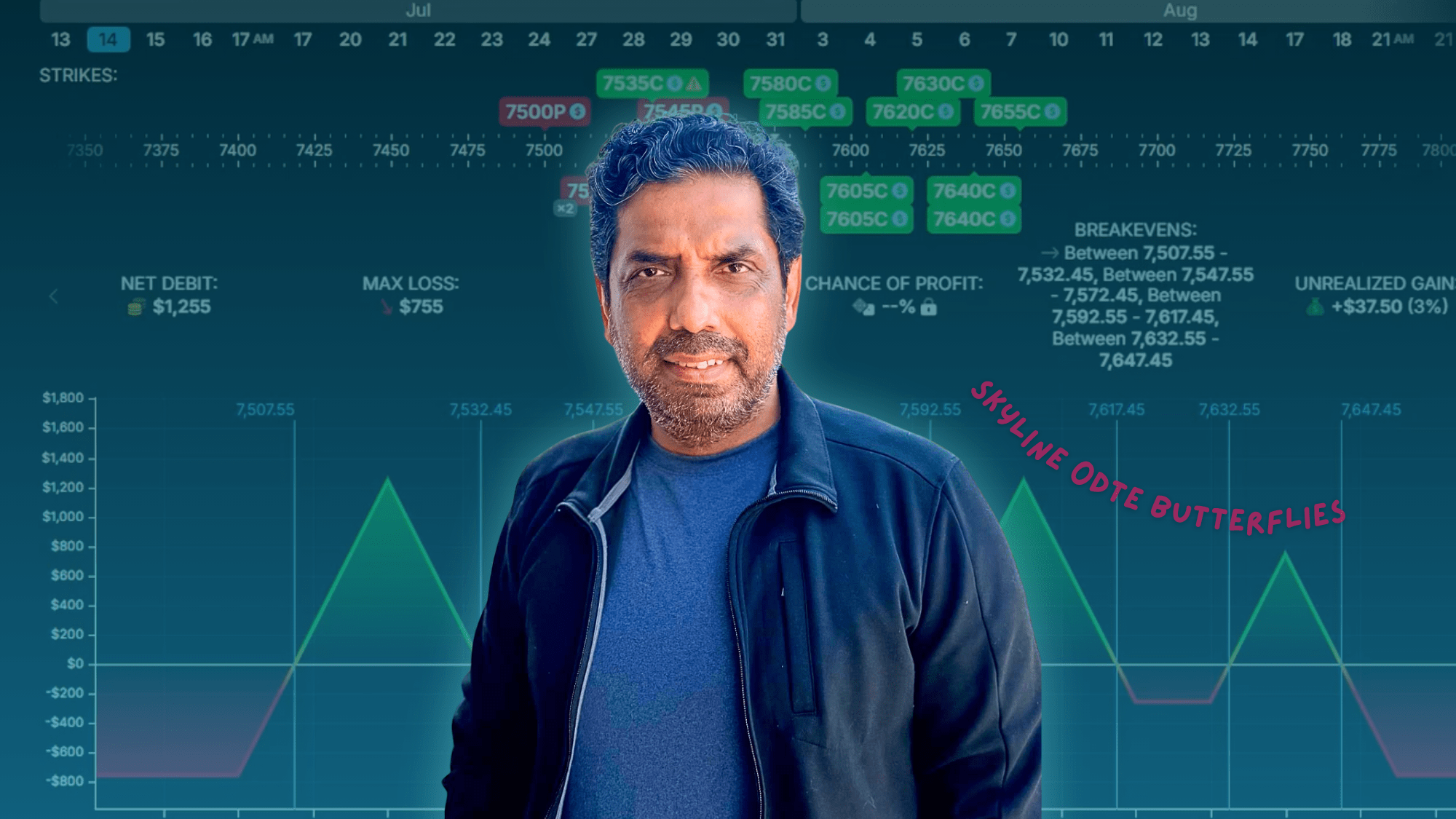


Traditional butterfly trades can work well – until the market suddenly moves. In this interview, Sorabh Khurana explains how he engineered a unique 0DTE butterfly strategy designed to better withstand today’s volatile markets.
Learn about the Skyline 0DTE butterfly strategy
Sorabh Khurana
Sorabh Khurana is an options trader and technology product leader based in Minnesota. Drawing on his engineering background, he developed the Skyline strategy after years of trading butterflies, iron condors, credit spreads, and other defined-risk options strategies. His goal was simple: build a position with a more resilient payoff profile than a traditional single butterfly.

Why the 0DTE butterfly strategy was created
According to Sorabh, the biggest weakness of many common options strategies is that their payoff profile can change dramatically when markets move unexpectedly. A butterfly, for example, can perform well for most of the day before a sharp move pushes the position into a losing area.
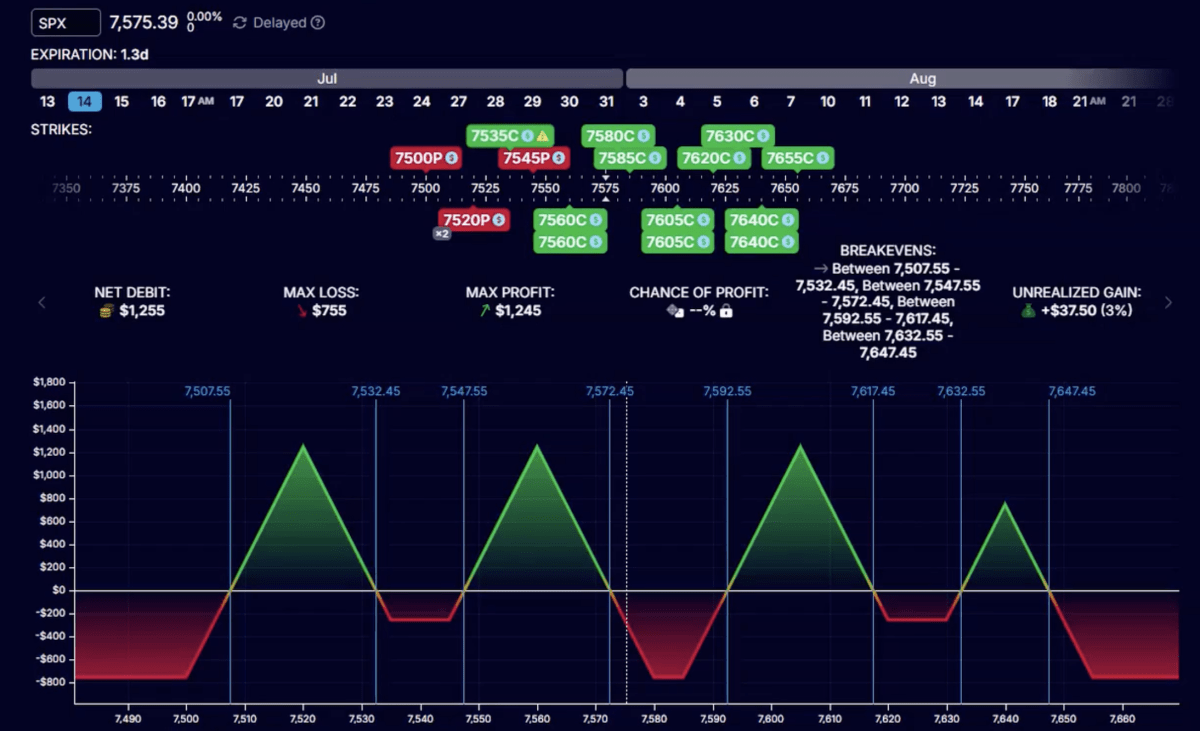
Rather than accepting those limitations, he approached the problem from an engineering perspective. Instead of asking which named strategy to trade, he focused on designing the risk profile and payoff profile he wanted first. The result became the Skyline strategy – a structure built from four overlapping butterflies that together create a much wider profit zone than a traditional butterfly while keeping capital at risk under control.
OptionStrat
…is a toolkit for options traders. OptionStrat is great for calculating and visualizing your strategies and trades
Get 20% OFF your first month with OptionStrat with this affiliate link
The four butterflies that make up the Skyline strategy
The Skyline strategy consists of four overlapping butterflies centered around the current SPX price.
Butterfly 1
- One long call At the Money (ATM)
- Two short calls 25 points above ATM
- One long call 50 points above ATM
Butterfly 2
- One long call 40 points above ATM
- Two short calls 60 points above ATM
- One long call 75 points above ATM
The second butterfly is another 25-point-wide call butterfly positioned further above the market. It overlaps the first butterfly by 10 points and includes a five-point “floor” on the upper wing. This floor acts as insurance by reducing the maximum loss if the market moves beyond the structure.
Butterfly 3
On the downside, the third butterfly is a 25-point-wide butterfly positioned just below the market. It overlaps the first butterfly by five points and mirrors the upper structure. Sorabh notes that this can be constructed as either a call butterfly or a put butterfly because the structure is balanced.
- One long call 5 points above ATM
- Two short calls 20 points below ATM
- One long call 45 points below ATM
Butterfly 4
The fourth butterfly is another 25-point-wide put butterfly placed further below the market. It overlaps the third butterfly by 10 points and also incorporates a five-point floor to reduce capital at risk if the market moves well beyond the profit range.
- One long put 35 points below ATM
- Two short puts 60 points below ATM
- One long put 80 points below ATM
Together, these four butterflies create the skyline-shaped payoff profile that gives the strategy its name. Rather than relying on one narrow profit tent, the combined position creates several profit peaks while keeping losses limited through the overlapping design and protective floors.
- Other videos about 0DTE butterfly strategies:
- Five ways to trade 0DTE butterflies
- Doc Severson: 0DTE Iron Fly
- Dale Perryman: Multiple 0DTE Iron Flies throughout the day
- Jamaal Ghauri: The Trojan Horse Butterfly
- Maria & Rob Helmick: The Maria Shoe Trade
Capital at risk is the key metric
One concept Sorabh repeatedly emphasizes is Capital at Risk (CAR).
Instead of evaluating strategies simply by maximum profit, he designs every position around how much capital is truly exposed if the trade finishes outside its intended payoff area.
Although the Skyline strategy combines four butterflies, his objective is to keep the total capital at risk similar to that of only one or two traditional butterflies while significantly expanding the overall profit zone.

Entry rules and automation
One of the more surprising aspects of the strategy is how simple the entry rules are.
The backtest opens the position shortly after the market opens – around 9:45 AM Eastern Time – provided the overnight market decline has not exceeded approximately 25 SPX points. There is no equivalent filter for overnight rallies.
Sorabh believes the strategy is particularly well suited to automation. Once the butterfly template has been defined, software can automatically construct the four butterflies each day, eliminating the need to enter each leg manually.
He currently trades some positions manually but is steadily moving toward full automation.

Backtested performance
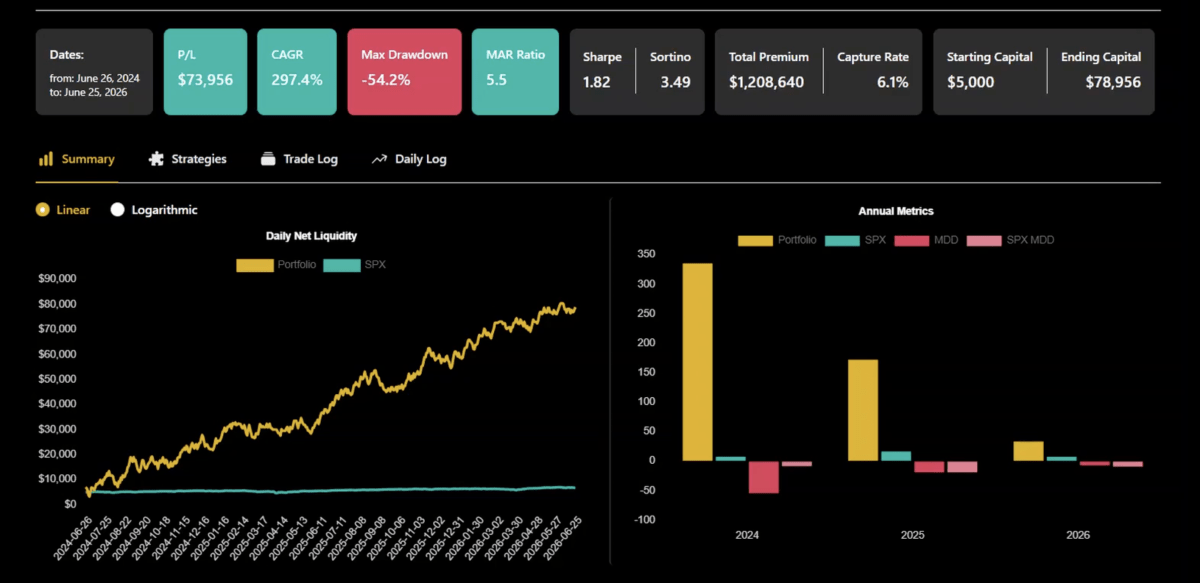
Using Option Omega, Sorabh backtested the strategy over approximately two years.
Starting with $5,000 and trading two contracts, the test produced an ending capital of nearly $74,000, corresponding to roughly 300% CAGR. He notes that the drawdown can be reduced by lowering the number of contracts traded.
One feature he particularly likes is that the backtest simply holds every position until expiration. There are no routine stop losses, adjustments or early exits built into the tested rules.
Option Omega
…is a platform for backtesting, automation and trade modelling. With Option Omega you can backtest your options strategy with data going back to 2013. Once you have identified your strategy, it can easily be automated. Option Omega also has a powerful tool to model your trades.
Get 50% OFF your first year with Option Omega with this affiliate link
Managing the position
Although the backtest assumes no management, Sorabh sometimes adjusts live positions.
If the market drifts toward the center “valley” of the payoff profile, he may add a call condor to lift that valley and reduce potential losses.
If the market moves sharply beyond one side of the Skyline, he may add another butterfly on that side to extend the profitable range.
These adjustments increase capital committed and typically reduce maximum profit, so he views them as discretionary tools rather than part of the core strategy.

📚 Book recommended in this video
- Lawrence G. McMillan: Options as a Strategic Investment

Can we get the link to the backtest used in the video? (I have an Option Omega subscription and would like to run it myself). Peer review. 🙂
How about adding a couple 5-wide condors (shorts on either side of ATM) in the middle of the structure? This will reduce max loss to almost zero if SPX closes anywhere inside the core skyline structure. I’ll post a ToS risk graph if you tell me where to put it.
Hi, can you [lease add context to the: “adding a couple 5-wide condors (shorts on either side of ATM) in the middle of the structure” and how its done ?
thank you.
Very interesting indeed, also in comparison to the FlyAgonal “theta bomb” . I would like to run the backtest myself as well, or learn more about it since I can only have 8 legs in the backtester … 🙂 tack!
*EDIT* he probably used a portfolio backtest of the combination of 2 x 2 butterfly’s – which in turn would make overall profit taking optimization more difficult…
I ran 2 strategy backtests (Option Omega does not allow so many legs in 1 backtest) and they showed rather poor results. Nothing compared to what this person is talking in the video. Combining them in portfolio is still poor. This person does not show his strategy backtest page of optionomega but just shows the portfolio page, so can not verify. Bottomline – results are very poor as per what he described in this interview. He should show his Option Omega backtest configuration page!
This is is Option Omega backtest: https://optionomega.com/share-portfolio/jULTU2Q9ZcPjKbrSzEUh It is a portfolio page, but if you click on strategies, you will get his detailed backtest setup. He explains his backtest further on this link: https://www.theoptionsengineer.com/research/skyline-0dte-v1-backtest
The Analyze tab of ThinkOrSwim allows one to stage a trade and then execute it in stages. This tab provides you a visual of the overall profit curve.
I was able to reproduce the result between 2024 and 2026, but applying the same strategy to 2022-2024, the result was very bad. Does this mean it’s optimized specifically for 2024-2026 or am I missing something?
I suggest opening the 4 positions at 10:30 AM, following the strategy of other 0DTE iron fly traders. By this time, early morning market volatility has usually settled. Additionally, we should close the positions early rather than waiting for expiration. This ‘skyline’ strategy works best in range-bound conditions, where the SPX closes near our entry price, maximizing profitability.
Overall, I consider this strategy to be very risky. If the market price closes outside the range of the four tents at the end of the trading day, a loss is guaranteed. On the other hand, the price staying within the entire range doesn’t guarantee success. To succeed, you’d more or less have to hit the peak of one of the four tents. And if you don’t hit them, things don’t look promising either. The reported returns in the 1,000% range are likely to be illusory. Adding additional butterflies at the upper or lower end of the range significantly increases the cost of the operation. Furthermore, this only makes sense up to a certain time point.