




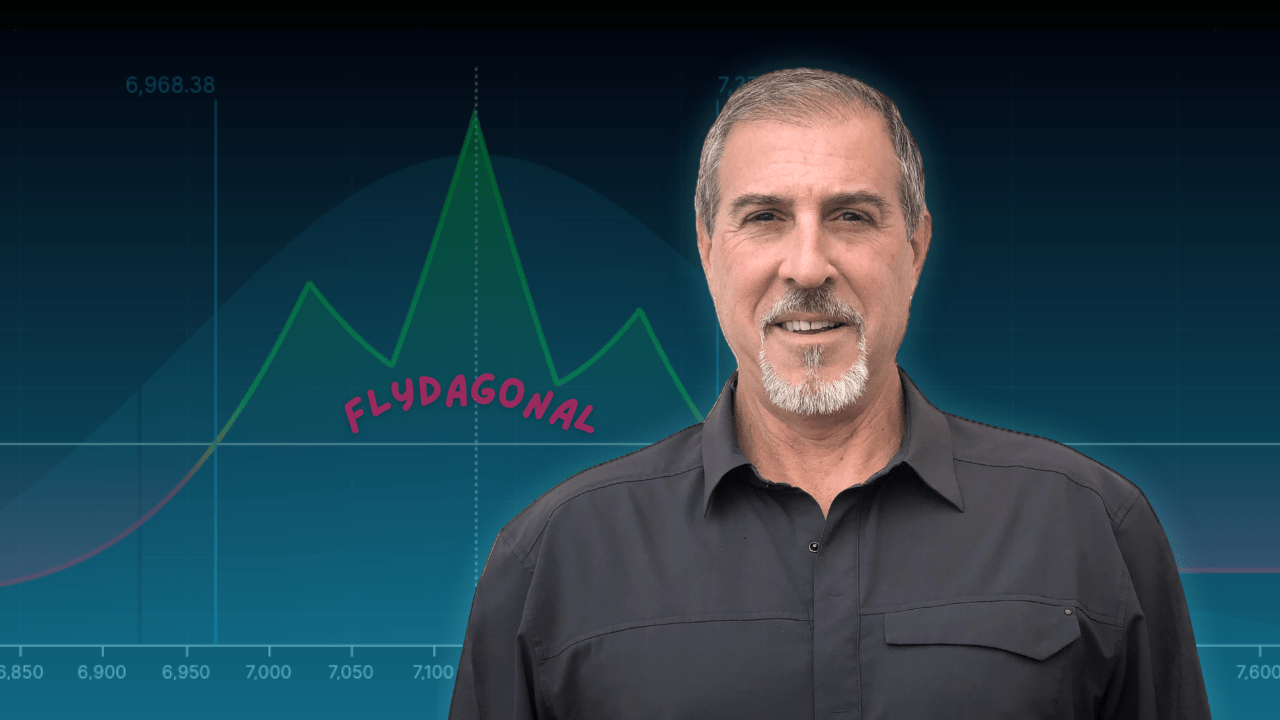


The Flydagonal is a new options strategy designed to accelerate theta decay by combining multiple structures into one trade. In this interview, Steve Ganz walks through how the strategy is built, how he trades it, and why it has attracted attention among income-focused options traders. The Flydagonal is a continuation of Steve’s Flyagonal strategy, which he presented in a previous interview on Theta Profits.
Learn all about Flydagonal in this video
Steve Ganz
Steve Ganz is an experienced options trader and educator with over 30 years of market experience. He has taught options trading to hundreds of students and worked with platforms such as Options Alpha, OptionStrat, and Option Traders Assistant.
In addition to trading his own capital, he has been actively involved in developing tools and educational content to help retail traders better understand complex strategies. Ganz is particularly focused on income-generating approaches using defined-risk setups, and he is known for combining practical trading experience with a structured, data-driven approach to strategy development.

The Flydagonal options strategy
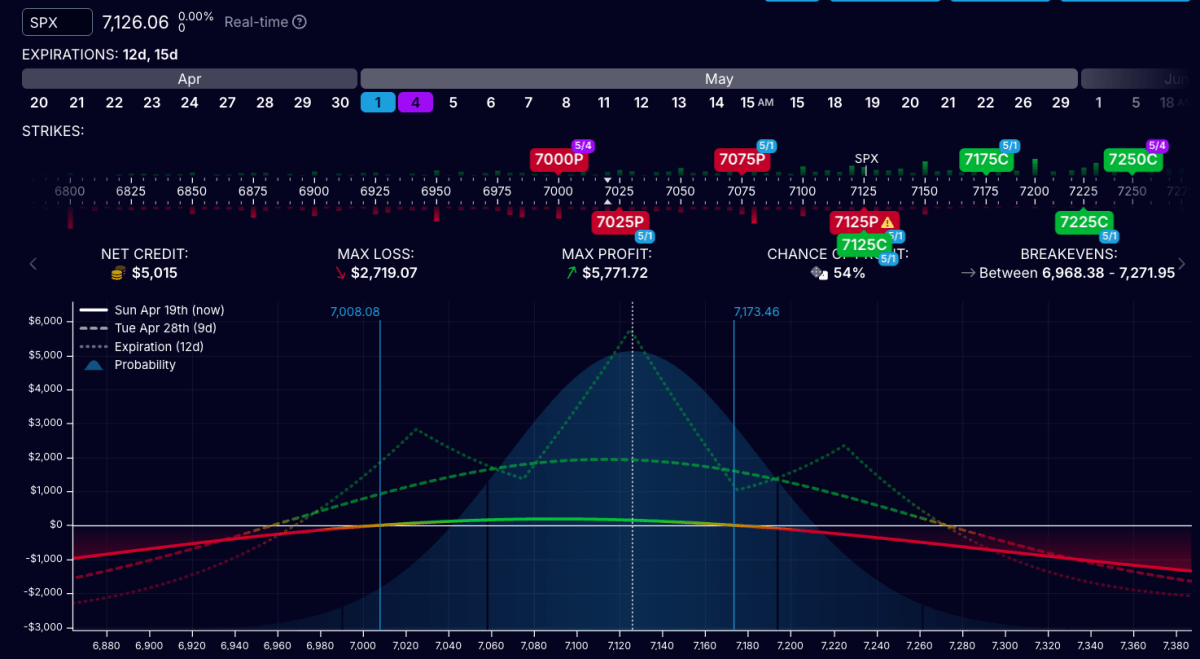
The Flydagonal is an advanced 8-leg options strategy that combines three structures:
- An iron butterfly centered at the current market price
- A call diagonal spread above the market
- A put diagonal spread below the market
These three components are layered on top of each other to create a wide profit zone—often referred to as a “tent.”
The goal is simple:
Create multiple sources of theta decay that all work simultaneously.
Ganz refers to this as a “theta bomb”, where time decay is significantly stronger than in a single-structure trade.
How the Flydagonal generates income
The core idea behind the Flydagonal is to accelerate time decay while keeping risk defined.
Instead of relying on just one structure, the strategy overlaps three:
- The iron butterfly provides a strong premium collection at the center
- The diagonals extend the range and add flexibility
- Together, they create a wider area where the trade can profit
This allows traders to:
- Target short holding periods (often a few days)
- Capture 5–10% returns per trade
- Exit quickly once profit targets are reached
According to Steve, the strategy is designed to decay faster than traditional setups like standalone butterflies.

Entry, duration, and profit targets
The Flydagonal is typically entered with:
- Short-term expirations (often around 7–14 days). Steve always sets the iron butterfly and the shorts in the diagonals to expire on a Friday, and the longs in the diagonals on the following Monday.
- A structure centered near the current market price
- A roughly delta-neutral setup
Profit-taking is a key part of the approach:
- On the day the trade was enternd and the following day: Target around 5–7%
- After that: aim for 10–15%
- Trades are often closed within 1–5 days. Steve’s average after 50 trades is four days.
The focus is on consistency and repetition rather than holding trades for maximum profit.
Previous videos with Steve Ganz
- Steve Ganz: The Flyagonal strategy
- Steve Ganz: Butterfly options trades explained
Why combine butterflies and diagonals?
Traditionally, traders choose strategies based on volatility:
- Butterflies perform better in higher volatility
- Calendars and diagonals perform better in lower volatility
Ganz’s idea was to combine both approaches into one structure.
By doing this, the Flydagonal becomes:
- Less dependent on volatility direction
- More flexible across different market environments
- Easier to deploy without waiting for “perfect” conditions
This makes the strategy more agnostic to volatility, which is a key advantage for active traders.

Risk and adjustments
The Flydagonal is a defined risk strategy, meaning the maximum loss is known upfront.
However, it is not a “set and forget” trade.
Ganz emphasizes that:
- Adjustments are a critical part of managing risk
- Most trades do not require adjustments, but traders must be prepared
- Different techniques are used depending on market movement
For example:
- On downside moves, traders may add new structures or shift positions
- On upside moves: adjustments are possible but often more challenging due to lower volatility
One key insight is that downside moves are often easier to handle than sharp upside rallies.
When the strategy struggles
No strategy works in all conditions, and the Flydagonal is no exception.
According to Ganz, the most difficult scenario is a whipsaw market:
- A sharp move down followed by a rapid move up
- Adjustments made in one direction can be undone quickly
- This can lead to compounded losses
While rare, these conditions highlight the importance of:
- Understanding worst-case scenarios
- Managing position size
- Being disciplined with adjustments

Risk profile
Despite its complexity, Steve considers the Flydagonal a lower-to-moderate risk strategy due to its defined risk nature.
Steve places it roughly around:
- 3 to 4 on a 1–10 risk scale
This reflects:
- Defined maximum loss
- High historical win rate (with transparency about occasional losses)
- Short time in trades
Key takeaways
The Flydagonal stands out because it combines multiple proven options strategies into one cohesive structure.
Key advantages include:
- Wide profit range (“wide tent”)
- Accelerated theta decay (“theta bomb”)
- Short trade duration
- Flexibility across market conditions
At the same time, it requires:
- Solid understanding of options
- Ability to manage and adjust trades
- Discipline in taking profits
And the strategy is not without risks. For intermediate options traders focused on income, the Flydagonal offers an interesting approach to capturing fast, repeatable returns, with clearly defined risk.

Flydagonal strategy FAQ
The Flydagonal is an advanced 8-leg options strategy that combines an iron butterfly with call and put diagonal spreads. The goal is to create overlapping positions that accelerate theta decay, allowing traders to generate income over a short period of time.
Steve Ganz in Options Income Academy developed the strategy.
The Flydagonal makes money primarily through time decay (theta). By stacking multiple options structures, the trade benefits from faster decay compared to a single strategy.
Traders typically:
– Enter the trade near the current market price
– Let time decay work over a few days
– Close the position once profit targets are reached
According to strategy creator Steve Ganz, the strategy usually targets:
– 5–7% within the first 1–2 days
– 10–15% if held slightly longer
These are targets, not guarantees, and results depend on market conditions.
The trades are set up with the shorts 8 – 14 days ahead, expiring on a Friday, and with the longs in the diagonals expiring the following Monday.
Most Flydagonal trades are short-term and typically last a few days.
The strategy is designed for quick exits once profits are achieved, rather than long holding periods.
The Flydagonal is designed to work in a variety of market conditions because it combines different structures.
It performs best when:
The market stays within a range
There are no extreme directional moves
It is relatively volatility-agnostic, meaning traders do not need to perfectly time volatility levels.
The main risks include:
Sharp directional moves, especially to the upside
Whipsaw markets (fast move down followed by a sharp move up)
Complexity in managing and adjusting multiple legs
Even though the strategy has defined risk, poor adjustments can still lead to losses.
Not always, but adjustments are an important part of the strategy.
According to strategy creator Steve Ganz:
– Many trades require no adjustment
– When needed, adjustments help manage risk and recover positions
Understanding adjustments is key to long-term success with this strategy.
The strategy is typically used on highly liquid underlyings, such as:
Index options (like SPX)
ETFs (like SPY, QQQ, IWM)
Large-cap stocks with strong liquidity
Liquidity is important due to the number of legs involved.
