







SPX options scalping is very different from the premium-selling strategies many options traders use. Instead of holding positions for days or weeks, this approach focuses on quick intraday moves that can sometimes last only seconds. In this interview, trader Eddy Li walks through the structure behind his scalping strategy and explains how he identifies high-probability setups in the SPX.
Learn how to scalp SPX options in this video
Eddy Li
Eddy Li is an active options trader from Canada who specializes in SPX options scalping. His approach combines technical analysis with fast intraday execution, using tools like VWAP, Fibonacci levels, and exponential moving averages (EMAs) to identify high-probability trading setups.
After starting as a value investor at a young age, Eddy eventually shifted toward technical analysis and options trading. Over time, he developed a structured approach to scalping SPX options, refining his strategy through extensive backtesting and live trading.
What is SPX options scalping?
Scalping SPX is a short-term trading approach focused on capturing small, quick price movements in the S&P 500 index (SPX).
Unlike swing traders who hold positions for days or weeks, scalpers typically stay in a trade for only seconds or minutes. The goal is to repeatedly extract small profits from short bursts of momentum.
Eddy explains that most of his trades last only a few minutes, and sometimes even seconds. Rather than trying to catch a huge move, he focuses on capturing small gains many times throughout the trading session.
This approach works particularly well with SPX options, because options can respond quickly to even small movements in the underlying index.
- Watch other interviews about 0DTE trading:
- John Einar Sandvand: 0DTE Breakeven Iron Condor
- Doc Severson: 0DTE Iron Fly
- Boomer Dan: 0DTE Levitation Trades
- Tammy Chambless: Multiple Entries Iron Condors (MEIC)
The three setups used for scalping SPX
Eddy’s strategy revolves around three core trading setups. Each is based on identifying key price levels and observing how the price reacts around them.
Trend continuation setups
The most common setup involves trading in the direction of a strong trend.
When the market is trending, the price often pulls back briefly before continuing higher or lower. These pullbacks provide opportunities to enter trades at favorable prices.
Eddy frequently uses Fibonacci retracement levels to measure these pullbacks. When the price retraces to levels such as 0.5 or 0.618 and then begins to move again, it can signal that the trend is continuing.
This is often the easiest and most forgiving setup because even if the entry is slightly early, the trend can still move in the trader’s favor.
Range trading setups
Markets do not trend all the time. Often, they move sideways between support and resistance levels.
During these periods, Eddy looks for opportunities to trade within the range. If price repeatedly bounces between two levels, a trader can buy near support and sell near resistance.
Range setups require careful observation of how the price behaves at key levels. Once those levels break, the strategy shifts toward a different type of trade.
Reversal setups
The third setup focuses on market reversals.
When the price reaches a significant level with heavy trading activity, momentum can sometimes shift. If a trend begins to break down and forms a lower high or higher low, it may signal that the direction is changing.
At that point, Eddy looks for confirmation signals before entering a trade in the opposite direction.

Key tools used when scalping SPX
Although the strategy moves quickly, it is still based on structured technical analysis.
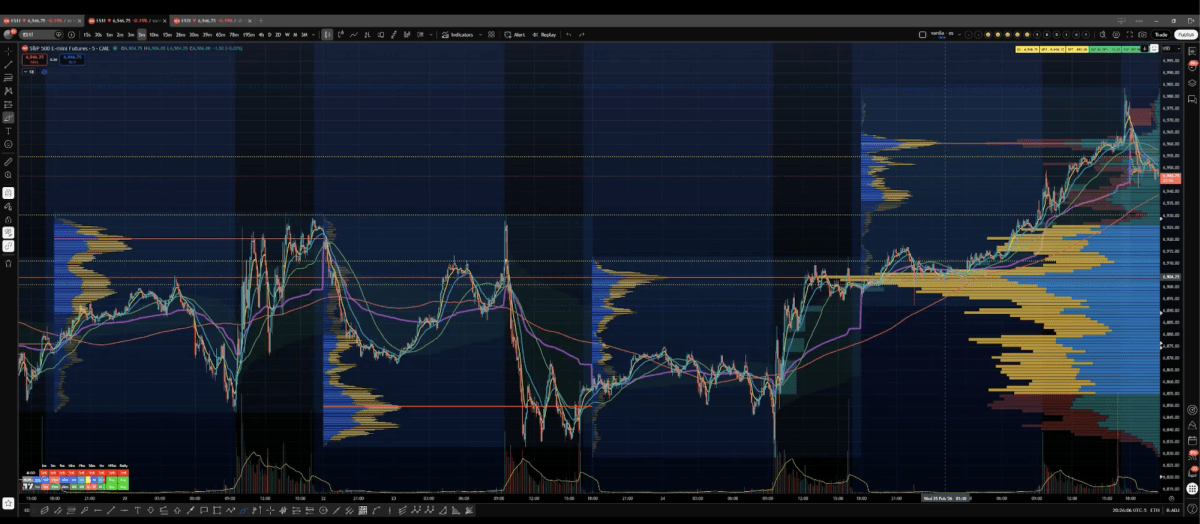
VWAP
One of the most important indicators in SPX options scalping is VWAP (Volume Weighted Average Price).
VWAP represents the average price of a security throughout the day, weighted by volume. Institutional traders often use it as a benchmark for execution.
Because of this, the price frequently gravitates back toward VWAP during the trading day. Scalpers use it as a reference point for identifying potential support, resistance, and intraday bias.
Exponential Moving Averages (EMA)
Eddy primarily focuses on the 8-period and 21-period exponential moving averages.
These moving averages help identify trends and possible reversals. When price pulls back to these levels and bounces, it can signal a continuation of the trend.
When the price breaks below both EMAs and forms a lower high, it may indicate a potential reversal.
Fibonacci levels
Fibonacci retracement and extension levels help estimate where pullbacks may stop and where the next price expansion could occur.
In wavy market structures, these levels often provide useful reference points for identifying entries and profit targets.
Risk management when scalping SPX
Fast trading requires strict risk management.
Eddy emphasizes that discipline and clear rules are essential for success. Each trade has a predefined risk, and he exits quickly if the price moves against him.
Instead of risking large portions of his account, he typically uses only a small percentage of capital on each trade. If a trade fails, the loss is limited.
This approach allows him to focus on consistency rather than large single wins.

Why experience and discipline matter
Scalping SPX options is not an easy strategy for beginners.
Because trades happen quickly, it requires intense focus and the ability to react instantly to price movements. Traders must understand both options mechanics and technical analysis.
Eddy often recommends practicing the strategy in paper trading first. Developing the necessary pattern recognition and discipline takes time and repetition.
For traders willing to put in the work, however, SPX options scalping can be an efficient way to participate in intraday market movements.
Trading results from SPX options scalping
Eddy Li reports strong results from his SPX options scalping strategy, although he emphasizes that they come from executing a large number of small trades rather than a few big winners.
In one test period, he traded a $10,000 account over roughly one month and executed about 500 trades, achieving a 77.9% win rate and generating roughly $19,000 in profit, which corresponds to about 300% growth during that test period. His average gains per trade were typically modest—often around $0.50 to $2 per option contract—but the high frequency of trades allowed the profits to compound throughout the day.
Over a longer period since he began actively trading options around 2018, Eddy estimates that his combined results across day trading, swing trading, and longer-term positions have exceeded 2,000% total returns, though he notes that these results include different strategies and market conditions over several years.
Books recommended in this video
- John F. Carter: Mastering the Trade
- Mark Minervini: Think & Trade Like a Champion
- Anna Coulling: A Complete Guide to Volume Price Analysis

[…] Eddy Li: Scalping SPX options […]