



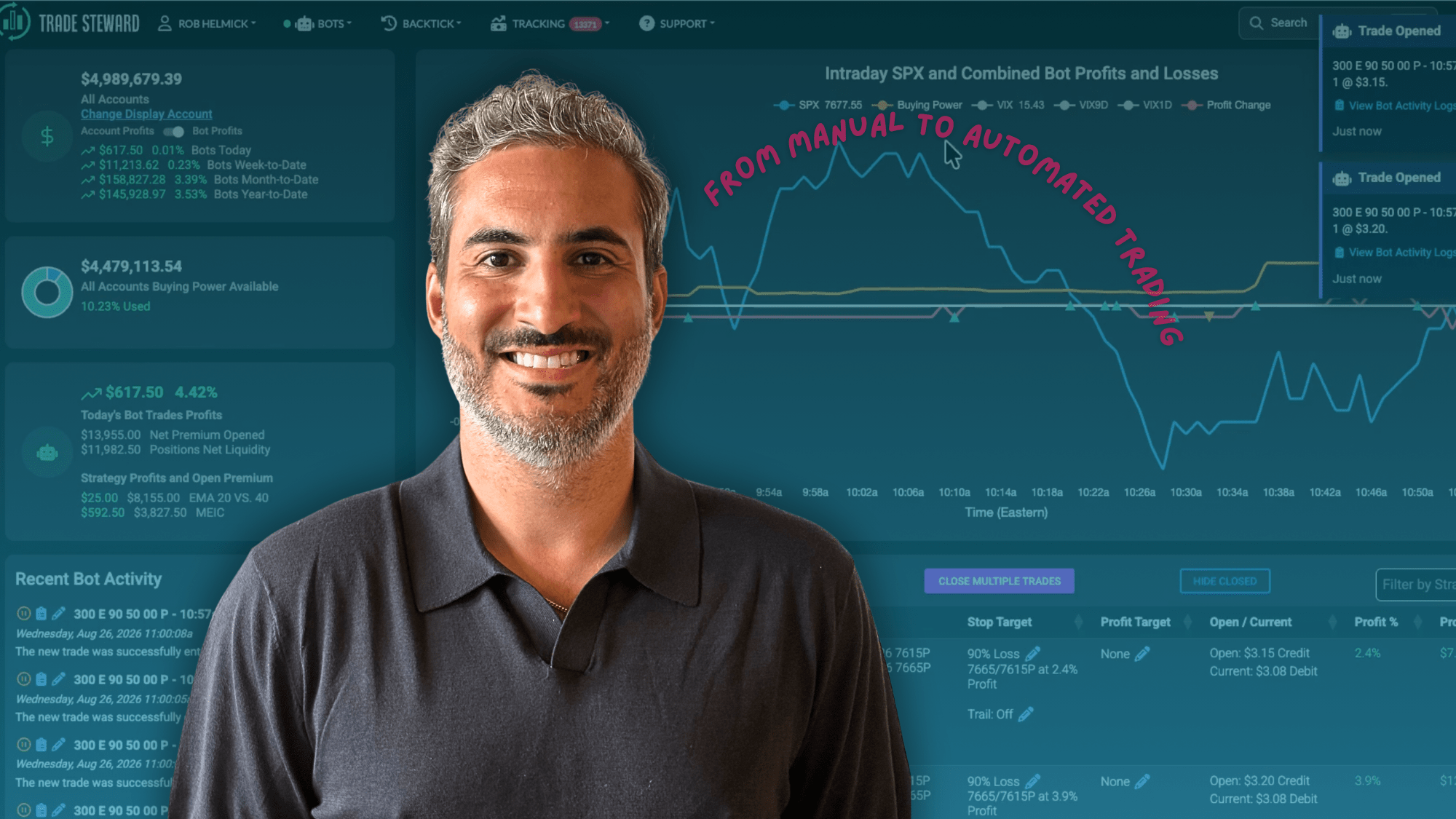


After more than a decade of trading options, Tastylive profile Nick Battista has made a major change. Most of his options trading is now automated — and the experience has challenged some of the principles and habits he developed as a discretionary trader.
Learn about how Nick Battista automated his 0DTE trading
From Tastylive to automated 0DTE trading
Nick Battista will be familiar to many options traders from his years at Tastylive. He has traded options for about a decade and spent years discussing volatility, time decay, probability, and the Tastylive philosophy of trading small and trading often. He lives in Chicago, Illinois, USA.
Today, he trades together with Rob and Maria Helmick, and the bulk of his day-to-day options activity has shifted to automated SPX 0DTE trading.
But Nick does not see that as abandoning what he learned at Tastylive. Instead, he is applying many of the same principles to a much shorter timeframe.
“The mechanics are still the same,” he says.
What has changed is how those mechanics are executed — and the sheer number of trades involved.
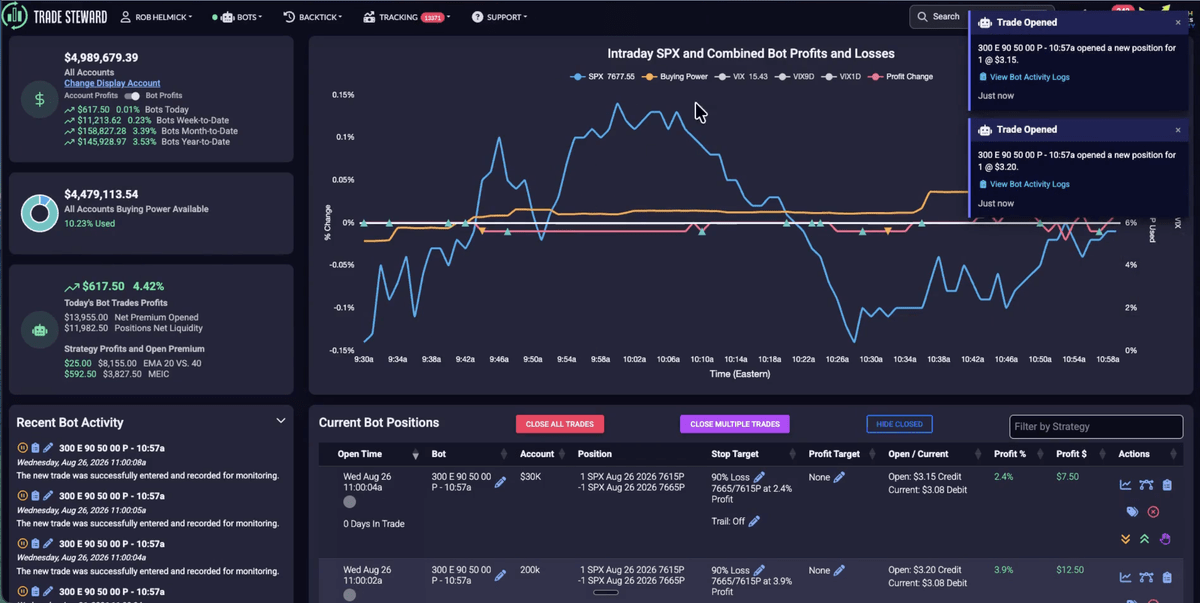
Around 200 automated trades a day
Nick’s automated SPX portfolio currently executes around 200 trades on a typical day, with trades often occurring only a few minutes apart.
This is not one single 0DTE strategy repeated hundreds of times.
The portfolio combines several approaches, including multiple-entry iron condors, trades based on Exponential Moving Averages, ratio spreads, and other setups. Most of the trades are entered after the first hour of the session and continue throughout the trading day.
An important principle is diversification through time.
Instead of entering a five-lot iron condor at one particular moment, for example, Nick might spread those five entries across an hour. As SPX moves, each new position has a slightly different risk profile.
The objective is not to identify the perfect entry. It is to build a collection of positions that work together.
By late in the session, Nick says the combined SPX portfolio can resemble a large, wide butterfly around the market — a structure he compares to how market makers traditionally managed their overall inventory and risk.
Backtesting before the bots start trading
Automated does not mean passive.
Much of the work happens before the trades are placed. Nick and his partners run extensive backtests, typically over the weekend, analyzing different strategies and how their performance changes with market conditions.
Strategies can be adjusted from week to week or even day to day. Once selected, they are programmed into bots that handle execution and trade management.
That allows a volume of trading that would be practically impossible manually. At roughly 200 trades per day, Nick estimates that a trade can occur every two or three minutes.
Automation therefore does more than save time. It makes an entirely different trading process possible.

When your brain gets in the way
Perhaps the most interesting change has been psychological.
Nick admits that when he looks at the account and sees it significantly up or down, his instinct is still to do something.
Automation prevents that impulse from automatically becoming a trading decision.
Entry conditions, risk, stops, and other rules have already been determined. Once the trades are running, the idea is to allow the probabilities and math to play out rather than constantly second-guessing the system.
That has forced Nick to reconsider some familiar trade-management habits.
One example occurs late in the day when short options may be trading for only five cents. With dozens of contracts open, his instinct tells him to buy them back and remove the remaining risk.
But repeatedly paying those nickels, plus commissions and slippage, can add up when hundreds of trades are being executed every day. At Nick’s scale, the economics can look very different from managing an individual small position.

Risk does not disappear with automated 0DTE trading
Automation removes some risks, but it creates others.
Human error remains possible when setting parameters for hundreds of trades. There is also slippage, poor fills, and the possibility of unusually large market moves.
Nick says these factors need to be incorporated into the modeling rather than ignored.
Position sizing is another major concern. A series of good days can tempt a trader to increase size just before conditions change — something automation itself cannot prevent if the trader changes the parameters.
For the SPX portion of the portfolio, Nick says they model for a maximum drawdown of around 2–2.5% under normal assumptions, while recognizing that an extreme event could produce a larger loss.

The results have exceeded expectations
Nick says the automated SPX trading has produced stronger results than they expected so far, averaging around 6–7% per month over roughly 10 months at the time of the interview. He says this is measured as a percentage of the buying power used.
He is careful not to project those returns forward. In fact, he explicitly expects that they will give some of the outperformance back.
The bigger lesson from his transition may therefore not be the return number.
It is the change in how he approaches trading.
After a decade spent making discretionary decisions, Nick increasingly thinks in terms of many occurrences, predefined risk and the combined portfolio rather than whether any individual trade is right or wrong.
His advice sums it up:
Forget about finding the perfect trade.
Make multiple trades, spread the risk through time, and judge the positions as a whole.
📚 Book recommended in this video
- Julia Spina: The Unlucky Investor’s Guide to Options Trading
