






This video is based on curated insights from previous interviews on the Theta Profits YouTube channel, where traders share how they approach 0DTE Butterflies. While the trade structure may be similar, the execution, risk management, and overall philosophy vary significantly from trader to trader.
Watch the video for the five 0DTE Butterflies strategies
Butterflies explained
A butterfly trade is an options strategy built around a specific price level. The typical goal is for the market to stay close to that level into expiration.
One common version is the Iron Butterfly (Iron Fly), which combines a put credit spread and a call credit spread with the same short strike at the center. This creates a defined-risk trade where the maximum profit occurs if the underlying closes near that central strike.
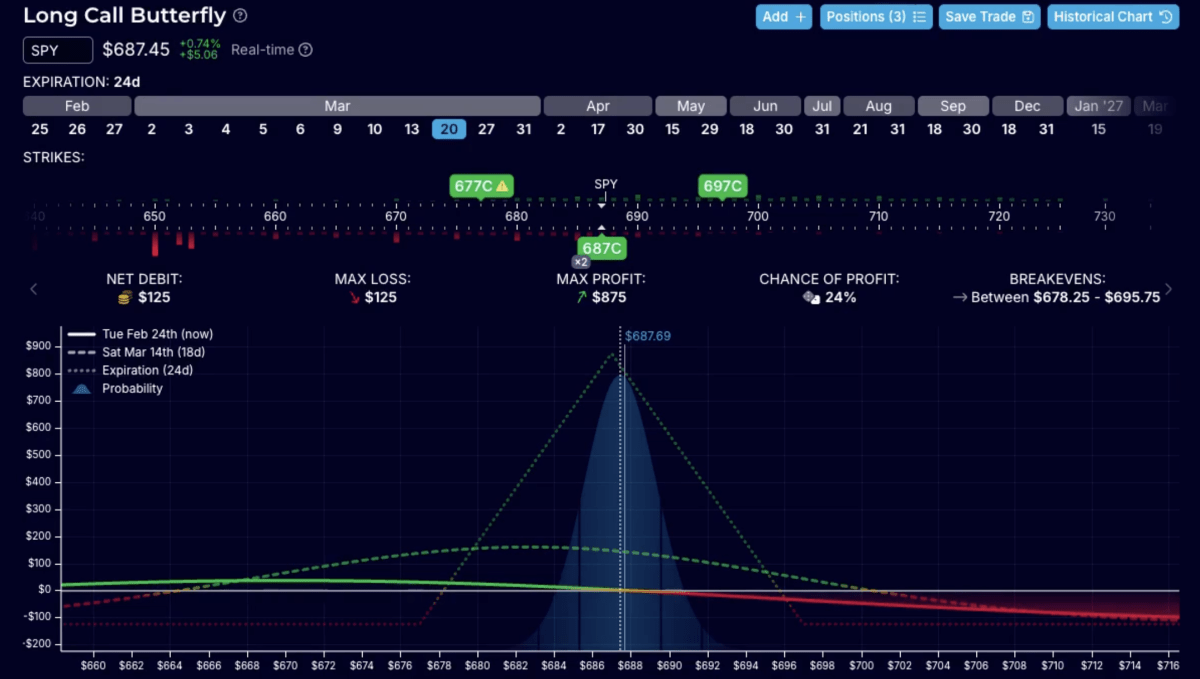
Butterflies can also be constructed using only options of the same type. A call butterfly (example below) uses only call options, while a put butterfly uses only put options. These versions have similar payoff structures but are typically entered for a debit instead of a credit.
Across all variations, the defining feature is the same: a payoff profile that peaks at a specific price level, making butterflies especially useful for traders who want to target where the market may end up at expiration.
1. Doc Severson: Fast and efficient iron flies
Doc Severson focuses on speed and efficiency. His approach is to place an at-the-money iron butterfly early in the trading day and exit quickly – often within minutes.
The key idea is to tighten the structure of the trade. By bringing the wings closer, as compared to an Iron Condor, he increases the premium collected and accelerates time decay. This allows him to capture profits faster rather than waiting for the market to move or for expiration to approach.
He bases the trade on the expected move and the opening range of the day. If the market remains stable within that range, he enters the trade. Risk management is strict, with predefined stop levels based on the expected move. If the price moves outside those levels, he exits immediately.
This is a high-frequency, short-duration approach where the goal is to take a consistent share of the opportunity and minimize time in the market.

2. Dale Perryman: Building positions throughout the day
Dale Perryman takes a more dynamic approach by placing multiple iron butterflies during the day. He refers to this as “fly catching.”
Instead of relying on a single position, he builds a series of trades at different price levels. The goal is to have one or more butterflies positioned close to where the market eventually closes.
The process starts with an initial trade around 10:00 AM, placed near the current market price. The premium collected from this first trade determines how additional positions are added. If premiums are lower, trades are placed closer together. If premiums are higher, they are spaced further apart.
Risk management involves monitoring each position. If a trade moves too far against him, it is closed before reaching full loss. This approach accepts more variability but creates the potential for larger wins when the market closes near one of the positions.

3. Jamaal Ghauri: The Trojan Horse butterfly
Jamaal Ghauri trades a high-risk, high-reward version of 0DTE Butterflies, which he calls the “Trojan Horse” strategy.
The focus is on identifying where the market is likely to close and placing a very narrow butterfly around that level later in the day. Entry typically happens around midday or early afternoon, when the market direction becomes clearer.
He uses a combination of indicators, including VWAP, RSI divergence, and gamma exposure, to identify potential “pin” levels – areas where the market may gravitate into the close.
The strategy has a relatively low win rate, but the payoff can be very large when the market closes near the center of the butterfly. This creates a strong risk-to-reward profile, where a few successful trades can offset multiple losses.

Azhar Pasha: Adaptive and protected structures
Azhar Pasha focuses on risk control by using a modified butterfly structure known as a broken-wing butterfly.
His setup combines one debit spread closer to the market with two credit spreads further out of the money. The debit spread acts as protection if the market moves against the position.
One of the key features of his approach is flexibility. If the market moves strongly in one direction, he can adjust by flipping the position – closing one side and opening a new spread in the opposite direction. This adjustment is often funded by gains from the protective part of the structure.
The goal is to reduce the impact of large adverse moves while still benefiting from premium collection. This makes the strategy more defensive compared to traditional short premium approaches.

Maria and Rob Helmick: The “Shoe Trade”
Maria and Rob Helmick take a simple and structured approach to trading 0DTE Butterflies,. They humorously call their strategy “The Maria Shoe Trade”, as it originally was intended to pay for Maria’s expensive shoe habit.
The strategy involves placing an at-the-money iron fly at a specific time of day, typically around 10:30 AM, and closing it either at a predefined profit target or later in the afternoon.
The reasoning behind the timing is to avoid early market volatility and allow price action to settle before entering the trade. The structure remains consistent, with fixed wing widths and clearly defined exit rules.
This approach emphasizes repeatability and discipline. Rather than trying to predict market direction, the focus is on executing the same process consistently over time.

[…] Five ways to trade 0DTE butterflies […]