




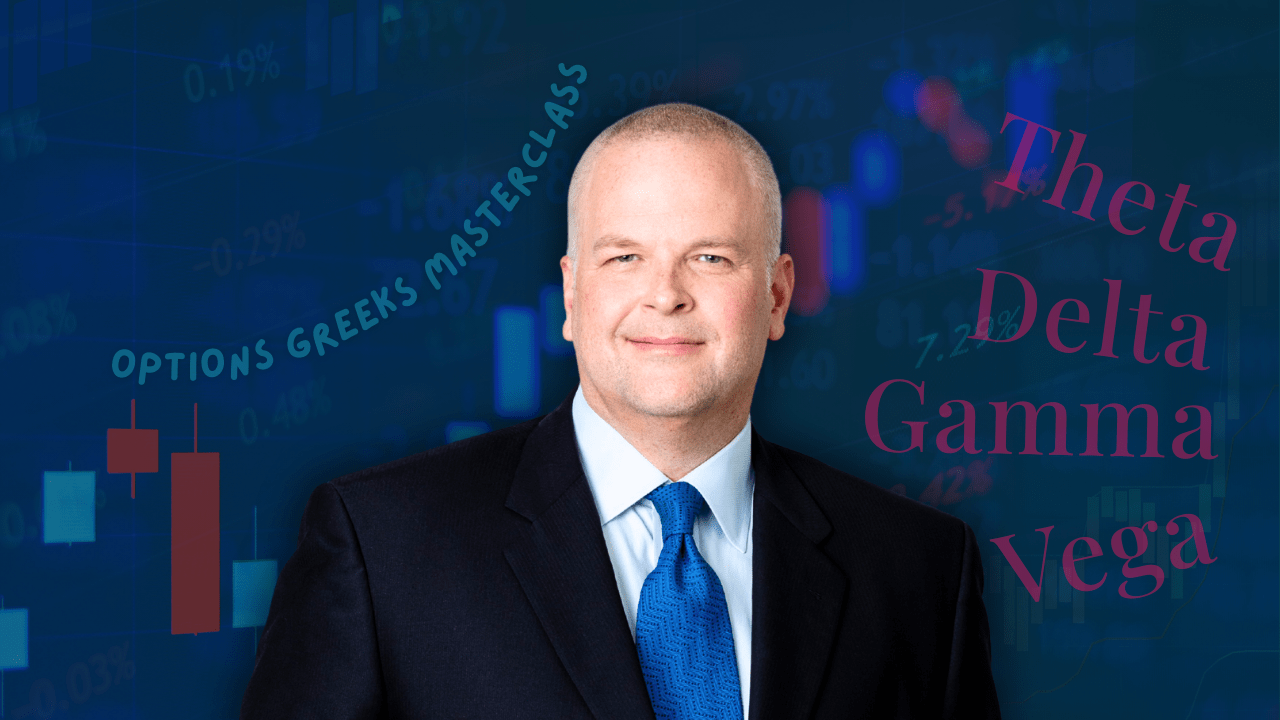


If you trade options, understanding the options Greeks is not optional. They explain how your P&L moves, why risk changes during a trade, and why positions can suddenly feel stable one moment and out of control the next.
In this options Greeks masterclass, I sit down with Mat Cashman from the Options Industry Council. The video is composed of four separate interviews we have conducted with him about Theta, Delta, Gamma, and Vega – now combined into one complete, structured guide to the options Greeks.
Watch the full options Greeks masterclass
Mat Cashman
Mat Cashman has traded options for more than 25 years, starting on the floor of the CBOE. Today, he serves as Principal of Investor Education at the Options Industry Council, where he teaches traders how options really work based on decades of hands-on experience.
Why options Greeks matter more than most traders think
Many retail traders focus heavily on strategy: iron condors, credit spreads, covered calls, 0DTE trades, etc. But strategy is only one layer.
The real engine behind every options position is the options Greeks.
The options Greeks measure how sensitive your position is to price movement, time decay, volatility changes, and acceleration of risk. If you don’t understand these moving parts, you are reacting to your trades instead of managing them.
In this masterclass, we walk through the four primary options Greeks – Theta, Delta, Gamma, and Vega – and explain how they interact in real trading situations.

Theta: The foundation of time decay
Theta measures how much an option loses in value over time.
Because all options have expiration dates, they have a decay curve. Theta represents how much value is expected to come out of the option over the next 24 hours.
For options sellers, Theta often feels like income. But as Mat explains, it is not guaranteed profit. Time decay is always happening, but other Greeks – especially Gamma and Vega – can easily overpower it.
One of the most important takeaways from the discussion is that Theta is not linear. Decay accelerates as expiration approaches. That is particularly relevant for zero DTE traders, where the entire extrinsic value must come out within hours.
If you sell options for income, understanding how Theta interacts with Gamma is essential.
Delta: Your directional exposure
Delta measures how much your option is expected to move for every $1 move in the underlying.
Think of Delta as your position’s speedometer. It tells you how sensitive your trade is to price movement.
A 0.50 Delta option should move approximately $0.50 for every $1 move in the stock. But Delta is not static. It changes as the stock moves, time passes, and implied volatility shifts.
Many traders also use Delta as a rough estimate of probability. A 0.70 Delta option is often interpreted as having about a 70% probability of finishing in the money. While not perfect, this framework helps traders think in probabilistic terms.
Understanding Delta is crucial for managing directional exposure — especially in multi-leg or delta-neutral strategies.

Gamma: why risk can suddenly accelerate
Gamma measures how fast Delta changes.
If Delta is your speedometer, Gamma is how quickly that speedometer moves.
Gamma becomes especially important as expiration approaches. The closer an option gets to expiration, the more sensitive it becomes to price movement, particularly if it is at the money.
This is why 0DTE trades can feel calm in the morning and chaotic in the afternoon. Time compression increases Gamma dramatically, meaning small stock moves can lead to large changes in Delta and overall risk.
A key insight from the masterclass is that Gamma does not make markets random. It compresses risk into a shorter time frame. For traders who sell options, understanding when they are short Gamma is critical, since collecting Theta typically means being exposed to negative Gamma.
Vega: The volatility factor
Vega measures how sensitive an option is to changes in implied volatility.
If implied volatility rises, option prices generally increase. If it falls, option prices decline, even if the stock does not move much.
Vega becomes especially relevant in earnings environments, periods of market stress, delta-neutral strategies, and volatility-based setups.
Many traders are surprised when their position loses money despite little price movement. In those cases, Vega is often the explanation.
If you trade options in any structured or hedged way, you are trading Vega whether you realize it or not.

How the options Greeks are linked
One of the most important lessons from this options Greeks masterclass is that the Greeks do not operate independently.
They are interconnected. Short Theta usually means short Gamma. High Gamma appears in short-dated options. Changes in implied volatility affect both Delta and Vega. Time accelerates Gamma as expiration approaches.
Understanding the options Greeks means understanding how your risk profile evolves during the life of a trade – not just at entry.
Summing up
The options Greeks are not abstract academic concepts. They are practical risk management tools.
If you trade short-dated options, sell premium, or actively manage positions, the options Greeks explain why your trade behaves the way it does, why risk changes over time, and why some positions suddenly feel unstable.
Mastering the options Greeks is one of the biggest transitions from beginner trader to consistently disciplined options trader.
If you want to trade with clarity instead of reacting emotionally to market moves, start with the Greeks.
