







Gold futures options trade with unusually high volatility, creating attractive – but demanding – opportunities for premium sellers.
In this video interview, Azhar Pasha explains how he sells credit spreads on gold futures as an income strategy. After six months, he has averaged around 10% per month in a dedicated account. He walks through how the strategy works, why gold behaves differently from index options, and what it takes to manage the risk effectively.
Learn how Azhar sells credit spreads on gold futures
Azhar Pasha
Azhar Pasha is an experienced options trader from Florida, USA, who focuses primarily on premium-selling strategies. By profession, he is a physician, but over the past several years, he has specialized in options trading, particularly defined-risk strategies in liquid markets such as SPX and gold futures options.
- Azhar Pasha on Linkedin
- Watch our first interview with Azhar Pasha: 0DTE Adaptive Butterfly
Why gold futures options are different
One of the key themes in the interview is volatility. Gold futures options often trade with significantly higher implied volatility than index options like SPX. This increased volatility inflates option premiums, which is attractive for traders who sell options rather than buy them.
However, higher volatility also means larger and faster price swings. Gold can move several percent in a single session, driven by macroeconomic data, central bank decisions, geopolitical events, currency movements, and more. This combination of high premiums and sharp movements makes gold futures options both appealing and dangerous.
- Watch other interviews with retail options traders:
- Steve Ganz: The Flyagonal strategy
- Ross Young: Jade Lizard
- Murray Lindhoet: The 1-1-2 strategy
- Ravish Ahuja: Double calendar spread
The core strategy: selling credit spreads on gold futures
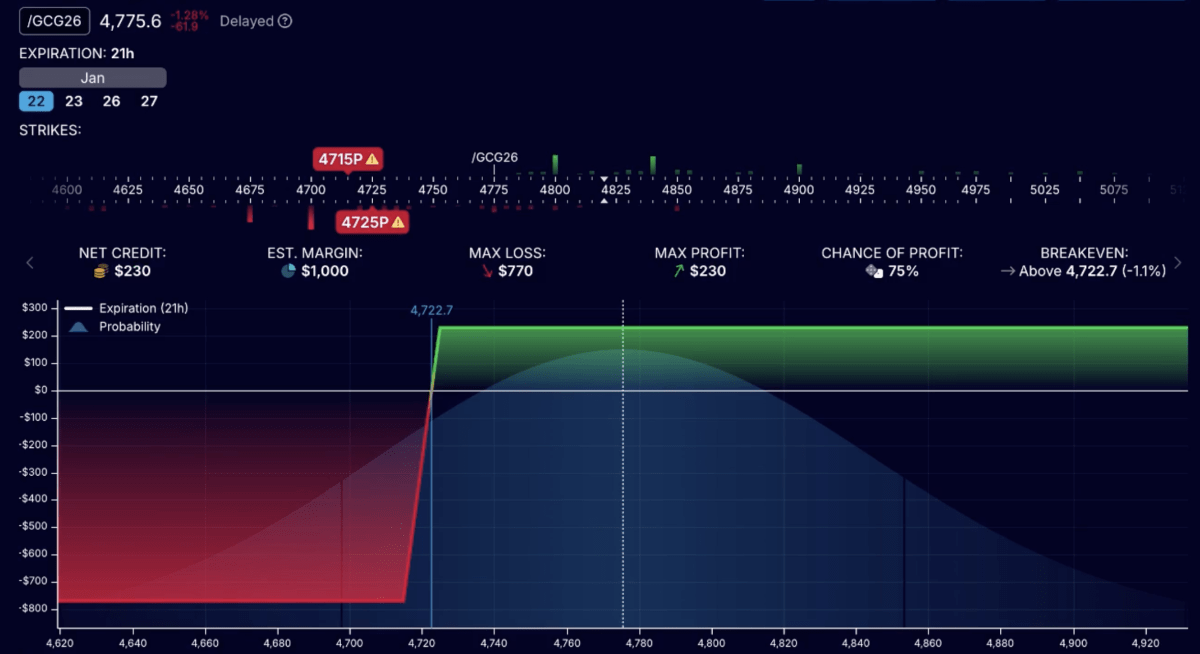
Azhar’s strategy is built around defined-risk credit spreads on gold futures options, traded primarily on daily expirations. He avoids naked options entirely and structures every trade so that risk, margin usage, and management rules are clearly defined upfront.
At a high level, the strategy works as follows:
Entry mechanics
- Trades daily-expiring gold futures options (options expiring the next trading day)
- Sells a put or call option at approximately the 10 delta
- Buys another option 10 points further out to create a vertical credit spread
- Typical risk is around $1,000 per spread, keeping margin usage controlled
- Chooses put or call spreads based on daily directional bias
Profit target
- Immediately places a profit-taking order at around 80% of maximum profit
- If price action behaves as expected, trades often close automatically before expiration
Risk management and exits
- Does not use hard stop losses
- Actively monitors positions during the trading day
- If the cost to close the spread reaches roughly four times the original credit received, the position is considered threatened and will be managed
Trade management
- Instead of closing for a loss, he typically rolls the position to the next day’s expiration
- Depending on price action, he may:
- Roll a put credit spread forward
- Roll a call credit spread forward
- Or flip direction, rolling a call spread into a put spread (or vice versa)
This rolling-based management approach allows flexibility but requires discipline, experience, and the ability to monitor trades actively throughout the day.
Directional bias and trade selection
Rather than trading neutral strategies, Azhar takes a clear directional bias for each trading day. He has found that gold often trends strongly intraday, making strategies like iron condors less effective in this market environment.
To determine direction, he relies heavily on data from MenthorQ, which provides insight into gamma positioning, order flow, call and put volume, expected daily ranges, and momentum scores for gold futures options. This data helps him assess whether market positioning favors bullish or bearish movement for the upcoming session.
He also pays close attention to price action around the London market open, which often sets the tone for gold trading during the day. If the data and early price action suggest bullish momentum, he sells put credit spreads. If conditions point to bearish momentum, he sells call credit spreads instead.

Risk management with credit spreads on gold futures
Risk management is a central focus of the interview. Azhar avoids naked options entirely and stresses the importance of position sizing. He generally limits initial exposure to a small percentage of total account margin to maintain flexibility if trades move against him.
Rather than using hard stop losses, he actively manages trades. If a position becomes threatened, he may roll it to the next expiration, sometimes even switching from a put spread to a call spread or vice versa, depending on how price action evolves. This rolling approach is discretionary and requires experience, discipline, and the ability to monitor trades during the day.
Results and performance context
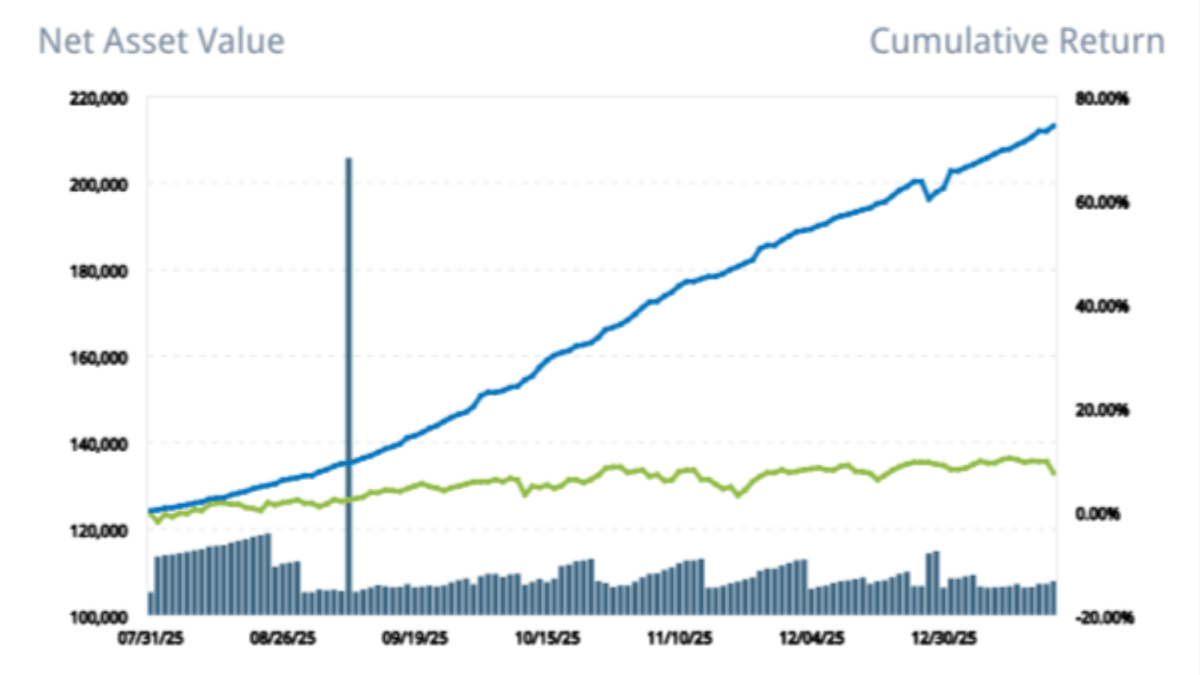
In the interview, Azhar shares that in one dedicated account trading this strategy, he has averaged around 10% per month so far over a recent six-month period.
This is presented as a case study, not a promise or expectation. He emphasizes that results depend heavily on market conditions, discipline, and proper sizing—and that poor risk control can quickly lead to significant losses in futures options.
Who are credit spreads on gold futures best suited for?
Selling credit spreads on gold futures is not a beginner strategy. According to Azhar, it is best suited for traders with prior options experience, those comfortable with defined-risk spreads, and traders who can actively monitor and manage positions during the trading day.
It is not suitable for passive investors or anyone unable to respond quickly to market moves.
Some key takeaways
- Gold futures options offer high premium due to elevated volatility.
- Defined-risk credit spreads help control downside risk.
- Directional bias matters more than neutrality in gold.
- Active management and conservative sizing are essential.
- This is a high-risk strategy that requires discipline.

I tried, but i didnt get any useful premium.
Spreads are like 10 wide about .50 $, but no assignment (waiting for long time)
Dieter