




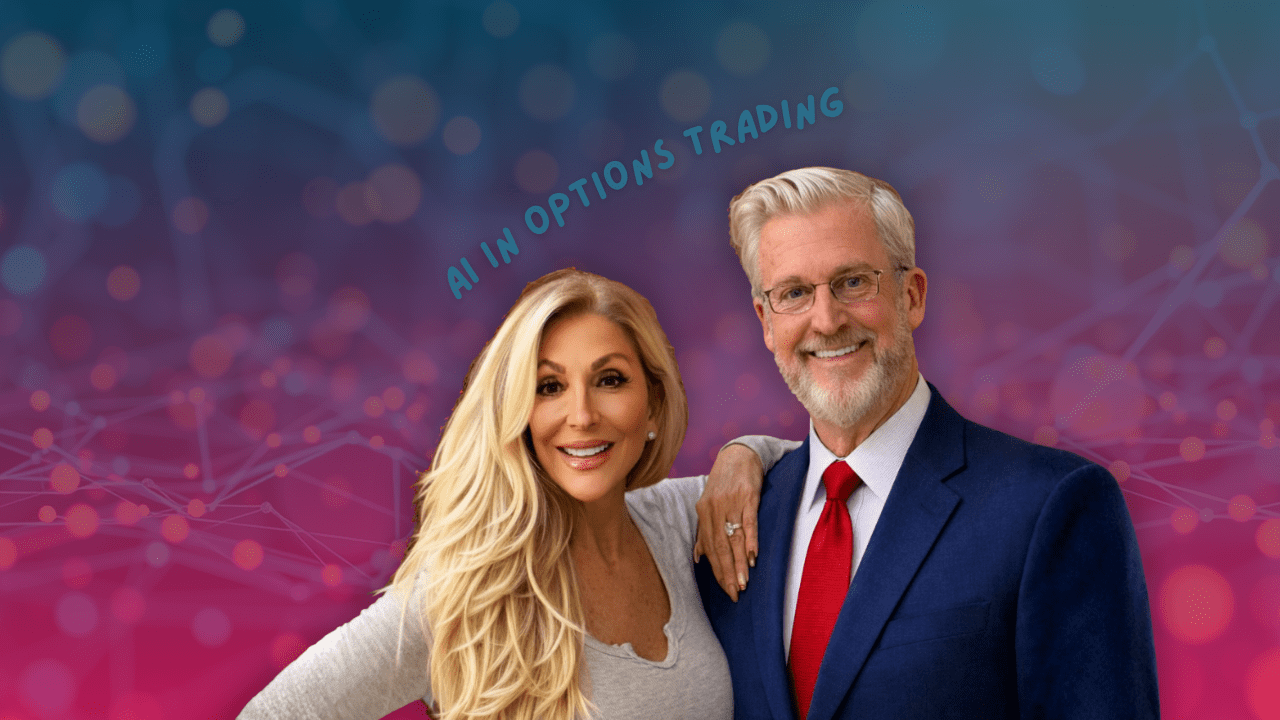

In this interview, Rob and Maria Helmick explain how they use AI to handle trading volumes that reach around 150 options trades per day. Rob focuses on large-scale, probability-driven execution, while Maria uses AI as a disciplined trading assistant. Together, they walk through how this approach has helped them improve capture rates, manage risk more effectively, and generate strong returns across both large and smaller accounts, all while keeping human decision-making firmly in control.
Watch Rob & Maria explain how they use AI for options trading
Rob & Maria Helmick
Rob and Maria Helmick, residing in Daytona Beach, Florida, are two experienced retail options traders who use artificial intelligence in very different ways.
Rob focuses on large-scale backtesting, probability, and automation. Maria uses AI as a practical trading assistant to support discretionary decision-making and portfolio management. They use the same AI engine, which they call Vera, but apply it in completely different ways.
That contrast makes this discussion especially useful for traders who are curious about AI for options trading but unsure how it fits into real-world workflows.
AI for options trading is not one-size-fits-all
One of the most important insights from the interview is that AI for options trading does not mean the same thing for every trader.
For Rob, AI is about scale. He treats options trading as a math problem where expected value plays out over thousands of trades. For Maria, AI is about clarity and preparation. She wants faster analysis, better structure, and fewer blind spots before placing trades.
Both approaches are valid. What matters is matching AI to your trading style rather than forcing your trading style to fit AI.
How Rob uses AI for scale, backtesting, and execution
Rob’s approach to AI for options trading is built around probability, repetition, and scale. When trading frequently, small statistical edges only show up if they are executed consistently across a very large number of trades.
He uses AI to:
- Analyze large backtest datasets
- Compare variations of the same strategy
- Evaluate risk metrics like drawdowns and capture rate
- Support automated execution logic
For backtesting and automation, Rob relies primarily on Option Omega, which he considers the most robust tool available for serious options traders. He explains that Option Omega allows for deep customization of entries, exits, stop-loss logic, timing, and position sizing, all critical when testing strategies that may involve thousands or even millions of data points. Just as importantly, it enables a direct transition from backtested strategies to live automation, reducing the risk of human error once trades are deployed.
Rob emphasizes that once trade frequency increases, manual analysis simply stops working. AI becomes essential not because it predicts the market, but because it can process, organize, and evaluate information at a scale no human can manage. Even so, AI does not make final decisions. Rob defines the rules, risk limits, and structure — AI supports the process by handling the data, analysis, and consistency required to execute those rules effectively.

How Maria uses AI as a trading assistant
Maria’s use of AI for options trading is far more hands-on and discretionary. She does not automate trades or rely on complex bots. Instead, she uses AI to improve preparation and portfolio oversight.
She uses AI to:
- Generate consistent pre-trade reports
- Evaluate stocks and futures before selling options
- Review portfolio risk using daily screenshots
- Flag potential issues such as earnings risk or weak price structure
Over time, Maria has trained her AI assistant to produce reports in a specific format that matches her decision-making process. This allows her to review key information quickly without losing control of the final decision.
For traders who prefer discretion over automation, this is a powerful example of how AI can add value without taking over the trading process.
- Watch other interviews on Theta Profits:
- Boomer Dan: 0DTE Levitation Trades
- Doc Severson: 0DTE Iron Fly
- Zoheb Noormohamed: The 1-1-1 options strategy
What AI can and cannot do in options trading
A major strength of the interview is the honest discussion about limitations. Rob and Maria are clear that AI for options trading is not foolproof.
They emphasize that:
- AI can make mistakes
- Data inputs must be reviewed
- Traders must understand the basics of options trading
AI works best as an assistant, not an autopilot. Traders who benefit most already understand risk management, position sizing, and trade structure. AI enhances those skills, but it does not replace them.
This realistic perspective separates practical AI usage from hype-driven promises.
Results, risk, and realistic expectations
The interview also covers results and expectations in a transparent way. Using AI for options trading, Rob explains that a $1 million account (measured by buying power used) was up about 31.7% over roughly 90 days, equivalent to approximately $317,000, following the transition to their current AI-driven process. In parallel, a $30,000 account, trading a much smaller number of daily positions, was up around $11,900 over the same period, or roughly 33% in three months.
Both Rob and Maria stress that these are short-term results, not guarantees, and that long-term success depends on disciplined risk management, conservative use of buying power, and understanding that even statistically sound strategies can experience drawdowns.
Key takeaways for retail options traders
For traders interested in AI for options trading, the interview offers several practical lessons:
- AI works best when guided by clear rules
- Different trading styles require different AI workflows
- Scale changes what is necessary, not just what is possible
- AI should support decisions, not replace them
- Understanding options fundamentals is still essential
Whether your goal is automation, discretionary trading, or better analysis, the interview shows how AI can fit into real trading without turning the process into a black box.

[…] he trades together with Rob and Maria Helmick, and the bulk of his day-to-day options activity has shifted to automated SPX 0DTE […]