





In this interview, Jamaal Ghauri walks through his 0DTE butterfly strategy step by step, showing how he identifies where the market is likely to close and how he structures trades to target large, asymmetric returns.
Learn all about the 0DTE butterfly strategy here
Jamaal Ghauri
Jamaal Ghauri is an experienced options trader with a background in institutional finance. He focuses on advanced strategies that combine technical analysis with options data, such as dealer gamma and second-order Greeks.
What is a 0DTE butterfly?
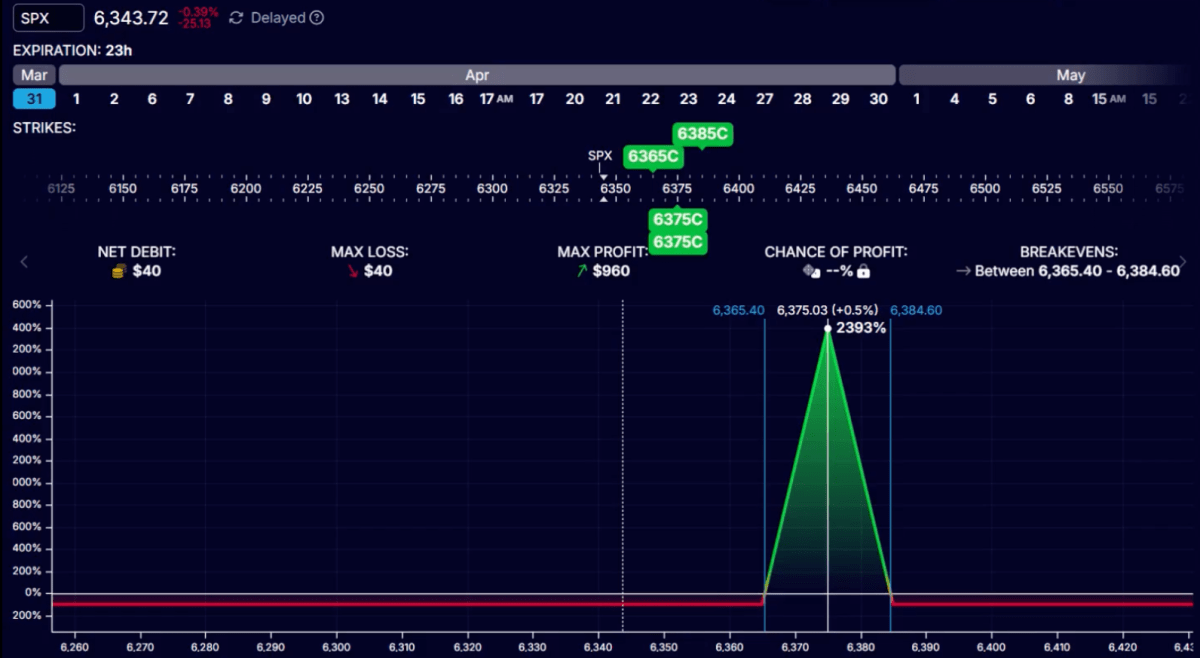
A 0DTE butterfly is an options strategy placed on contracts that expire the same day. It typically involves buying two options and selling two options at different strike prices to create a “tent-shaped” payoff.
The objective is to have the underlying asset—here, the SPX—close near a specific strike price at the end of the trading day. If that happens, the trade can generate very large returns relative to the initial cost.
The key advantage is that risk is fully defined. The most you can lose is the premium paid for the trade. However, the profit zone is narrow, so accuracy is critical.
Other video interviews about butterflies
- Steve Ganz: Butterfly options trade explained
- Doc Severson: 0DTE Iron Fly
- Azhar Pasha: The 0DTE adaptive butterfly strategy
- Rob & Maria Helmick: The Maria Shoe Trade
- Carl Allen: 21DTE put broken wing butterfly
- Dale Perryman: 0DTE Iron Flies on SPX
Step 1: Identify the right market conditions
The first step in executing a 0DTE butterfly is to determine whether the market environment is suitable.
Jamaal looks for:
- Slow, controlled price movement rather than sharp volatility
- No major news events or extreme volume spikes
- A market that is drifting and consolidating
This type of environment increases the likelihood that the market will “pin” to a level rather than make unpredictable moves.

Step 2: Estimate where the market will close
The most important part of the strategy is identifying the level where the market is likely to close.
To do this, the process combines several inputs:
- Basic technical analysis, such as trend lines and support/resistance
- RSI to identify potential reversals
- Momentum indicators to confirm direction shifts
- Dealer gamma data to understand where the price may be “pinned”
The goal is to find a price level where multiple signals align. This becomes the center strike of the butterfly.
Step 3: Structure the 0DTE butterfly
Once a target level is identified, the next step is to build the trade.
The structure is:
- Sell two options at the strike where you expect the price to pin
- Buy one option above and one below that strike
- Keep the width relatively narrow (usually 5–10 points on SPX)
This creates the characteristic payoff “tent,” where maximum profit occurs if price finishes near the center strike.
Because the structure is narrow, even small errors in the forecast can impact the outcome. Precision matters.
Step 4: Enter at the right time
Timing plays a crucial role in a 0DTE butterfly strategy.
Jamaal typically enters:
- Between 12:00 PM and 2:15 PM Eastern Time
- With a focus on around 2:15 PM as a key inflection point
At this stage of the day:
- Time decay accelerates
- Option Greeks become more impactful
- Market direction is often clearer
Entering too early reduces efficiency, while entering too late limits profit potential.

Step 5: Manage the trade actively
A 0DTE butterfly is not a “set and forget” strategy. Active management is essential.
The process includes:
Scaling out profits
As the price moves into the profit zone, Jamaal begins closing part of the position. This locks in gains and reduces risk.
Monitoring price action
Volume, speed, and direction of movement determine how aggressively to exit.
Leaving a small portion
A small percentage of the position is often held until expiration to capture maximum profit if the price pins perfectly.
This step is where much of the edge comes from. Two traders can take the same entry but achieve very different results based on management.
Step 6: Control risk and position size
Even though the strategy has defined risk, proper sizing is critical.
Key principles:
- Only risk a small percentage of total capital per trade. Jamaal’s rule is to never risk more than 1% of his account
- Accept that many trades will be full losses
- Focus on consistency rather than frequency
The win rate is typically around 50%, so discipline is required to execute the strategy over time.

Why the 0DTE butterfly works
The edge of the 0DTE butterfly comes from asymmetric risk and reward.
- Losses are capped at 100% of the premium
- Winning trades can return multiples of the initial investment
- Active management improves overall outcomes
Even with a modest win rate, the size of the winners can outweigh the losses.
Key takeaways
A 0DTE butterfly is a precision-based options strategy designed to profit from where the market closes at the end of the day.
To execute it effectively, traders must:
- Choose the right market conditions
- Accurately estimate the closing level
- Structure the trade correctly
- Enter at the optimal time
- Actively manage the position
For intermediate options traders, this strategy highlights how combining technical analysis with options data can create a structured and potentially powerful trading approach.
📚 Books recommended in this video
Jamaal recommends these two books on options trading:
- Sheldon Natenberg: Option Volatility & Pricing
- Lawrence G. McMillan: Options as a Strategic Investment
