What if you could trade SPX with no risk by the end of the day? That’s the goal of 0DTE levitation trades, Boomer Dan’s fascinating strategy for creating “floating” positions that stay in profit regardless of market direction.
Dan Westbrook — known to traders as Boomer Dan — is a long-time options trader, mentor, and former Hollywood film editor who turned his analytical mindset toward mastering zero-day-to-expiration (0DTE) trading. On his YouTube channel Boomer Dan, he teaches retail traders how to trade with precision and control. In this interview with Theta Profits, he shares his signature method: the 0DTE levitation trade — a setup designed to “float” above the zero line and eliminate all risk by the end of the day.
The idea behind 0DTE levitation trades
At its core, Dan’s goal is simple:
“To make the trade completely risk free as quickly as possible.”
Using SPX 0DTE options, he structures his trades so that after initial entry and adjustment, the profit-and-loss curve rises entirely above the zero line, meaning the trade cannot lose money at expiration. This is what he calls levitation: when a position “floats” in a profit zone no matter what the market does next.
Example of where Dan aims to be at the end of the day. No matter what, he will make at least $350. If the market makes a big jump up, he can make much more. In no case he will lose. Another example of a portfolio of trades where at least $1,606 of profits is locked in.
From iron condors to floating structures
Dan’s journey to this approach started with frustration. He used to be “the Iron Condor King,” but constant whipsaws and losses on 10-delta spreads pushed him to rethink his methods. Eventually, he realized that trading at-the-money credit spreads offered far more flexibility.
At-the-money spreads collect much higher credit, often with a 1:1 risk-to-reward ratio, giving him room to manage positions effectively. The levitation concept evolved from there: by starting with a strong credit base and using profits to build a balanced structure, Dan can remove all downside risk while keeping the upside open.
How the 0DTE levitation trades work
There are several ways to start the trade. In the video interview, Dan shares the easiest one.
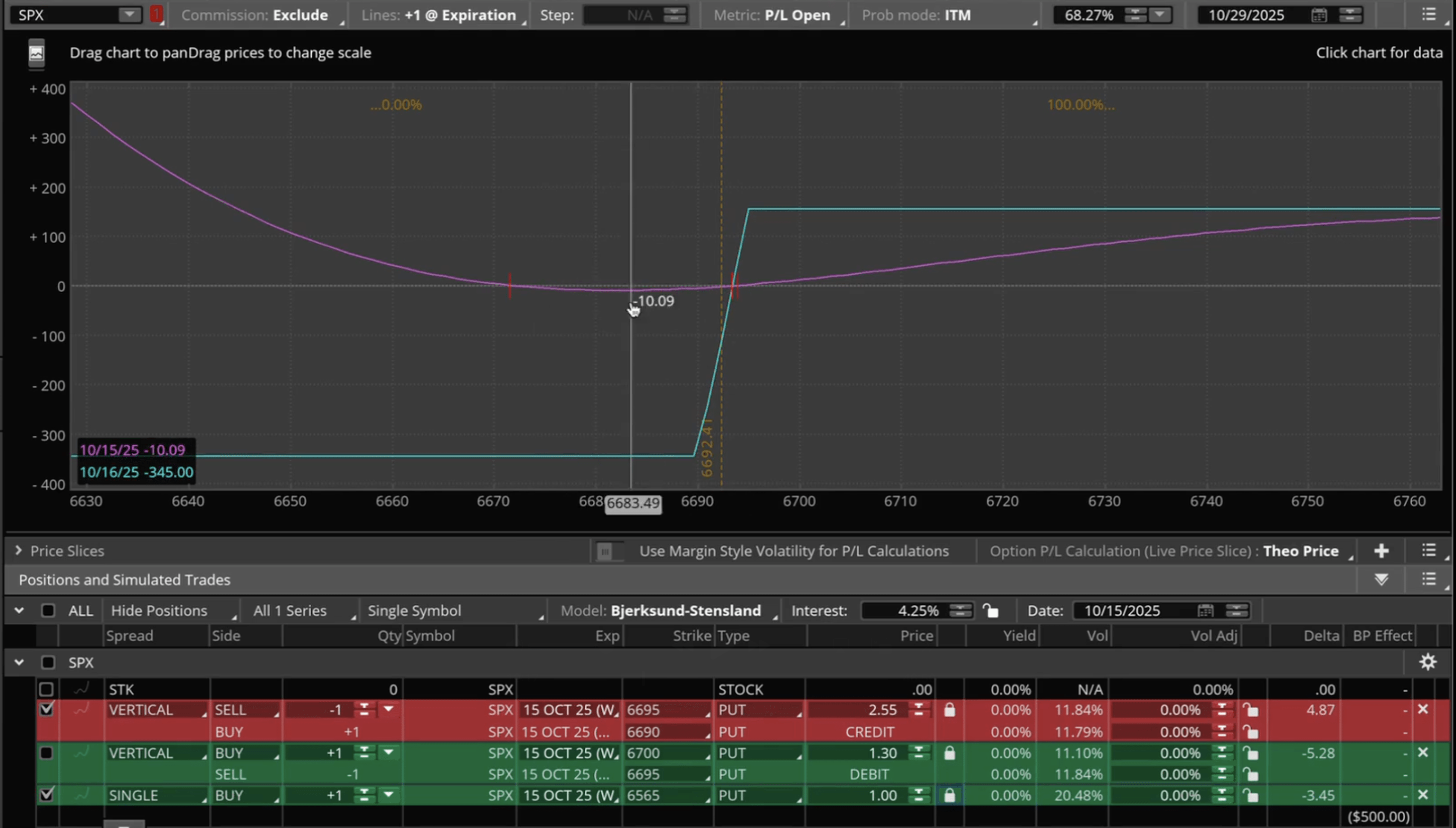
This basic setup begins with selling an at-the-money SPX credit spread. In the video, he uses a 5-point-wide put credit spread as the example. Dan aims to collect at least $2.5 in premium on such spreads, effectively having a 1 to 1 risk/reward radio.
If the market moves in his favor, Dan uses the profit from that spread to buy the opposite side, creating a butterfly.
At that point, the position “floats” above zero. No matter what happens, it will profit. But it has a profit tent with the potential of the biggest profit.
He describes it simply:
“Even if it flies up all the way to the moon, or if it crashes all the way to zero, we’re guaranteed to make money on this.”
This flexibility allows him to stack multiple butterflies throughout the trading day, creating what he calls a “wall of profit tents.” Each new butterfly adds guaranteed income and increases the total floating profit zone.
Step 1 in our example trade: Dan opens a at the money put credit spread with the short at 6695 and the long at 6690. He collects $2.55 in premium.Step 2 in our example trade: The market moves in our desired direction, and the trade is $103 in profit. Dan now opens a put debit spread witt a long put at 6700 and a short put at 6695. For this he pays $1.3.Step 3 in our example trade: After the debit trade has been added, we now have a butterfly position that will always profit. The minimum profit is $125. Using a hedge: Here is the profit and loss curve after we have bought a put for $1. This gives us a lot of flexibility during the first 1-2 hours even if the market moves against us.
Managing risk with precision
Unlike many high-risk day trading strategies, the 0DTE levitation trade starts with built-in protection. Dan often hedges each credit spread by buying a cheap same-day put option or using MES futures as a dynamic hedge. This means he can stay in control even when the SPX makes sudden moves.
In the example used in the video, he buys the closest put that he can get for $1. This gives him a very solid protection for the first 1-2 hours after the trade has been opened.
His philosophy is clear:
If it moves your way — build the butterfly.
If it moves against you — exit early and reset.
He typically risks no more than $50–$100 per trade, making the losses small and recoverable, while the winning setups compound through the day. He will close the trade when the position hits that level.
For many traders, 0DTE strategies feel like gambling — high speed, high volatility, and high stress. Dan’s levitation method turns that perception on its head. It’s structured, mathematical, and repeatable.
He estimates that he achieves a floating, risk-free position seven or eight times out of ten. Once levitated, the trade can be left alone.
“I can just close the laptop and walk away knowing the trade’s going to be a winner.”
It’s an appealing idea: control the chaos of zero-day trading and finish the session with locked-in profits — not uncertainty.
Who 0DTE levitation trades are best for
Dan believes the strategy is best suited for intermediate options traders — those who already understand credit spreads, butterflies, and basic risk management. You don’t need to be an algorithmic trader, but you do need to act quickly, understand ThinkorSwim or a similar platform, and make rational adjustments in real time.
He emphasizes that this is not a “set and forget” system. It requires attention during the first hour or two of the market session — but once levitating, it becomes nearly maintenance-free.
Risk and reward profile
When asked to rate the strategy’s risk level, Dan smiles:
“Once it’s levitating, I give it a zero or a minus zero — there’s no way you can lose.”
At initiation, when the hedge is on, he considers it about a 1 or 2 on a 10-point risk scale — meaning low, but not zero. The only real danger comes when the SPX does nothing. If the market stalls, time decay slowly eats into profits. Otherwise, movement is his friend.
Key takeaways from Boomer Dan’s approach
Trade at-the-money, not far out-of-the-money. It gives you enough credit to manage the position.
Use small hedges. A $1 put or MES future can protect against sudden reversals.
Stack profits. Keep adding butterflies to lift your floating zone higher.
Stay disciplined. Know your loss threshold ($50–$100 per trade) and exit quickly if wrong.
Let winners float. Once levitating, you’ve already won — don’t overtrade it.
Where to learn more
Dan offers a free eBook explaining step-by-step how to set up 0DTE levitation trades, available on his website BoomerDan.com. You can also follow him on YouTube, where he posts daily live trades and walkthroughs.
It is a “lock the profit strategy? Stop loss if market move against you.
You can lock the profit with any option position.
For example I like to start with a 3legs box and close the box when market move in my direction.
Or stop loss when move againts me for a lot of time.









It is a “lock the profit strategy? Stop loss if market move against you.
You can lock the profit with any option position.
For example I like to start with a 3legs box and close the box when market move in my direction.
Or stop loss when move againts me for a lot of time.
[…] Boomer Dan: 0DTE Levitation Trades […]